A political leader’s memoir can be a document of their life, struggles and political experiences. If it contains personal memories, political assessments and the author’s own interpretation of contemporary events, there is no justification for preventing it from appearing in a democracy. However, when the same book makes claims on highly sensitive subjects such as the Prime Minister, political organisations, the India-China border and alleged Chinese incursions into Indian territory, the question moves beyond freedom of expression and becomes one of facts, evidence and the publisher’s responsibility.
In fact, the controversy surrounding Sonia Gandhi’s proposed book Belonging: A Journey of Love is centred on precisely this issue. The international edition of the book is scheduled to be published by Alfred A. Knopf on 10 November 2026. The international website of Penguin Random House lists the book as a 544-page memoir.
The controversy over its publication in India intensified when reports said that editorial differences had emerged between Penguin Random House India and Sonia Gandhi over certain portions of the manuscript. According to reports, editorial changes were discussed concerning passages related to Prime Minister Narendra Modi, the Rashtriya Swayamsevak Sangh, India-China relations and alleged Chinese incursions, and Sonia Gandhi reportedly did not accept those changes.
After this, questions were raised by the Congress as to why the same book being published internationally was not being published in India. Some leaders linked the issue to freedom of expression and even alleged purported pressure from the Central Government. But then came an important twist in the story. Penguin’s statement: ‘We are not the publisher of this book in India.’
Penguin Random House India publicly distanced itself from these claims on August 28, stating that it is not the publisher of Belonging in India. It also said that claiming that it changed its decision to publish the book because Sonia Gandhi did not accept editorial changes did not accurately present the circumstances. The publisher further clarified that fact-checking and providing editorial suggestions to authors are a normal part of the publishing process. According to the company, during the relevant discussions it was willing to publish the book and would not comment further on confidential discussions.
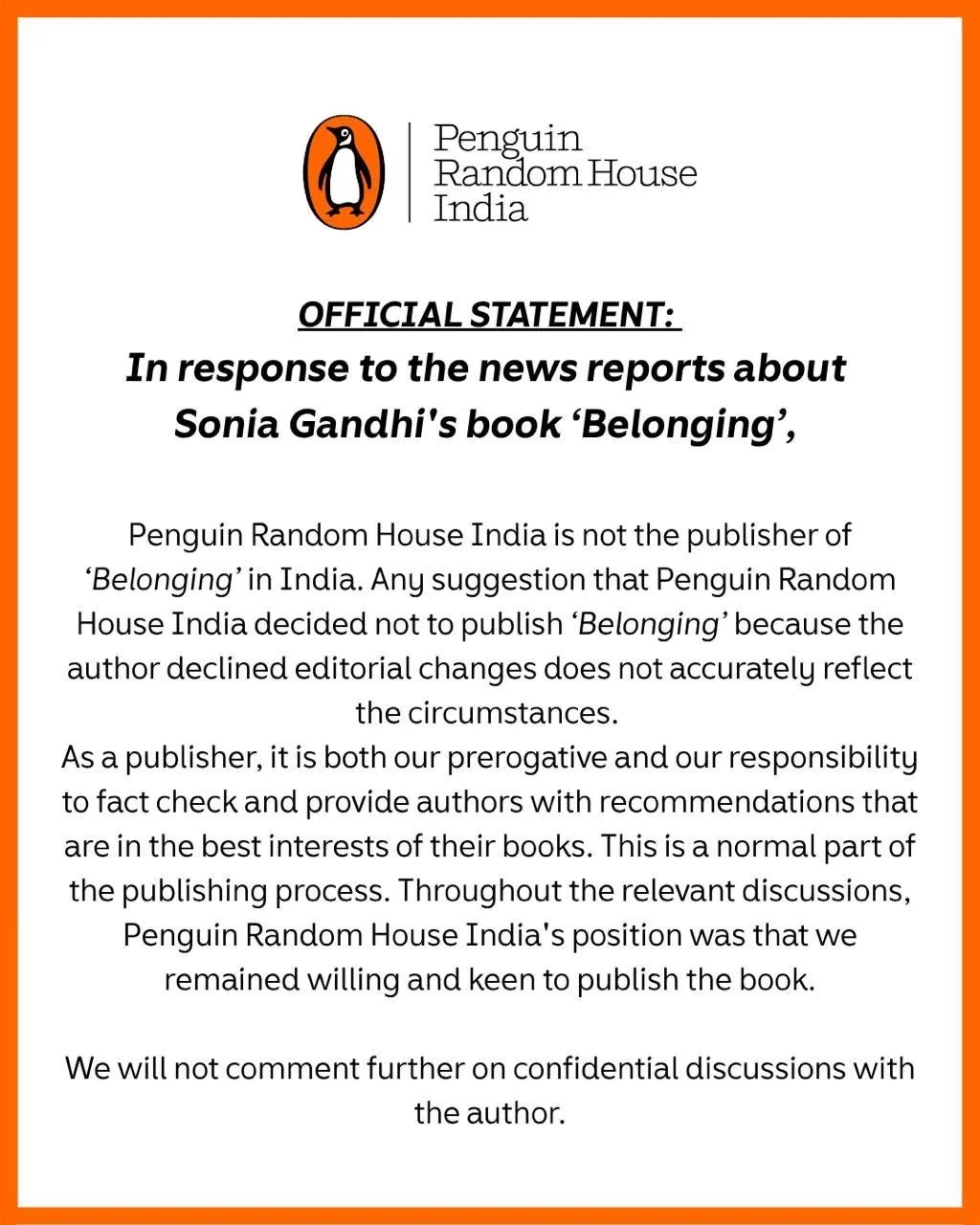
That is, the most important fact in this controversy is that Penguin itself does not accept the claim of ‘government pressure’. The question now is: when the publisher itself is not confirming government intervention, what is the basis for directly linking its decision to the Modi Government?
The Question Is Not Just About Sonia Gandhi’s Book
Does freedom of expression mean that any author has complete freedom to make any claim about any person, institution, government or army, and that the publisher must publish it without fact-checking? If the answer is yes, then what would be the meaning of the editorial process?
Across the world, editorial scrutiny, fact-checking and legal review are a normal part of the process at serious publishing houses. If a book contains allegations against a living person, serious comments on a government decision, references to military action or a claim relating to the borders of a country, it is natural for a publisher to examine the basis on which the statement has been made. An author has the right to write, but a publisher cannot be compelled to publish.
The India-China Border Question Is Not a Political Statement
The most sensitive part of the controversy surrounding Sonia Gandhi’s book is reportedly connected with India-China relations and alleged Chinese incursions. China’s activities along the border, the Line of Actual Control, the status of Indian territory and the actions of the Indian Army are not matters of ordinary political commentary. Claims concerning these subjects have a direct bearing on the country’s sovereignty and security.
In such circumstances, if a memoir states that China entered Indian territory at a particular time, that a government dealt with the situation improperly, or that the Army was prevented from taking a decision in a particular circumstance, the reader has the right to know whether these are the author’s personal memories, political assessments or verified facts.
This is where the publisher’s role begins. Asking for facts is not censorship. In many circumstances, asking for facts is precisely the publisher’s responsibility. If a leader writes that the Prime Minister said something to them at a particular meeting, it may be part of their personal experience. However, if the same book presents a military incident, border dispute or government decision as an established fact, the nature of that claim changes.
Questions will arise there. What is the source? Where is the document? What do other independent sources say? Was the position of the concerned person obtained? Is the claim corroborated by the public record? Asking these questions does not mean silencing an author’s voice. It means protecting the reader’s right.
The Congress Argument and Its Weakest Point
Congress leaders have linked the entire episode to freedom of expression. Ashok Gehlot, Kamal Nath and several other Congress leaders have questioned why, if the book can be published abroad, there is an obstacle to publishing it in India and whether there was any kind of pressure. Certainly, this is a serious allegation, but a serious allegation also demands serious evidence.
If the Central Government instructed Penguin Random House India to remove any part of the book, the document should be produced. If any government official pressured the publisher, evidence of that should be produced. If any ministry ordered the book to be stopped, that order should be made public. No such government instruction has emerged in the Penguin statement currently available. On the contrary, rather than confirming government pressure, the publisher has described editorial processes and fact-checking as normal parts of the publishing process. Therefore, at this stage, saying that ‘the Modi Government stopped the book’ is a political allegation, not an established fact.
The Author’s Freedom Is as Important as the Publisher’s Freedom
There is another serious question here. When speaking of freedom of expression, can we forget the publisher’s freedom? If Sonia Gandhi has the right to present her own side of her political experiences in her book, a publisher must also have the right to question an author when it considers fact-checking necessary in a manuscript. If the author does not wish to accept a change, that is also her right, and if the publisher does not wish to publish the book in that form, that too is its right.
Democracy means the freedom of both sides. The system becomes unhealthy when one side turns its freedom into an obligation upon the other. What do Penguin’s earlier controversies indicate? Penguin Random House India’s name has previously surfaced in controversial publishing cases as well. In June 2026, it decided to withdraw from distributing in India Sacco’s graphic reportage The Once and Future Riot, based on the 2013 Muzaffarnagar riots. Sacco said that Penguin India had demanded changes to some of the quotations he had used in the book.
Therefore, the Sonia Gandhi book case is not a controversy that has emerged in a vacuum. There is a difference between ‘questioning Modi’ and ‘blaming Modi’. In fact, viewed in one way, a major problem of Indian politics emerges here. Questioning the Government is the Opposition’s right. Criticising the Prime Minister is also a democratic right. Seeking answers from the Government on India-China policy is also legitimate, but describing a publisher’s decision as an action of the Government without evidence is a different matter. Asking questions is democracy; delivering a conclusion without evidence weakens the quality of democracy.
If the Congress believes that pressure was exerted over the book, it should present the evidence. But if there is no evidence, describing every editorial disagreement as a conspiracy of the Modi Government makes political discourse superficial. Will the yardstick change when the Government changes tomorrow? This question is particularly important today. The BJP Government is currently in power at the Centre. Before this, there was a Congress-led Government. In the future, another party may come to power. Should publishing freedom change with a change of Government? No.
Today, if a book about a leader associated with the BJP Government contains serious allegations, fact-checking is necessary. Tomorrow, if there is a Congress Government and a book containing serious allegations about a Congress leader is published, fact-checking will still be necessary. That is the democratic principle. Political parties change. Governments change. Prime Ministers change, but the standard of fact-checking should not change.
The Biggest Question: Who Can Write What About the Army, and How?
There is also a need to view this controversy in the context of national security because reports have referred to passages concerning China and Indian territory. The Indian Army is not a political party. Any serious claim relating to its operations, decisions and deployment along the border can have a wide public impact. Therefore, it may not be appropriate to accept a statement concerning the Army without verification merely in the name of a political memoir.
The objective here should not be to defend any Government. If any Government has made a mistake along the border, there should be questions supported by evidence. If there has been any lapse by the Army, there should be evidence of it. If China has taken any action, there should be evidence of it, and if the allegations are wrong, they too should be refuted with evidence. Patriotism does not mean accepting everything said by the Government as correct. But treating an unverified claim as fact in the name of national interest is not patriotism either.
Let the Book Be Published, But With Facts
What is the healthiest solution to this controversy? Let the book be published. Let its political views come before the public. Let Sonia Gandhi’s side reach readers. Let her experiences concerning Prime Minister Modi also be read. Let the Congress perspective also come forward. Let her claims concerning India-China relations become part of the public debate, but wherever a claim has been presented as fact, the evidence should also be brought forward.
If a statement is a personal experience, it should be identified as such. If it is an allegation, it should be presented as an allegation. If it is a historical fact, its sources should be provided. That is responsible publishing.
What is the real ‘test’ in this entire controversy? This is not a test of Sonia Gandhi’s political reputation. It is not a test of the Modi Government either. It is not an electoral battle between the Congress and the BJP. It is a much bigger test. It is a test of how Indian democracy establishes a balance between freedom of expression and responsibility towards facts.
The real question is also this: should the book of any major political figure in India be exempted from fact-checking because of the reputation of its author? If the answer is ‘no’, then Penguin’s right to fact-check must be accepted. And if the answer is ‘yes’, then tomorrow we will no longer have the moral right to question any claim made in the book of another political leader.
The words recorded about India’s history, its borders and its Army will remain as documents before future generations. Therefore, the most important thing is to place the correct facts with evidence. If Sonia Gandhi is unable to do this, questions will inevitably be raised about her. Why, then, should she and other Congress leaders take offence?