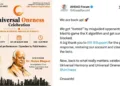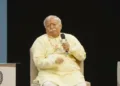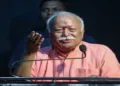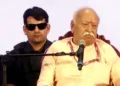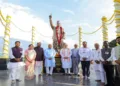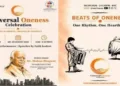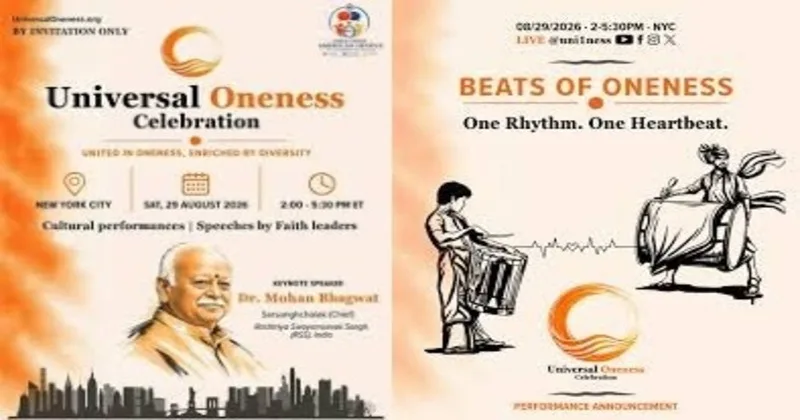
Something larger than a gathering at Madison Square Garden is unfolding in New York this weekend. At one of America’s most recognisable public arenas, Hindu America is preparing not merely to receive RSS Sarsanghchalak Mohan Bhagwat, but to place an ancient civilisational idea—Vasudhaiva Kutumbakam—confidently in the American public square.
Two days before Bhagwat is scheduled to address the Universal Oneness Celebration on August 29, more than 200 Hindu-American organisations are associated with the gathering and thousands are expected to participate. The numbers are impressive, but what they represent is more important. At the centre of the programme is an idea that long predates the political controversies now surrounding it: the understanding that the world is one family.
For decades, Hindu Americans have been among the most accomplished immigrant communities in the United States. They built businesses and institutions, entered medicine, technology, academia and public life, established temples and community organisations, and raised generations of Americans who could be entirely at home in the United States without relinquishing the civilisation from which their families came. What they did less successfully was explain themselves.
Too often, the vocabulary through which Hinduism, Hindutva, the RSS and even contemporary Bharat were introduced to American audiences came from elsewhere—from academics, advocacy organisations, religious-freedom bodies, political activists and diaspora pressure groups. Hindu Americans became extraordinarily successful at being American, but remained comparatively hesitant about entering the American public square explicitly and confidently as Hindus.
New York this weekend suggests that equation is changing. The significant story is not simply that opposition has gathered around Bhagwat. It is the scale and confidence with which Hindu America is gathering around a programme whose stated vocabulary is not grievance or retaliation, but civilisational oneness.
The opposition has been intense. USCIRF has asked the Trump administration to consider revoking Bhagwat’s visa and barring his future entry. New York Mayor Zohran Mamdani has opposed the gathering. Advocacy organisations have mobilised; a billboard campaign has carried provocative accusations through Manhattan; AHEAD Forum’s account on X was suspended days before the programme and has sought reinstatement; and the Hindu American Foundation has issued precautionary security guidance.
Yet the essential facts remain uncomplicated. Mohan Bhagwat is in America. The gathering is proceeding. More than 200 Hindu-American organisations are associated with it. Thousands are expected to gather. And, as of August 27, there has been no publicly announced action by the US executive branch to implement demands that his visa be revoked.
FROM IMMIGRANT SUCCESS TO CIVILISATIONAL CONFIDENCE
The evolution of Hindu America cannot be understood simply through electoral politics or the growing number of Indian-origin faces in American public life. Its deeper story lies in the journey from immigrant survival to civilisational self-confidence.
The early generations came primarily to build lives. They studied, worked, raised families and created extraordinary professional success. Temples followed, then cultural associations, Bal Vihars, service organisations and institutions intended to transmit something of Bharat to children who were American by birth but inheritors of a much older civilisation. For many families, Hindu identity remained largely private: at home, in the temple, on the festival calendar.
But immigrant communities change when their children cease to be immigrants. A second and third generation asks different questions. Why should Deepavali require endless explanation? Why should yoga be celebrated after being separated from the civilisation that produced it? Why should an American Hindu hesitate to speak about dharma, civilisation or Bharat because somebody may immediately impose a political label upon that conversation?
And perhaps the most important question: who gets to define what being Hindu means in America? These questions preceded Mohan Bhagwat’s present visit and will remain long after it is over. What New York has done is bring them into unusually sharp focus.
More than 200 organisations do not constitute a single political ideology. Hindu America is far too diverse for that. What brings such a constituency together is therefore more interesting than attempts to reduce it to one political label. The language chosen for August 29 offers a clue: Vasudhaiva Kutumbakam. Drawn from the Maha Upanishad, it expresses an expansive civilisational consciousness in which the world is regarded as one family. It was not invented for Madison Square Garden; it belongs to an inheritance that has travelled across centuries and oceans.
USCIRF ESCALATES—WASHINGTON DOES NOT
Against this backdrop has come the latest intervention by the U.S. Commission on International Religious Freedom. USCIRF has called upon the US government to consider targeted sanctions against RSS members and Indian officials whom it alleges are responsible for religious-freedom violations. Its chair, Asif Mahmood, has gone further, calling for Bhagwat’s existing visa to be revoked and for him to be made ineligible for future entry.
These are serious recommendations from a congressionally created federal commission. But accuracy requires explaining what USCIRF is—and what it is not. USCIRF is an independent bipartisan advisory commission. It monitors religious freedom abroad and recommends policy to the President, Secretary of State and Congress. It cannot itself revoke Bhagwat’s visa, impose Treasury sanctions or determine whom the United States government may engage.
As of August 27, there has been no publicly announced State Department revocation of Bhagwat’s visa, no Treasury sanction against him and no White House announcement adopting USCIRF’s recommendation. Reuters has also noted that the US government has previously stopped short of implementing sanctions recommended by USCIRF.
For an Indian audience, this distinction is crucial. An advisory commission’s recommendation can easily become, through headlines and social media, “America’s position”. It is not. A federal commission has made a recommendation; the American executive has not publicly adopted it. Bhagwat’s presence on American soil while this argument continues is the clearest demonstration of the difference.
THE RSS RESPONDS WITH CIVILISATIONAL CONFIDENCE
As the political temperature around the New York gathering increased, the RSS response was neither defensive nor confrontational. It chose instead to restate the premise upon which the gathering itself has been built.
RSS Akhil Bharatiya Prachar Pramukh Sunil Ambekar described the Universal Oneness Celebration as an interfaith gathering in which the Sarsanghchalak would communicate with a diverse, multicultural and multi-faith audience. Organised, he said, in a spirit of “open dialogue and mutual respect”, the event reflects a Bharatiya ethos that is “fundamentally inclusive and welcoming to all.”
There is something significant in that response. Faced with demands that Bhagwat’s visa be revoked, calls for cancellation and an organised campaign surrounding his appearance, the RSS has not answered by narrowing the conversation. It has widened it.
The response to those who seek to define the Sangh from outside is, in effect, an open door: come, listen, question and engage. Understand what the RSS says about itself before accepting somebody else’s description of what it represents.
That is a position rooted less in political combat than in civilisational self-assurance. An organisation marking a century of existence does not have to answer every adjective directed at it with another adjective. It can place its ideas, its work and its understanding of Bharat before the world and allow them to be examined. That confidence is important. So is the willingness of Hindu America to create the space in which the conversation can take place.
WHEN ADVOCACY SEEKS TO DEFINE THE NARRATIVE
There is an organised advocacy campaign surrounding Bhagwat’s visit. The Indian American Muslim Council and other organisations have campaigned against it. Savera, a US-based coalition explicitly opposed to what it calls Hindu supremacist politics, has examined organisations and individuals involved in the programme. Other groups have organised protests, sought political intervention and pressed for greater media attention.
They have every democratic right to do so. America’s public square belongs to them as much as it belongs to those gathering to hear Bhagwat. But advocacy and journalism perform different functions.
Words such as “extremist”, “supremacist”, “fascist” and “hate” cannot simply migrate from political campaigning into news coverage stripped of attribution. The journalistic questions are elementary: who is making the allegation, what evidence supports it, what does the accused organisation say, and what interests and institutional relationships shape the advocacy itself?
The same scrutiny should apply to everybody. Organisations associated with the RSS can be examined for their structures, finances and relationships. Those seeking to influence American opinion about the RSS can be examined with equal seriousness. Transparency cannot be an obligation imposed upon only one side.
An American encountering the RSS for the first time should know what its critics allege, but also how the RSS describes itself and why millions encounter the Sangh through shakhas, community service and social initiatives. Then allow the reader to judge. That is the difference between journalism and advocacy.
FOUR WORDS ON A NEW YORK BILLBOARD
Perhaps nothing illustrates the compression of history more vividly than the illuminated billboard truck that circulated around Madison Square Garden carrying the words “RSS KILLED GANDHI.” Four words carrying an enormous accusation.
The judicial record is more precise. Nathuram Godse had earlier been associated with the RSS. During his trial, however, Godse stated that he had left the organisation years before Gandhi’s assassination and subsequently became a member of the Hindu Mahasabha. The case prosecuted named individuals for murder and conspiracy; the RSS as an institution was not an accused.
The court therefore did not deliver a judicial finding that the RSS, as an organisation, murdered Mahatma Gandhi. Nor, strictly speaking, did it give the RSS a formal “clean chit”, because an organisation not before the court as an accused was not there to be acquitted. Godse’s earlier relationship with the RSS remains a subject of historical and political debate, but “RSS KILLED GANDHI” is an activist assertion, not the judgment delivered by the court that tried Gandhi’s assassins.
A billboard has only seconds to capture attention. History has no obligation to fit on its side.
WHO GETS TO DEFINE A HINDU IN AMERICA?
Beneath the immediate controversy lies a deeper question. American academic and activist work increasingly uses expressions such as “transnational Hindutva”, “Hindu nationalism” and “Hindu supremacy” while examining organisations connecting Hindu communities in America with Bharat. Research deserves to be examined on its evidence. But vocabulary matters because vocabulary eventually becomes perception.
Criticism of the Modi government is not automatically hostility towards Hindus. Criticism of Hindutva is not necessarily anti-Hindu, and the RSS should not be beyond legitimate scrutiny. But the reverse proposition deserves equal clarity: a Hindu temple does not become a political organisation because some members admire Narendra Modi; a cultural organisation does not become extremist because it celebrates Bharat; an American Hindu does not surrender the right to speak about civilisation because somebody else regards civilisational consciousness as political.
Hindu identity cannot permanently be interpreted to America primarily through the vocabulary of those ideologically opposed to it. This is where the confidence visible around August 29 becomes important. The answer is not censorship. It is self-definition.
MAMDANI CAN OPPOSE. HINDU AMERICA CAN ANSWER.
New York Mayor Zohran Mamdani has publicly opposed Bhagwat’s gathering and expressed his disagreement with what he understands the RSS vision of India to represent. He is entitled to that view.
But Mamdani has also acknowledged an important institutional reality: the city may not possess jurisdiction to stop a private gathering simply because its mayor disagrees with the politics of a speaker. That distinction is not a weakness of American democracy. It is one of its strengths.
The mayor can disagree. Protesters can gather outside. Hindu Americans can gather inside. Journalists can question everybody. There is no democratic contradiction in all those things happening simultaneously.
American singer Mary Millben has publicly challenged Mamdani’s position, demonstrating once again that there is no single “American” view of Bhagwat or the RSS. America is arguing. And Hindu Americans are part of America.
THE ANSWER TO SCRUTINY IS GREATER PARTICIPATION
The Hindu American Foundation has issued precautionary security guidance ahead of the gathering, asking attendees to remain vigilant and civil. No specific publicly established threat has been cited, so the advisory should be understood as precautionary rather than evidence of imminent danger.
AHEAD Forum’s account on X was suspended just days before the programme. The organisation has sought reinstatement. X has not publicly disclosed the reason, and no responsible conclusion can therefore be drawn about the motivation behind the suspension.
These developments may reinforce a feeling among some Hindu Americans that public expressions of their identity face a degree of scrutiny they did not encounter when Hindu identity remained largely private. But withdrawal would be the wrong response. For a community carrying an ancient civilisation into a modern immigrant society, confidence means possessing the institutions, scholarship and public voice to answer criticism without surrendering either dignity or identity.
FROM SUCCESS TO SELF-DEFINITION
For years, Indian success in America was measured through educational attainment, physicians, entrepreneurs, technologists, CEOs and the rise of Indian-origin Americans through corporate and professional life. Those achievements remain extraordinary. But mature communities eventually seek something beyond success. They seek the right to be understood.
Hindu Americans are increasingly discovering that representation does not merely mean another Indian-origin CEO or elected official. It also means possessing the confidence to explain one’s civilisation without allowing others to establish the terms upon which it may be discussed.
This does not require every Hindu American to support the RSS, nor does it require treating every criticism of the RSS as hostility towards Hinduism. It requires something more fundamental: Hindu civilisation cannot permanently be explained to America principally through the vocabulary of those who approach it from ideological opposition.
Hindus themselves must enter that conversation, bringing not counter-slogans but texts, history, scholarship, institutions, seva and lived experience. Dharma is not simply religion. Rashtra is not merely the nation-state. Seva is more than charity. Civilisation is larger than electoral politics.
A civilisation does not become confident by shouting more loudly. It becomes confident when it no longer requires somebody else’s vocabulary to explain itself.
VASUDHAIVA KUTUMBAKAM IN MANHATTAN
There is symbolism in the location itself. Madison Square Garden is neither a Hindu nor an Indian space. It is one of America’s most recognisable arenas. Into that quintessentially American setting comes an idea from the Upanishadic civilisational inheritance: Vasudhaiva Kutumbakam.
A civilisation confident of itself does not arrive in America asking merely to be tolerated, nor does it need to imitate the vocabulary of every American ideological contest. It can bring its own vocabulary: dharma, seva, kutumb, samvad, Vasudhaiva Kutumbakam. Service. Family. Dialogue. The world as one family.
There will be protesters and critical journalists. USCIRF has made its recommendations. Advocacy organisations will continue their campaigns. That is their right in an open society. None of it diminishes what is taking place inside. The ability of these voices to coexist may itself provide the most compelling answer to the controversy.
Mohan Bhagwat will speak. His opponents will speak. America will hear both.
When the lights at Madison Square Garden eventually go out, the more enduring significance of August 29 may lie elsewhere. More than 200 Hindu-American organisations will have gathered publicly around a civilisational idea. Thousands of Hindu Americans will have occupied not merely seats in an American arena but a place in an American conversation. A community that spent decades succeeding quietly in America will have demonstrated that it is increasingly prepared to speak confidently as Hindu America.
Not against America. Not apart from America. But as part of America.
That is why the real story in New York this weekend is larger than the controversy surrounding Mohan Bhagwat. It is the rise of a Hindu America confident enough to be American without becoming less Hindu—and Hindu without feeling any less American.