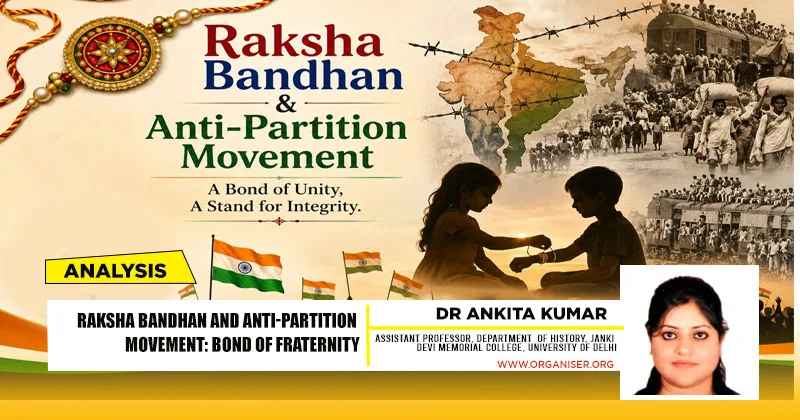
In 1905, Lord Curzon’s administration set out to accomplish through the stroke of a pen what centuries of invasion and colonisation had never quite managed — the vivisection of Bengal along religious lines. What followed was not simply a political agitation. It was something closer to a civilisational reflex, in which the Hindu ritual of tying the rakhi was reshaped by Rabindranath Tagore into a public act of national solidarity between Hindus and Muslims. The story of the 1905 Raksha Bandhan movement deserves better than the status of a nostalgic footnote to the Swadeshi movement. It was an early and remarkably clear demonstration of something that runs through Bharatiya civilisational thought: when confronted with an external, divisive design, Bharat’s communities have a habit of reaching for shared cultural symbols to reassert a unity that colonial categories were never quite able to erase.
By the turn of the twentieth century, Bengal Presidency, which then covered present-day West Bengal, Bihar, Jharkhand, Odisha and Assam, along with what is now Bangladesh, had become the intellectual and political nerve-centre of Bharatiya patriotism. Calcutta was the capital of British India, and the Bengali intelligentsia, through its press, literature, and associations, had begun to articulate a coherent national consciousness that unsettled the colonial establishment considerably.
Curzon’s Divide
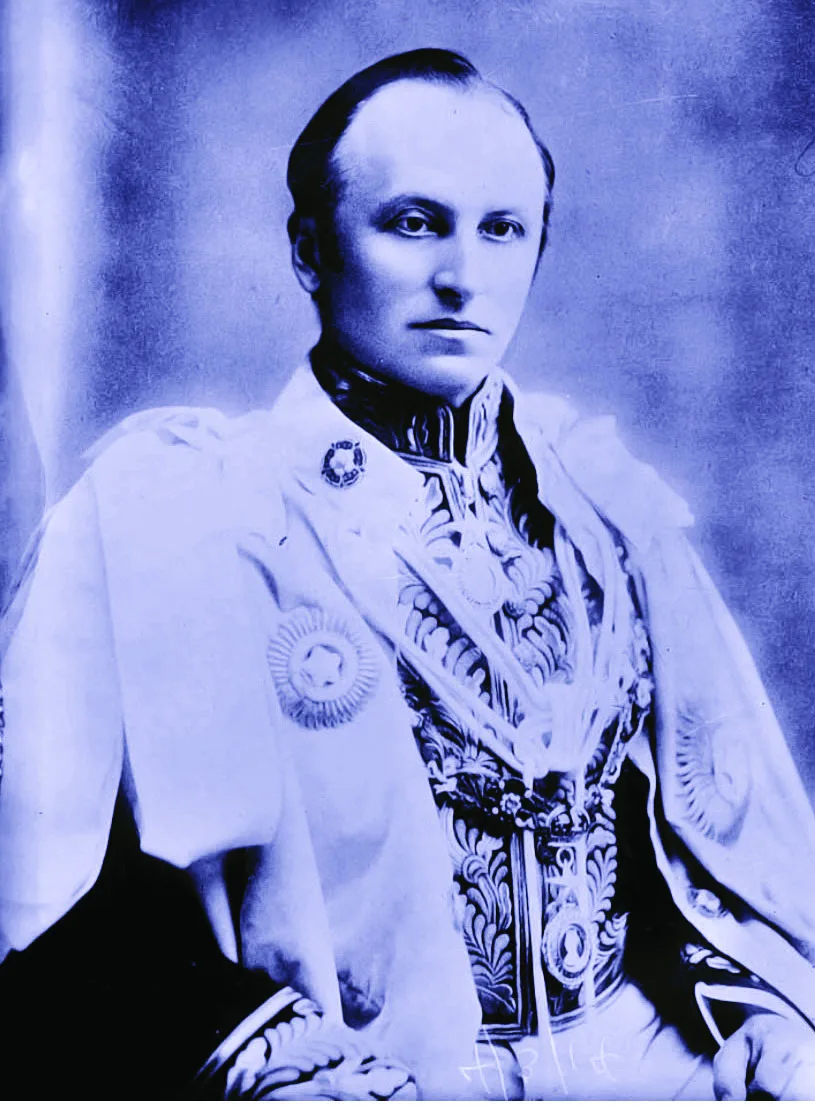
Official correspondence and later scholarship make clear that Curzon’s stated justification — that Bengal was administratively too unwieldy to govern as one unit, was a convenient cover for something more calculated. The partition split the largely Muslim eastern districts from the largely Hindu west, handing West Bengal to Hindus and East Bengal to Muslims. Contemporaries read this at the time, and historians have continued to read it since, not as an administrative tidying-up but as an application of “divide and rule”: a deliberate effort to cut the Bengal Presidency along religious lines and blunt the patriotic movement growing within it. The historian Sumit Sarkar, whose 1973 study The Swadeshi Movement in Bengal, 1903–1908, remains the standard scholarly account of the period, laid this out in detail from the colonial administrative record itself: the census logic Curzon cited was thin cover for a Partition designed, in practice, along communal lines to weaken a Bengali nationalist movement the Government had come to see as a threat. Not every historian frames the underlying fault line itself as a colonial invention, however. RC Majumdar argued in that same work, controversially, against the view that Hindu-Muslim tension was purely a British-manufactured artefact, holding instead that the two communities had long functioned with distinct customs, outlooks and institutional lives even before colonial rule. On this reading, what Curzon did in 1905 was not invent a division out of nothing but exploit and sharpen one that already existed, a distinction that does not excuse the partition’s design so much as it complicates any account, including this one, that treats communal identity in Bengal as simply a colonial imposition to be dissolved by a strong enough gesture of unity.
Curzon’s own conduct bears this out. In June 1905, he met a delegation of Muslim leaders in Assam and worked to persuade them that a separate administrative unit was needed to protect their distinct religious and political identity, an early instance of the colonial state actively cultivating separatist sentiment, one that would, decades later, harden into the demand for Pakistan. The Partition was announced in July 1905 and came into effect on October 16, 1905. That date, chosen by the colonial bureaucracy with no apparent thought beyond administrative convenience, would go on to acquire an entirely different meaning in Bengal’s memory: October 16, 1905 fell in the sacred month of Shravan, on the day of Raksha Bandhan.
A Thread Against Partition
Rabindranath Tagore, by then already the foremost literary voice of Bengal, saw in this coincidence an opening of real significance. Raksha Bandhan, in its familiar form, was a domestic and devotional observance, a sister tying a thread of protection around her brother’s wrist, invoking a long life for him and reaffirming a bond of mutual care. Tagore did not set this inherited meaning aside. In keeping with a long Indic habit of adapting ritual to the needs of the moment, he simply extended it outward, from the family to the nation. His biographer A Majumdar records, in Tagore by Fireside, that Tagore turned Raksha Bandhan from a religious tradition into what he called a secular motif of unity amidst diversity, a deliberate tool against the Banga Bhanga, the vivisection of Bengal.
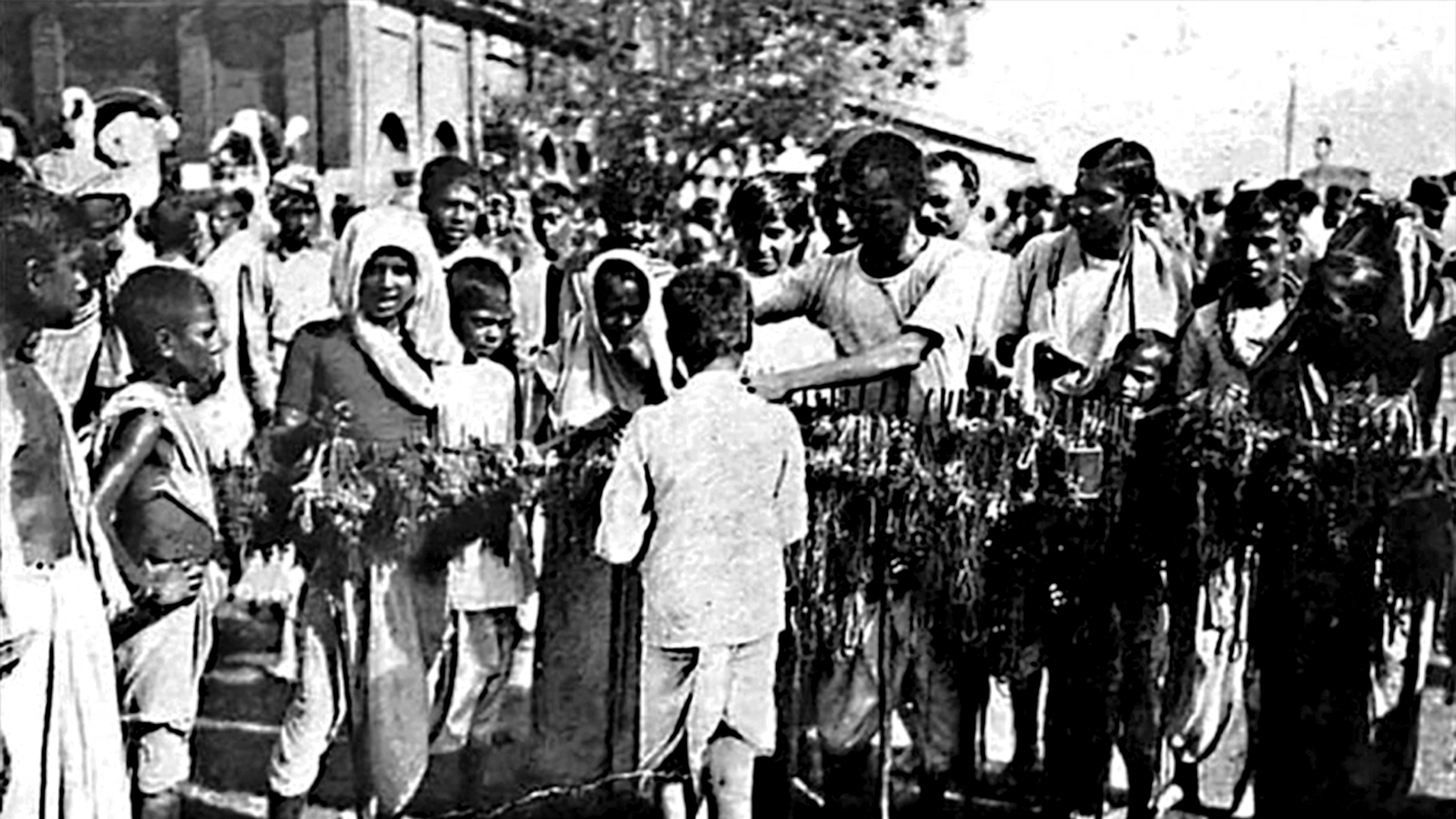
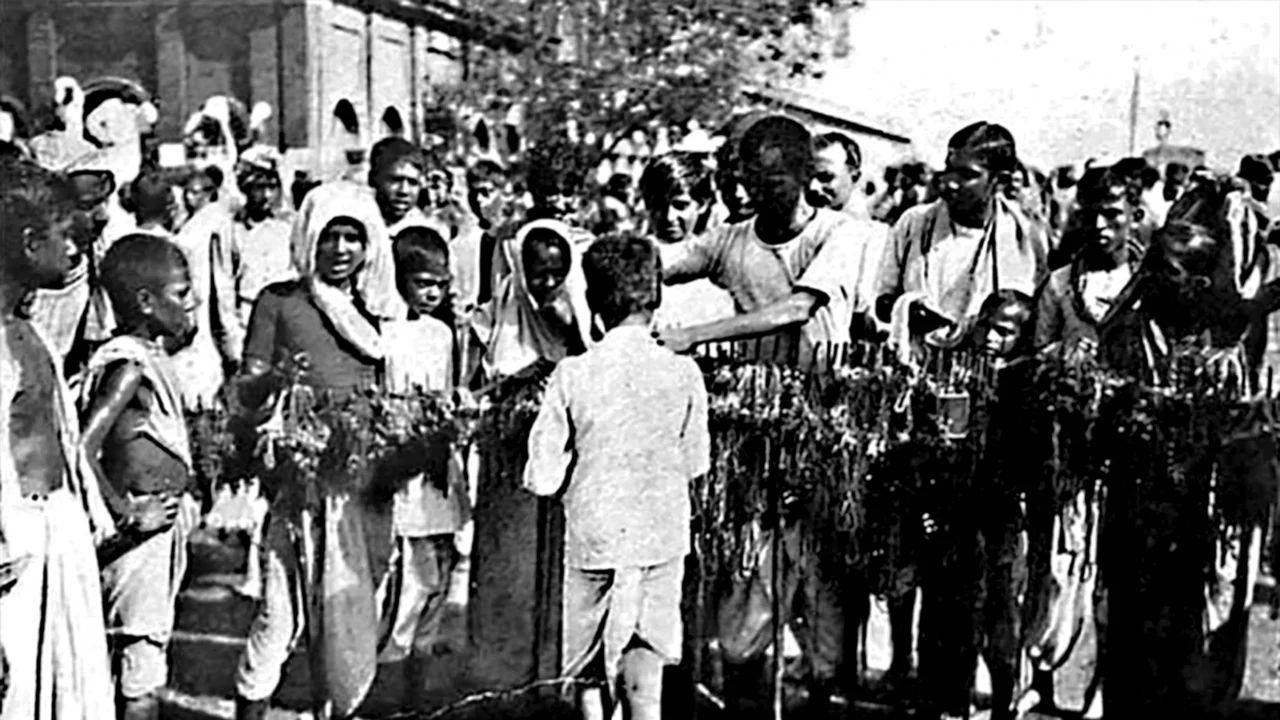
Tagore declared the day the partition took effect a day of mourning across Bengal, asking that no fires be lit in Bengali kitchens as a mark of collective grief. But mourning was never going to be his real weapon. He called on Hindus and Muslims across the province to step outside their homes and tie rakhis on one another’s wrists in public, turning a private, familial ritual into a civic statement that the two communities considered themselves bound by a single thread that no administrative boundary could cut. Hindus and Muslims were urged to tie the thread on each other, so that it stood not for a family bond alone but for mutual protection and trust between communities, a visible rejection of the very divisions the British were trying to draw.
Unity In The Streets
People responded in numbers. In Calcutta, Dhaka and Sylhet, men and women from different communities gathered publicly to tie rakhis on each other, in scenes that were as emotionally charged as they were politically pointed. Tagore himself is said to have led a procession that began with a ceremonial dip in the Ganga, moved through the streets tying rakhis to whoever came forward, and ended, tellingly, at a mosque, where he tied the sacred thread on the wrists of Muslim clerics. It was a small act with a large implication: the guardianship of national unity belonged to both communities together, not to one alone.
It was in this same moment of resistance that Tagore wrote some of his most enduring patriotic songs, compositions that would go on to shape the political imagination of the subcontinent for generations after him. Banglar Mati Banglar Jol was composed in 1905 in support of the movement against the partition, and Tagore inaugurated the “Raksha Bandhan Utsav” on October 16 of that year specifically to bring Hindu and Muslim Bengalis together in protest. The song became one of the most prominent musical expressions of the anti-partition movement. The institutional memory of that day survives in Calcutta’s civic history too: the foundation stone of the Federation Hall society, bringing together national figures such as Surendranath Banerjee, Tagore himself, Jagadish Chandra Bose, Taraknath Palit and Anandamohan Bose, was laid in Calcutta on October 16, 1905, on the occasion of the Raksha Bandhan ceremony, and went on to organise the anti-partition movement across the province.
It is worth situating what Tagore did within a longer memory. The rakhi already carried associations that ran beyond sectarian lines in Bharatiya historical memory. Tagore’s real insight was recognising that this inherited symbolic language, rooted in Hindu ritual but never confined to it, could be pressed into service again as something legible to both communities. It was a demonstration that Bharat’s indigenous cultural forms had a natural capacity to bring people together that colonial administrative categories, built as they were on counting and separating, could never fully replicate.
Unity And Its Limits
It would not be honest to claim that the Raksha Bandhan movement, on its own, reversed the Partition. Undoing Curzon’s design took six years of sustained agitation, the Swadeshi boycott of foreign goods, the growth of national education, revolutionary activity, and mounting political pressure that finally led to the annulment of the partition in 1911, announced at the Delhi Durbar. Raksha Bandhan’s contribution was not administrative. It was civilisational. It showed, right at the start of the agitation, that the partition’s underlying premise, that Bengal’s Hindus and Muslims were separable peoples with irreconcilable interests, did not match the lived reality of the province. It offered, through ritual rather than through petition or legislation, a living answer to the colonial argument that the two communities were fundamentally incompatible.
That this unity ultimately proved fragile, and that the very communal categories Curzon tried to entrench in 1905 would return with tragic consequences at the actual Partition of Bharat and Bengal in 1947, is a sobering fact rather than a mark against Tagore’s effort. If anything, it says something about how effective and durable the colonial strategy of manufacturing religious division turned out to be, and how much sustained cultural, social and political work genuine unity requires if it is to survive engineered fractures of this kind. Sarkar’s own research is a useful corrective here against reading 1905 as simple triumph: he found that the wider Swadeshi campaign, for all the power of gestures like the rakhi-tying, closed with Bengal’s two communities more conscious of the antagonisms between them than before it began, not less. Part of the reason, as the historian Sekhar Bandyopadhyay has also traced, was that much of the movement’s mobilising imagery beyond Tagore’s own contribution, invocations of Kali and Shakti, appeals to the Gita, was distinctly and unmistakably Hindu, which could read to Muslim Bengalis as exclusion dressed as unity even where individual gestures such as the rakhi were consciously interfaith. The 1905 Raksha Bandhan movement is, in that sense, evidence of two things at once: the real strength of Bharat’s syncretic instincts, and how vulnerable those instincts remain when they meet sustained, deliberate efforts at division.
A Thread No Map Can Cut
The events of 1905 are worth returning to today. They are a reminder that Bharat’s unity has historically been asserted not by suppressing religious or cultural identities but by extending indigenous symbols, festivals, rituals, and songs into a shared idiom capable of holding diversity together. Tagore did not ask Bengal’s Muslims to become Hindus, nor its Hindus to set aside their traditions. He asked both communities to see, in an old thread of protection, a metaphor for something deeper: shared soil, shared history, a shared future that no colonial map could dissolve. At a time when both external and internal forces still seek to exploit Bharat’s fault lines, the memory of that Shravan morning in 1905, when thousands walked the streets of Calcutta and Dhaka, tying rakhis on strangers of another faith, is worth holding on to. Not as nostalgia, but as a working example of how civilisational resilience actually looks in practice.