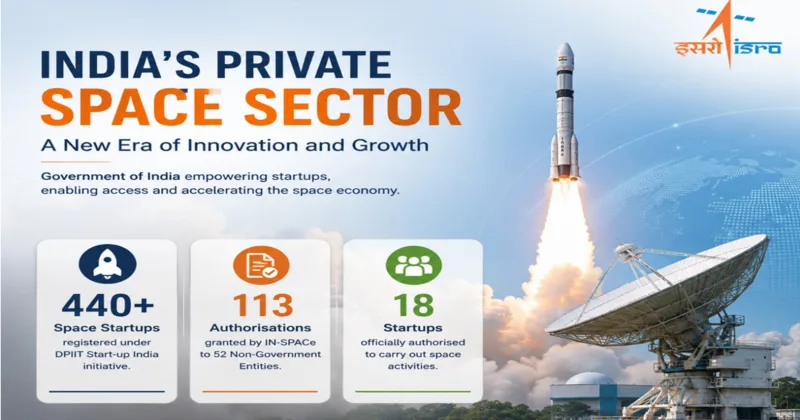
Indian private space sector is no longer a fledgling experiment, it is a rapidly expanding ecosystem backed by structured government facilitation, according to fresh data placed before Parliament. As per figures from the Department for Promotion of Industry and Internal Trade (DPIIT) Start-up India Portal, around 440 space technology startups are currently registered in the country. The scale of this growth and the mechanisms enabling it, were detailed in a written reply in the Rajya Sabha by Dr. Jitendra Singh, Union Minister of State for the Prime Minister Office and Personnel, Public Grievances and Pensions, Atomic Energy and Space.
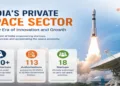
At the centre of this ecosystem is the Indian National Space Promotion and Authorisation Centre (IN-SPACe), the nodal agency created to regulate and promote private participation in India’s space activities. According to the data, IN-SPACe has granted a total of 113 authorisations to 52 Non-Government Entities (NGEs) to carry out various space-related activities. Of these 52 entities, 18 are officially recognised start-ups underscoring that while the broader startup count runs into the hundreds, only a select group has so far secured formal authorisation to conduct space activities under India’s evolving regulatory framework.
The 18 Authorised Space Start-ups
The government’s reply names all 18 start-ups that have received authorisation from IN-SPACe. The list reflects a diverse cross-section of India’s private space industry, spanning launch vehicle manufacturers, satellite developers, and space-technology solution providers:
- Agnikul Cosmos Pvt Ltd
- Akshath Aerospace Private Limited
- Azista BST
- Bellatrix Aerospace Pvt Ltd
- Cosmoserv Space India Private Limited
- Dhruva Space Private Limited
- Digantara Research and Technologies Pvt. Ltd
- GalaxEye Space Solutions Private Limited
- HEX20Labs India Pvt Ltd
- Inorbit Space Telecommunications Private Limited
- Manastu Space Technologies Private Limited
- NSpace Tech India Private Limited
- OrbitAID Aerospace Private Limited
- PierSight Space Private Limited
- PixxelSpace India Private Limited
- Skyroot Aerospace Private Limited
- Space Kidz India
- TakeMe2Space Technologies Pvt. Ltd
Names such as Agnikul Cosmos, Skyroot Aerospace, Dhruva Space and PixxelSpace have featured prominently in Indian private space narrative in recent years, having conducted high-profile tests and launches. The presence of newer entrants like OrbitAID Aerospace, GalaxEye and TakeMe2Space in the list signals that authorisation is steadily broadening beyond the sector’s earliest pioneers.
The governments response also clarifies a data gap, state-wise details of the number of recognised space start-ups are not available with IN-SPACe, meaning there is currently no official breakdown of which Indian states are producing or hosting the highest concentration of space-tech ventures.
Five Years of Escalating Facilitation
Perhaps the most revealing part of the disclosure is the year-wise breakdown of facilitation extended by IN-SPACe to start-ups with a timeline that traces the sector’s technical maturation from 2022 to 2026.
2022: Agnikul Cosmos, Skyroot Aerospace and Pixxel received early-stage support including flex seal and acoustic testing, S/X-band antenna RF testing, sub-orbital launch access (for Skyroot Vikram-S mission) and launch vehicle telemetry (TM) reception support.
2023: The circle widened to include Dhruva Space, Pixxel Space, Skyroot Aerospace, Agnikul Cosmos, Space Kidz and Azista BST. Facilitation that year covered access for Agnikul Agnibaan SoRTeD launch, RAMAN-I and RAMAN-II engine testing, environmental testing for Azaadisat-2, static stage testing and ground station support.
2024: Skyroot Aerospace, Pixxel Space, Manastu Space, PierSight Space and NSpace Tech India were facilitated with stage-1 casting and propellant supply, hardware-in-loop simulations, and POEM (PSLV Orbital Experimental Module) payload EMI/EMC and shock testing, reflecting a shift toward more complex integration and payload-testing support.
2025: Agnikul Cosmos, Dhruva Space, PierSight, GalaxEye and Skyroot Aerospace accessed cryogenic pump preliminary design review (PDR) support, X/UHF-band downlink assistance, thermal vacuum and outgassing (TVAC) tests, trajectory validation and cooling umbilical supply facilitation aimed squarely at propulsion and satellite-readiness milestones.
2026: The latest year on record shows TakeMe2Space, Bellatrix Aerospace, Skyroot Aerospace, OrbitAID Aerospace and Dhruva Space being granted access to the First Launch Pad (FLP) for Skyroot’s Vikram-1 vehicle, docking mechanism lab testing, SRS shock testing and silicide coating support for micro-thrusters.
The progression across these five years from acoustic and RF testing in 2022 to actual launch-pad utilisation for an orbital vehicle in 2026 illustrates a start-up ecosystem moving up the technology-readiness ladder, supported at each stage by IN-SPACe-facilitated access to ISRO infrastructure and expertise.
Where the Money Is Going
The government disclosure also lays out, in rupee terms, how much funding IN-SPACe has sanctioned and disbursed across its various schemes as of 31 July 2026, over the preceding five financial years.
The IN-SPACe Seed Fund Scheme/PIE, with a project envelope of Rs 6,500 lakh, has seen a cumulative disbursement of Rs 389.30 lakh starting from nil in FY 2022-23 and rising through Rs 56 lakh, Rs 88.3 lakh, Rs 225 lakh and Rs 20 lakh in the years that followed.
By far the largest allocation is the Venture Capital Funds scheme, carrying a massive Rs 1,00,000 lakh (Rs 1,000 crore) envelope. SEBI approval for this scheme was granted on 31 October 2025, after which disbursement accelerated sharply reaching a cumulative Rs 18,893.04 lakh, the dominant share of all IN-SPACe funding disbursed so far.
Three other schemes remain in earlier stages of rollout:
The Technology Adoption Fund (Rs 50,000 lakh envelope) has selected three NGEs for technology development, but disbursement so far stands at nil.
The Satellite Bus as a Service (SBaaS) scheme (Rs 7,500 lakh envelope) has also selected three NGEs for development, with a cumulative disbursement of Rs 750 lakh.
The Common Technical Facilities scheme (Rs 50,000 lakh envelope) has seen agreements signed with the governments of Gujarat and Tamil Nadu, but no disbursement has yet been recorded.
Taken together, against a combined project envelope of Rs 2,14,000 lakh across all five schemes, the cumulative amount sanctioned and disbursed stands at Rs 20,032.34 lakh. The figures indicate that while the Venture Capital Funds scheme has moved from approval to disbursement at pace, several other funding instruments particularly the Technology Adoption Fund and Common Technical Facilities scheme remains largely at the selection or agreement stage, with actual money yet to flow.
A Single-Window Digital Gateway
Beyond funding and testing access, IN-SPACe has also built a digital platform intended to serve as a single-window interface for India’s space start-ups. Through this platform, according to the government reply, start-ups can apply for authorisation, seek funding opportunities, access mentorship, use ISRO and IN-SPACe facilities, avail technology transfer, receive launch, mission support and participate in skill-development and capacity-building programmes.
This digital consolidation is significant for a sector where earlier private players often had to navigate multiple government departments and informal channels to access ISRO expertise or facilities. The platform effectively centralises what was previously a fragmented process.
Access to ISRO most critical infrastructure including the launch pads at the Satish Dhawan Space Centre in Sriharikota is also formally routed through this platform. Applications for usage are processed according to a standard operating procedure (SOP) based on submissions received via IN-SPACe Digital Platform, with the readiness of each applicant reviewed by an Expert Committee constituted by IN-SPACe. This structured review process is designed to ensure that only technically ready missions gain access to India limited and high-value launch infrastructure.
The Road Ahead: Commercial Launches
Looking forward, the government’s reply also offers a glimpse into the near-term commercial launch pipeline for Indian private companies. For FY 2026-27, two commercial rocket launches by Indian private companies are planned. For FY 2027-28, the picture is less firm: the launch manifest for that year is yet to be approved by IN-SPACe, though the government indicates that more than six launches may potentially be undertaken by Indian private companies during that period, pending finalisation.
This cautious but upward-trending projection from two confirmed launches to a potential six-plus in the following year suggests that India’s commercial launch cadence, while still nascent compared to global players, is expected to more than triple within two years if the pending manifest materialises as anticipated.
The data paints a picture of an Indian private space sector that is expanding on multiple fronts simultaneously, a broadening base of registered start-ups (440), a smaller but growing pool of formally authorised entities (18 out of 52 NGEs), escalating technical facilitation from basic component testing to full launch-pad access, a funding pipeline increasingly anchored by the large Venture Capital Funds scheme and a maturing institutional framework built around IN-SPACe digital platform and Expert Committee review process.
At the same time, the figures also reveal where gaps remain most notably the absence of state-wise start-up data, and the slow pace of disbursement under schemes such as the Technology Adoption Fund and Common Technical Facilities, both of which carry substantial Rs 50,000 lakh envelopes but have yet to record any actual disbursement. As Indian space sector continues its journey from a government-monopolised domain to one with active private participation, this Parliamentary disclosure offers one of the clearest official snapshots yet of how far that transition has progressed and how much runway remains.