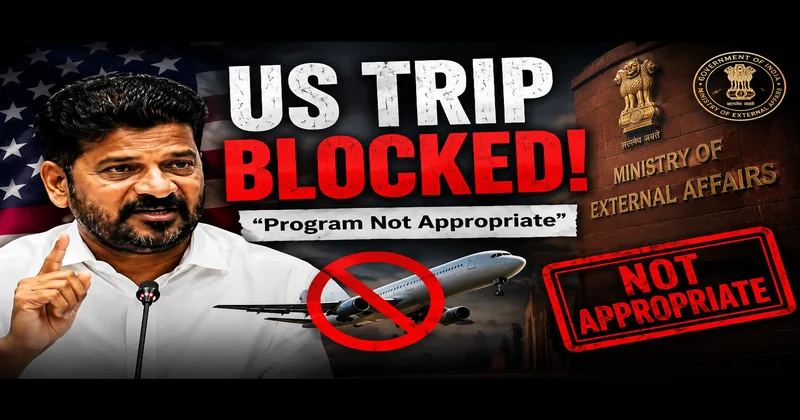
HYDERABD: Telangana Chief Minister A Revanth Reddy’s recent attempt to frame his diplomatic itinerary as a crusade for state development was unmasked by the Ministry of External Affairs (MEA). New Delhi’s firm denial of political clearance for Revanth Reddy’s US tour exposed how state-funded foreign travel was being leveraged to platform anti-Bharat elements. While Reddy attempted to mask his diplomatic itinerary under the guise of state development, his UK engagements-highlighted by meetings with controversial figures like Oxford Professor Maya Tudor, known for writing hostile commentary against Indian democracy-revealed a concerning disregard for national dignity.
While the Ministry of External Affairs (MEA) cleared the UK leg of his overseas tour-allowing him to engage with institutions in London and Oxford-it firmly denied political clearance for his proposed multi-city trip to the United States. Reddy was supposed to travel abroad from August 21 to August 29.
The institutional clarity provided by MEA Official Spokesperson Randhir Jaiswal exposes the flaws in the chief minister’s grandstanding.
“The visit of Chief Minsters, as indeed, other dignitaries is assessed by the ministry to accord political clearance. The program proposed in such cases should be appropriate to the office held and the purpose of the visit. In this case, that was not so in respect of the US. Therefore, clearance has not been given. Incidentally his visit to the UK has been cleared,” the MEA said in a statement.
#WATCH | Delhi: On Telangana CM Revanth Reddy's foreign visit, MEA Spokesperson Randhir Jaiswal says, "… Let me also tell you that clearance was given for his visit to the United Kingdom."
On permission denied for Telangana CM Revanth Reddy's visit to the United States, MEA… pic.twitter.com/ulC71RmGbF
— ANI (@ANI) August 21, 2026
Understanding the MEA’s Protocol Standard
The Ministry of External Affairs made it clear that diplomatic protocol and national institutional decorum take precedence over state-level PR campaigns.
Institutional Propriety: Official foreign visits by state heads must adhere to strict guidelines regarding the dignity of the office held and the scope of international engagements.
Procedural Flaws: The proposed US schedule lacked the substantive official backing and diplomatic weight required for an incumbent Chief Minister’s visit, failing to align with established norms.
Selective Approval: The fact that the MEA approved the UK segment demonstrates that the Centre acts objectively on merit, not partisan prejudice.
Exposed at Oxford: Revanth Reddy’s Links to Anti-Bharat Academic Maya Tudor
The Congress camp in Hyderabad immediately attempted to spin the denial as a central political conspiracy, claiming the decision was driven purely by partisan motives. However, the decision reflects standard institutional protocol to prevent unvetted, high-level political posturing abroad. The central government’s objective screening is clearly evidenced by its approval of Reddy’s UK tour; however, rather than using that privilege responsibly, the Chief Minister chose to meet with anti-Bharat academic figures.
Reddy’s UK tour has laid bare the Congress party’s willingness to align with western academic circles known for pushing anti-India narratives. By seeking partnerships under his “Telangana Rising” banner with Oxford University academics like Professor Maya Tudor-who has penned overtly hostile pieces like “Why India’s Democracy Is Dying”-Reddy has prioritised political grandstanding alongside vocal critics of Bharat’s sovereignty over national integrity.
Courting figures who actively undermine the nation’s democratic credentials on global platforms shows a concerning disregard for national dignity, revealing how the Congress leadership willingly collaborates with foreign detractors under the guise of state development.
According to reports, Reddy was also supposed to meet New York City Mayor Zohran Mamdani-a vocal critic of the Indian government. Reddy’s itinerary proposed unauthorised interactions Mamdani, who has previously interfered in Bharat’s judicial matters by meddling in cases involving anti-Bharat activists. By seeking political engagements with entities known for attacking Bharat’s sovereignty and judicial independence, the Telangana Chief Minister attempted to use state-funded travel for partisan posturing alongside anti-national forces. The MEA’s firm refusal rightly draws a line against state leaders circumventing constitutional norms to engage with foreign figures actively targeting the Modi government and national stability.
Taken together, these developments highlight a clear pattern: while the Congress leadership attempts to frame the MEA’s decision as a politically motivated obstruction, the Centre’s refusal to clear Chief Minister Revanth Reddy’s US tour served as a necessary institutional check to safeguard diplomatic decorum. The contrast between Reddy’s official rhetoric of seeking investments under “Telangana Rising” and his actual engagements-whether courting controversial Oxford academics who attack Indian democracy or planning unauthorised meetings with anti-Bharat political figures like Zohran Mamdani-proves that the foreign itinerary was being weaponised for partisan posturing.