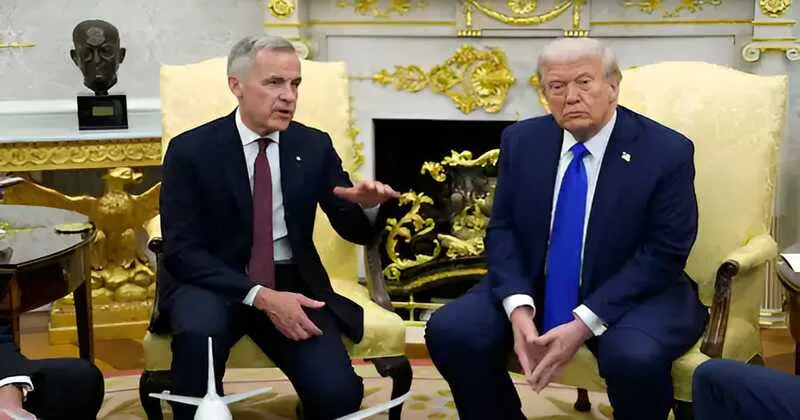
Washington DC/Ottawa: Trade negotiations between the United States and Canada have collapsed, setting the stage for a fresh escalation between the two historic allies as President Donald Trump prepares to impose 50 per cent tariffs on about USD 20 billion worth of Canadian products. Canadian Prime Minister Mark Carney has suspended the talks and ordered Ottawa’s negotiators to return home, while warning that Canada will respond with reciprocal measures to protect its workers and businesses.
The breakdown followed an intense three-day negotiating effort in Washington that failed to produce an agreement before the extended deadline. The new US tariffs are scheduled to take effect on August 22. They will cover roughly 5 per cent of Canada’s annual exports to the United States, with affected products ranging from hockey sticks to tongue depressors.
Last-minute talks fail to produce a deal
The negotiations had been extended after Trump postponed the original tariff deadline, giving both sides additional time to bridge differences. Despite the extension, the two governments failed to settle their remaining disagreements.
Shortly before midnight on 21 August 2026, US Trade Representative Jamieson Greer said Canada had refused to finalise a deal on terms that Washington believed had been agreed upon earlier in the negotiations.
“Tonight, Canada declined to finalise the trade deal under the terms agreed earlier this week,” Greer said on a press call. He argued that the US had offered Canada “the best treatment of any major exporter to our market”, but claimed that new Canadian demands and reversals of earlier commitments had disrupted the balance reached during negotiations.
Carney gave a sharply different account. He said changes introduced by Washington at the last stage of the negotiations were “unfair, uneconomic” and raised questions about whether any agreement reached with the US could be relied upon. “As a result, this evening, I have decided to suspend trade negotiations with the US and have directed Canada’s negotiators to return to Ottawa,” Carney said.
He added that his government would announce additional measures to support Canadian workers and businesses.
Tariffs threaten a deeply integrated trade relationship
The immediate economic impact of the new tariffs could be significant, although the affected products represent a relatively small portion of Canada’s overall exports. The measures will apply to specified Canadian goods even when those products qualify for preferential treatment under the US-Mexico-Canada Agreement.
The new duties also come on top of existing American tariffs affecting Canadian steel, lumber and automobiles, increasing pressure on industries already facing uncertainty. A senior US official said Canada was seeking concessions that Washington was unwilling to provide, particularly in the automotive, steel, aluminium and lumber sectors.
🚨 BREAKING: TRADE TALKS COLLAPSE 🚨
Canada and the U.S. are blaming each other after negotiations fell apart.
Trump’s 50% tariffs are now hitting Canadian goods – and Carney still has no deal. pic.twitter.com/VMPB4W0K36
— Northern Perspective (@NorthrnPrspectv) August 22, 2026
The scale of the wider economic relationship makes the dispute particularly consequential. The United States and Canada exchanged about $880 billion in goods and services in 2025. Nearly 72 per cent of Canada’s goods exports went to the US, leaving the Canadian economy especially exposed to disruptions in cross-border commerce.
The 5,525-mile border between the two countries is largely undefended, while about 330,000 people and goods worth roughly $2 billion cross the border each day. Around 800,000 Canadians live in the United States, reflecting the unusually close economic and social links between the neighbouring countries.
US Customs and Border Protection issued guidance to importers shortly before Greer’s briefing, confirming that the specified tariffs would take effect after 12:01 AM on August 21, 2026.
From longstanding alliance to renewed confrontation
The dispute extends beyond the immediate tariff battle and highlights a broader deterioration in US-Canada relations under Trump. The two countries have repeatedly fought over trade issues, including Canadian softwood lumber and American access to Canada’s protected dairy market. Nevertheless, those disputes historically remained within a broader framework of cooperation between two close allies.
That relationship has included military cooperation, including Canada’s participation alongside the United States in Afghanistan following the September 11, 2001 attacks. Trump’s approach, however, has marked a sharp departure from that tradition. He has repeatedly promoted tariffs as a tool to encourage manufacturing in the United States and has also spoken about Canada becoming America’s 51st state.
Political frustration inside Canada has intensified as a result. A petition seeking the expulsion of US Ambassador Pete Hoekstra had collected nearly 248,000 signatures since July 21, 2026. The petition accuses Hoekstra, a Trump ally, of helping to normalise the President’s comments about annexing Canada.
Ottawa is now preparing reciprocal action. Carney has said Canada will impose tariffs on US goods in response to the American measures, while Washington has warned that Trump could receive options for further action if Canada retaliates.
The confrontation also carries political risks for the Trump administration. US importers ultimately pay tariffs at the border and may pass higher costs on to consumers. With American voters already concerned about the cost of living, a major expansion of trade tensions could add further pressure on prices ahead of the November 2026 midterm elections.
The collapse of the negotiations therefore leaves both governments facing a difficult choice that return to the negotiating table and seek a compromise, or allow a tariff confrontation to deepen across one of the world’s most integrated bilateral trading relationships.