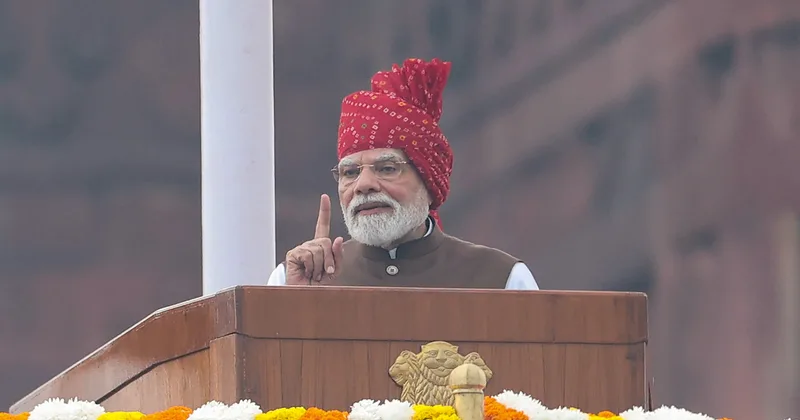
New Delhi: Prime Minister Narendra Modi has laid out an ambitious 23-point action roadmap for Viksit Bharat 2047. The underlining goal is to transform the Viksit Bharat mission from a government vision into a nationwide mass movement. The 23-point roadmap encompasses sectors such as sports, skilling, agriculture, artificial intelligence, domestic technology, pharmaceuticals, industrial capacity and governance reforms.
The roadmap calls every section of society, from five-year-old school children and university students to skilled workers, industry leaders and senior citizens, to contribute to India’s journey towards becoming a developed nation. The action points emerged from Prime Minister Modi’s interaction with Secretaries to the Government of India on July 22 and were subsequently conveyed to all secretaries in a July 29 communication issued by the Cabinet Secretary TV Somanathan.
Viksit Bharat @2047: PM’s 23 Key Action Points — Cabinet Secretary Directs Ministries to Initiate Actionhttps://t.co/8bJhIkbqsu pic.twitter.com/O0VPc7Sfon
— Staff News (@StaffNews_In) August 21, 2026
The central message of PM Modi’s road map to Viksit Bharat is, achieving the Viksit Bharat@2047 vision cannot remain the responsibility of individual ministries or the government alone. It must become a collective national mission pursued through a “whole of government” and whole-of-society approach.
Beyond a government programme; Viksit Bharat is th goal of every citizen
At the heart of the 23-point roadmap is the idea that Viksit Bharat@2047 should become “the goal of a common man and not of the Government alone”. The Prime Minister has urged the government to pursue this objective through two major routes.
- Build a mass movement drawing inspiration from the kind of nationwide mobilisation witnessed during India’s freedom struggle
- Create a powerful youth movement through programmes in universities and colleges
Thus, Young people are expected to play a central role in carrying the Viksit Bharat vision forward. The My Bharat campaign and portal could also be utilised to address challenges such as drug addiction among the youth. PM Modi reiterated to develop motivational mechanisms to prevent young people from falling into substance abuse.
Preparing children for the 2036 Olympics
The first aspect in PM Modi’s 23-point roadmap is pertaining to sports. Sports has emerged as one of the most striking priorities in the roadmap, driven by a long-term generational vision. The children who could represent India at the 2036 Olympics are currently between five and ten years old. Thus, the Prime Minister urged to begin the groundwork for India’s Olympics 2036 ambition and must commence in schools at a very young age, PM Modi added.
Schools, colleges should encourage young children & students to participate in sporting competitions and showcase their achievements at different levels. The objective is to identify talent early and build a stronger sporting culture across the country and specifically prepare them to excel in Olympics 2036, to which India has bid and aspiring to host.
However, the responsibility for sports will not be left to the Sports Ministry alone. PM Modi has called for a whole-of-government approach, bringing multiple ministries and sectors into the effort. The Sports and Tourism ministries, for instance, could work together to promote sports tourism. MSMEs, technology departments and startups could also contribute to sports development through innovation, infrastructure and new technologies.
Ministries, departments and organisations have additionally been encouraged to organise sporting competitions at workplaces to promote both physical fitness and team-building, the outcome document of PM Modi’s meeting with Government secretaries mentioned.
Upskilling to suit global employment standards; ITIs get major push
Another key focus of the roadmap is integrating vocational skills into the education system at an earlier stage. The government wants skill development opportunities to become part of school education, ensuring that students are exposed to practical and vocational capabilities alongside conventional academic learning.
ITI courses are also set for a review to improve employability and create stronger opportunities for upskilling. The roadmap proposes exploring pathways through which students with ITI diplomas could eventually acquire degrees.
The plan also seeks to bridge the gap between Indian skills and global employment opportunities. A global mapping of demand for skilled workers has been proposed, with India’s training programmes set to align more closely with international requirements.
The roadmap cites the possibility of connecting skilled manpower from the North-Eastern states with employment opportunities in countries such as Japan. Along with technical capabilities, greater emphasis has been proposed on soft skills and digital technology, helping Indian workers become more competitive in overseas job markets.
Senior citizens should return as mentors
The 23-point agenda also looks beyond India’s immediate demographic dividend and seeks to tap the experience of senior citizens and retired professionals. Senior citizens could be engaged as mentors in ITIs and other programmes on an honorarium basis, following an approach similar to the “Professor of Practice” model under the National Education Policy.
Their experience could help bridge the gap between classroom learning and real-world professional knowledge. At the same time, final-year engineering students could be encouraged to volunteer for two to three months at ITIs, bringing newer technical knowledge and advanced skills to vocational institutions, the roadmap document adds.
The roadmap therefore brings together two generations: experienced senior citizens sharing practical wisdom and younger engineering students contributing contemporary technical expertise. As India gradually moves towards an ageing population, the government also wants to develop broader plans to engage senior citizens in mentorship programmes and other national initiatives rather than allowing their experience and knowledge to remain an underutilised resource.
Agricultural education aligning with regional realities
The roadmap also calls for a significant revamp in the agricultural education, particularly the need to align university syllabi with local and regional realities. Agricultural universities across India are expected to examine whether their courses genuinely reflect the agro-climatic conditions of their respective regions, emerging challenges and other aspects instead of relying excessively on common or uniform approaches.
The broader agricultural agenda also should focus on crop diversification. The government has been asked to explore expanding irrigation where appropriate, while ensuring that such expansion does not encourage unsuitable water-intensive crops.
The roadmap says that agricultural students could also be trained and involved in innovative schemes, including initiatives such as installing solar panels along field boundaries. Such measures could potentially provide farmers with an additional and more assured source of income while supporting India’s wider clean energy ambitions.
Push for Indian-origin AI and messaging platforms
Strengthening domestic technology is another major pillar of PM Modi’s action plan. Ministries and government departments have been asked to encourage the use of home-grown digital, artificial intelligence and messaging platforms to improve the security of government data. The document specifically mentions domestic platforms such as Zoho, Sarvam and Arattai, signalling a push towards greater adoption of Indian-origin technology alternatives.
The emphasis reflects the broader importance being placed on technological self-reliance and data sovereignty, security as AI and digital systems become increasingly central to governance. The Prime Minister has also stressed the need for effective use of data and AI, along with wider engagement with universities and a stronger focus on research and innovation across sectors.
Building expertise within government
One of the strongest governance messages in the roadmap is the need to strengthen specialised expertise within the government itself. Officials are expected to be trained in areas such as preparing tender documents, legislative drafting, dispute management and other specialised functions instead of depending extensively on private consultants.
The government’s iGOT platform has been identified as a potential tool for continuous capacity building. The broader objective is to create a more capable and self-reliant administrative system equipped to handle increasingly complex policy, legal, technological and procurement challenges.
The roadmap also suggests reconsidering the terminology of “expenditure” where government spending results in the creation of productive assets, arguing that such spending may require a different approach and assessment.
Pharma industry and infrastructure in focus
The pharmaceutical sector has been included prominently in the reform agenda. The government has called for process reforms and deregulation, keeping pace with rapidly changing scientific developments while improving the ease of doing business.
More broadly, ministries have been directed to identify gaps in rules, regulations, processes and systems before they become major bottlenecks. The focus should be on anticipating future requirements rather than waiting for problems to emerge.
The industrial agenda should include developing more Indian construction companies capable of executing complex infrastructure projects and strengthening domestic manufacturing capacity for heavy, sophisticated and complex machinery and equipment.
The roadmap also calls for stronger industry-academia collaboration. Universities and colleges are expected to update their courses and syllabi regularly in response to technological developments and changing industry requirements.
Breaking departmental silos
Perhaps the most significant administrative message in the roadmap is directed at India’s top bureaucracy. Secretaries have been asked to function as leaders of public interest rather than followers of departmental interest.
They are expected to take ownership of cross-cutting national priorities such as Swachhata, Swadeshi, deregulation and decriminalisation, rather than restricting their focus to the narrow boundaries of individual ministries. The underlying message is to break departmental silos and encourage ministries to work collectively as parts of one government.
Greater consultation among stakeholder ministries has also been proposed before Cabinet proposals are finalised. The objective is to resolve potential disagreements and operational deadlocks at an earlier stage, prevent delays and ensure smoother implementation once decisions are taken.
Prime Minister Modi’s 23-point roadmap is thus comprehensive as it looks at the five-year-old as a potential stakeholder to compete for India at the 2036 Olympics and senior citizens as mentors for next generation. It also looks at the government officer expected to develop specialised expertise, the ministry required to work beyond departmental boundaries & bottlenecks in the path of marching towards Viksit Bharat.