Centuries before satellites pierced the sky, Indian astronomers were already charting planetary motion with instruments carved from stone. Aryabhata computed the length of the year to within minutes of the modern measurement, Bhaskaracharya work on gravitation predated Newton by five hundred years. That inheritance that the heavens could be measured, modelled and eventually reached did not vanish with colonial pressure. It resurfaced in 1963, when a modest rocket lifted off from a Kerala fishing village and seeded what would become the Indian Space Research Organisation. Six decades later, that same instinct for exact, patient engineering was on display again on August 11, 2026, at the Satish Dhawan Space Centre in Sriharikota not in the blaze of a launch, but in the quieter discipline of a ground static test, where ISRO qualified an upgraded first-stage solid booster for its newest and most commercially consequential launcher, the Small Satellite Launch Vehicle.
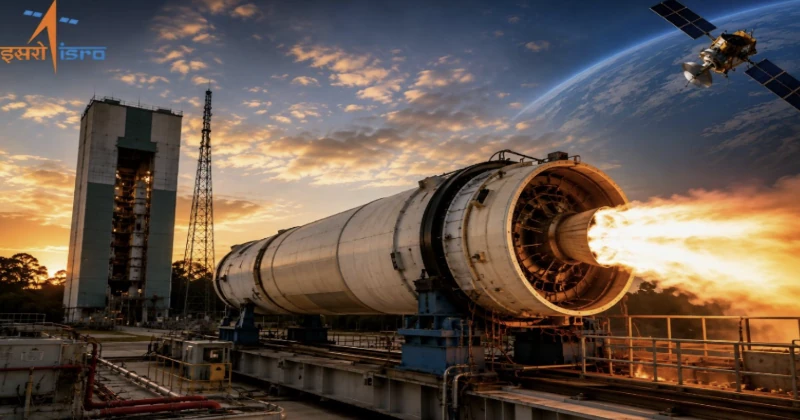
ISRO announced that it had successfully conducted the ground static test of an improved version of SSLV solid booster stage, designated SS1, at the static test facility in Sriharikota. The upgraded stage carries three design changes an enhanced propellant burn rate across two motor segments, an optimised thermal protection system, and process refinements to the nozzle sub-system aimed squarely at making the stage easier to manufacture at scale. Together, these changes have also reduced the stage overall mass. Through the test, ISRO instrumentation captured more than 600 parameters covering the motor’s ignition behaviour, ballistic performance, structural response, thermal profile, dynamic loads and acoustic signature. The recorded data, the agency said, closely matched pre-test predictions the clearest signal that a design has moved from the drawing board to flight-ready hardware. With this test, the design improvements built into SSLV’s first stage stand formally qualified, clearing the way for the upgraded SS1 to enter the vehicle’s operational configuration.
SSLV itself exists to solve a problem that ISRO’s larger rockets were never built to handle. The Polar Satellite Launch Vehicle, India’s long-serving workhorse, was designed for substantial payloads on multi-year mission timelines, and smaller satellites seeking a ride were routinely left waiting for a co-passenger slot to open up. As the number of small satellite operators multiplied through the 2010 universities, startups, foreign customers that waiting list became a competitive disadvantage. SSLV was conceived specifically to close it with a compact, three stage solid plus liquid terminal stage vehicle that could be assembled by a small team within days rather than months, and launched at short notice against a customer’s timeline rather than the agencies. The August 11 test belongs to that founding mission it is not a new capability so much as a refinement of the one SSLV was always meant to deliver.
The vehicle operational design reinforces the same intent. SSLV can fly inclined orbits out of Sriharikota, and is also configured to launch polar orbits from the upcoming spaceport at Kulasekarapattinam in Tamil Nadu giving India two dedicated small-lift gateways rather than one shared launch complex servicing every class of mission. That is a deliberate separation of infrastructure by mission type, freeing Sriharikota larger pads for heavier, less frequent launches while a lighter, faster-turnaround vehicle handles the growing volume of small satellite traffic on its own dedicated ground.
The three design changes read like minor engineering footnotes. Each in fact addresses a distinct constraint that shaped the original SS1.
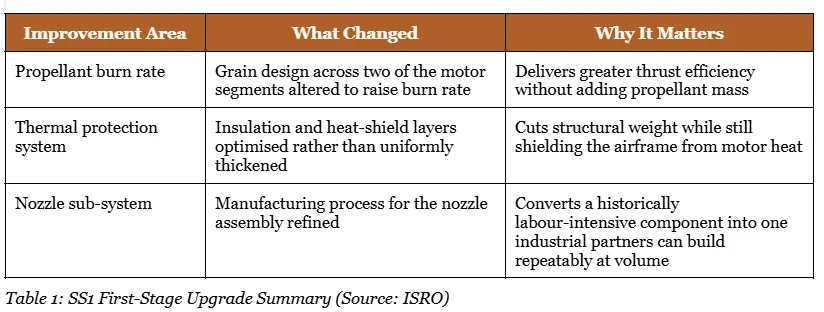
The nozzle change matters most for what comes next. A solid motor nozzle has traditionally been among the hardest parts of a launch vehicle to mass-produce, requiring specialised skills and long lead times. Making it “production friendly” is not a performance upgrade so much as an industrial one it is what allows a rocket stage to move from being handcrafted inside a space agency to being manufactured on an assembly line by private industry, which is precisely the direction SSLV has been built to travel.
The payoff of these changes is concrete, ISRO estimates the induction of the improved SS1 will lift SSLV payload capability to Low Earth Orbit by roughly 100 kilograms. That figure is modest against a heavy-lift rocket’s capacity, but it is significant in the segment SSLV is designed for. Small satellites typically under 500 kilograms are the fastest-growing category in the global space economy, and an extra 100 kg of headroom can be the difference between flying a satellite with a backup subsystem or without one, between carrying a sharper imaging sensor or a lighter one or between a single dedicated mission and a rideshare pairing of two.
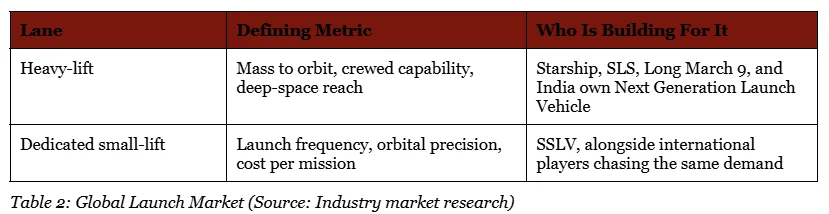
Why is ISRO investing careful engineering effort into a small solid booster while SpaceX pursues Starship, NASA works through the Space Launch System, and China develops its Long March 9 for lunar-class missions? The answer lies in how the global launch market has actually split into two distinct lanes, each governed by a different logic.
Industry forecasts project that small satellites will account for roughly a third of all satellites launched over the next decade, yet contribute only about six per cent of total launch mass a market defined by frequency and precision, not brute lift capacity. The global small-satellite market itself is estimated at over fifteen billion dollars in 2026, on course to approach twenty billion dollars within a decade, while the dedicated small-launch services segment companies and vehicles built specifically to fly these satellites, rather than carry them as secondary payloads is forecast to more than quadruple in value by the mid-2030.
Heavy lift rockets are poorly suited to this particular demand. A small satellite riding as a secondary payload on a heavy launcher waits on someone else’s schedule, someone else’s orbit, and someone else priorities. SSLV was conceived to remove exactly that dependency a vehicle a customer can book on short notice, that reaches a precise orbit, and that can be assembled and launched faster than India’s larger workhorses. Heavy-lift and small-lift are not competing strategies; they are answers to two different questions. India is pursuing both its own Next Generation Launch Vehicle is advancing separately for heavier, more ambitious missions while positioning SSLV to capture a market segment where speed, cost and manufacturing scale, rather than raw thrust, decide who wins.
There is a strategic dimension to this as well, one that rarely features in headlines about rocket size. A launch-on-demand vehicle is not only a commercial asset, it is also the kind of capability that allows a nation to replace a damaged or degraded satellite quickly, rather than waiting months for a slot on a larger, oversubscribed vehicle. As reconnaissance, communication and navigation increasingly depend on constellations of small satellites rather than a handful of large ones, the ability to reconstitute that constellation on short notice becomes a quiet but real component of national resilience one that a fast, production-friendly small-lift vehicle is far better positioned to deliver than any heavy-lift rocket built primarily for mass and reach.
That is also why this test is as much an industrial milestone as a technical one. SSLV was designed from the outset as a production-friendly, quick-turnaround, launch-on-demand vehicle and has already completed two successful development flights. The Transfer of Technology to Indian industry is already under way, with Hindustan Aeronautics Limited brought in as ISRO hundredth technology-transfer partner to build SSLVs independently a pattern already proven with the PSLV, where private industry has taken over end to end production of India’s most reliable launcher.
This sits alongside a wider ecosystem of Indian private players from IN-SPACe-authorised startups building their own small launchers to established manufacturers absorbing ISRO’s designs all being drawn into a supply chain that no longer runs through the agency alone. It is the hardware foundation beneath the government ambition to raise India annual launch cadence several-fold over the coming years, a target unreachable if ISRO alone continued to build every rocket by hand. Each qualified design improvement, including this one, becomes a template private manufacturer can replicate at scale, rather than a one-off achievement confined to a government test stand.
None of this diminishes the technical achievement of August 11. A solid rocket motor is unforgiving of error its performance is fixed the moment it is cast, with no opportunity to adjust once ignited. Qualifying a redesigned stage against more than 600 simultaneous measurements, and finding the results matching prediction, is exacting, unglamorous work. It is also, in its own way, a continuation of the same civilisational habit that once tracked the stars with stone instruments measure precisely, build patiently, and trust the discipline of the method over the drama of the moment. SSLV upgraded first stage will not make headlines the way a crewed mission or a lunar landing does.
But as India’s small satellite manufacturers, and the world, look for a launcher that is fast, precise and now lighter than before, this quiet test on the Sriharikota tarmac may prove to be the more consequential milestone the one that decides not who reaches farthest into space, but who gets there most often, most reliably and most affordably.