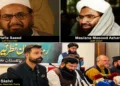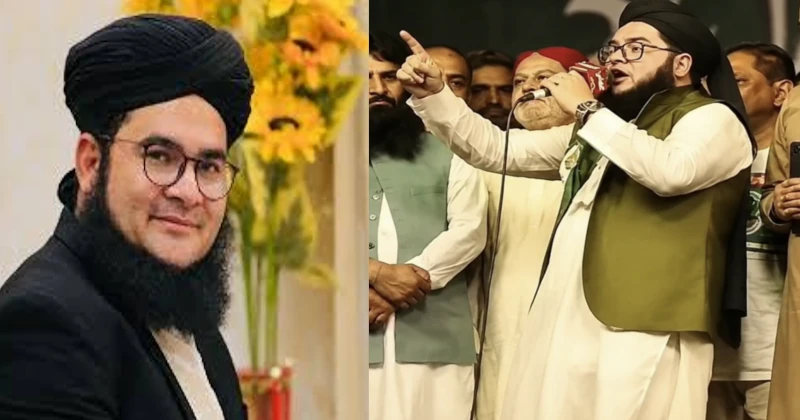
New Delhi: Pakistani cleric Allama Nasir Madni, who reportedly suffered a serious cardiac episode while delivering a Friday sermon earlier this month, has returned to the public stage and is now at the centre of controversy over remarks in which he allegedly claimed that Lashkar-e-Taiba (LeT) founder Hafiz Saeed sent 10,000 terrorists to Kashmir.
Madni was reportedly seen addressing a gathering linked to the LeT in Bahawalnagar on August 14, where he spoke about Saeed and his alleged role in sending militants towards Kashmir. The remarks, offer a disturbing glimpse into the rhetoric surrounding Pakistan-based jihadist networks and their activities directed at India.
🚨LeT’s Naseer Madani Returns to Stage After Heart Attack, Claims Hafiz Saeed Sent 10,000 Terrorists to Kashmir
This is the same Maulvi Naseer Madani who suffered a severe heart attack a few days ago but, unfortunately, somehow survived.
Yet, on 14 August, he was seen shouting… https://t.co/JIR4cVJeBv pic.twitter.com/sCp6sZiBuY
— Kashmir Conflict Stories (@ConflictStories) August 17, 2026
‘Saeed sacrificed himself’
In the speech, Madni reportedly portrayed Hafiz Saeed as someone who had sacrificed himself for what he described as the “motherland” and claimed that Saeed had sent thousands of militants towards Kashmir.
The cleric’s comments have drawn attention because they appear to openly reference the alleged mobilisation of militants for operations in Kashmir a region that has for decades remained a central focus of Pakistan-based terrorist organisations.
From hospital bed to inflammatory rhetoric
Madni’s return to the stage comes only weeks after reports of a medical emergency during a Friday sermon in Jahanian, Punjab. According to Pakistani reports, the cleric collapsed while delivering a sermon at Masjid Al-Bashir Ahle Hadith in Jahanian on July 3.
Initial reports said he suffered a suspected heart attack or cardiac arrest and was subsequently taken to a hospital in Multan. A subsequent health update reported that he was in stable condition after being taken to the Chaudhry Pervaiz Elahi Institute of Cardiology in Multan.
His reappearance at a public gathering has therefore attracted attention not merely because of his recovery, but because of the nature of the rhetoric attributed to him.
Hafiz Saeed and the Kashmir terror network
Hafiz Saeed is the founder of Lashkar-e-Taiba, an organisation responsible for numerous attacks and designated as a terrorist organisation by several governments. He was convicted by a Pakistani court in terrorism-financing cases and has remained imprisoned in Pakistan.
The 2008 Mumbai terror attacks, which killed more than 160 people, were carried out by LeT gunmen, while the organisation has long been associated with militant activities in J&K.
Madni’s reported remarks also stand out because they appear to frame Saeed not as a criminal or terrorist leader, but as someone who made sacrifices for a purported national cause.
Madni has previously been described in some reports and online material as a cleric with alleged links to militant groups, including LeT and Jaish-e-Mohammed (JeM). These allegations should, however, be distinguished from established facts unless supported by official investigations or judicial findings.
His public profile has primarily been that of a Pakistani religious preacher and social-media personality. Available Pakistani reporting confirms that he has a substantial following and frequently delivers public religious speeches.
In 2020, Pakistani media reported that Madni was abducted at gunpoint and assaulted by unidentified men after being invited to lead prayers in the Kharian area. Police subsequently arrested suspects in connection with the kidnapping.
The reported “10,000 terrorists” claim is significant precisely because it goes beyond routine anti-India rhetoric.
For decades, Kashmir has been used by Pakistan-based extremist organisations as a rallying cry for recruitment and mobilisation. Organisations such as LeT and JeM have sought to portray militancy in Kashmir as a religious or nationalist struggle, despite their involvement in attacks against civilians, security personnel and political targets.