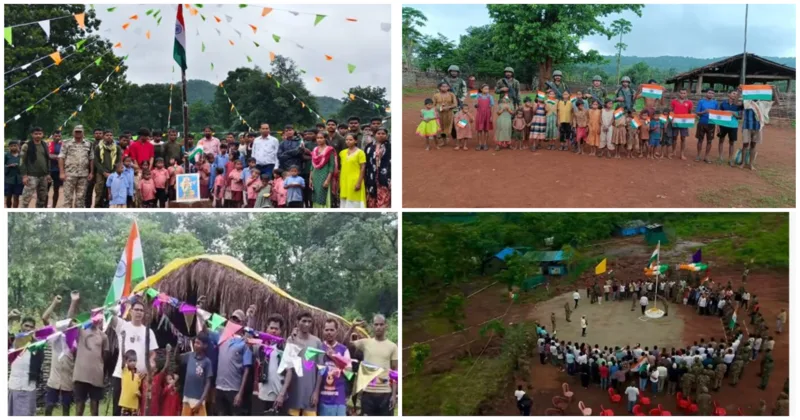
Jagdalpur : In a landmark development for Chhattisgarh’s Bastar region, the national tricolour was unfurled for the first time since Independence in 92 remote villages across Bijapur, Sukma and Narayanpur districts on the occasion of Independence Day.
For communities that had remained cut off from open celebrations of national festivals for decades amid Maoist violence and restrictions, the sight of the national flag flying over their villages carried a significance far beyond a ceremonial programme. It marked what the state government described as a visible sign of the return of peace, security, constitutional governance and public confidence to some of Bastar’s most inaccessible areas.
The development comes months after the state declared the affected areas free from Maoist armed cadres on March 31, 2026. The first-ever Independence Day celebrations in these villages have since emerged as a powerful symbol of a changing Bastar.
#WATCH | Chhattisgarh: Tricolour hoisted for the first time in Boter village of Abujmarh on Independence Day today. This was once Naxal-affected and hoisting the Tricolour here meant a threat to one's life. pic.twitter.com/i8mBPIxPAK
— ANI (@ANI) August 15, 2026
According to the Chhattisgarh Government, the tricolour was hoisted for the first time in 33 villages of Bijapur, 50 villages of Sukma and nine villages of Narayanpur.
Many of these settlements were located in areas once considered strongholds of Maoist influence. Their participation in Independence Day celebrations reflects the expanding reach of security forces and administration, while also signalling a renewed effort to connect remote communities with democratic institutions and development.
92 Villages Witness Their First Independence Day Celebration
The scale of the celebrations was significant. In Bijapur, 33 remote villages, including areas around the sensitive Karregutta hills, witnessed the unfurling of the national flag. In Sukma, 50 villages—including former Maoist-affected areas such as Minpa, Tadmetla and Burkapal—joined the national celebrations.
In Narayanpur, nine villages in and around the remote Abujhmad region witnessed Independence Day celebrations with the tricolour being hoisted openly.
कुर्रेगुट्टा की पहाड़ी जो कभी नक्सल आतंक का गढ़ थी, आज वहाँ शान से तिरंगा लहरा रहा है और आजादी का पर्व धूमधाम से मनाया जा रहा है। जहाँ कभी बंदूकें गरजती थीं, वहाँ राष्ट्रभक्ति गूँज रही है।
लाल माटी पर लहराता तिरंगा नक्सलमुक्त नए बस्तर की शक्ति, प्रगति व आत्मविश्वास का प्रतीक है। https://t.co/geuGaX38YA
— Amit Shah (@AmitShah) August 15, 2026
For residents, the occasion represented more than a traditional flag-hoisting ceremony. It marked a visible change in the relationship between remote communities and the state, with villagers participating in a national celebration that had remained inaccessible to them for years.
The government has attributed the transformation to improved security conditions and the restoration of administrative access in areas that were previously difficult to reach because of Maoist activity.
Government Highlights Return of Constitutional Governance
Chhattisgarh Deputy Chief Minister and Home Minister Vijay Sharma described the developments in Bastar as evidence of the restoration of constitutional governance in areas that had previously lived under the shadow of Maoist violence.
He said areas where national festivals had once been restricted and where, according to the government, black flags had been displayed during Independence Day were now witnessing the national tricolour being unfurled with pride.
Sharma said the declaration of Maoist-affected areas as free from armed cadres on March 31 was a major turning point. The Independence Day celebrations marked the first such occasion after that development when several former Maoist strongholds could openly celebrate the national festival.
As part of efforts to commemorate the sacrifices of security personnel and other national heroes, more than 500 schools, public squares and community centres across Bastar division are also being named after martyrs, according to the government.
Abujhmad Witnesses a New Dawn
The transformation is particularly significant in Abujhmad, one of Bastar’s most remote and historically Maoist-affected regions.
Nine villagesincluding Boter, Koraskodo, Hachekoti, Adnar, Kumnar, Diwalur, Gundekot, Rekapal and Rasmeta witnessed Independence Day celebrations with the national flag being unfurled for the first time.
Narayanpur Superintendent of Police Sandeep Patel said the ceremonies brought visible happiness, pride and renewed confidence among villagers.
The sight of the tricolour flying over villages that had previously experienced the impact of Maoist diktats was accompanied by patriotic slogans and participation from children, young people and elderly residents.
The establishment of security camps has also strengthened the sense of security among local communities, with police officials reporting a substantial decline in Maoist influence and access to these villages.
Boter: A Journey Through One of Bastar’s Most Remote Areas
The experience of Boter village illustrates the geographical challenges involved in extending administration and security infrastructure into the remote areas of Abujhmad.
Located around 120 kilometres from Narayanpur district headquarters, Boter remains a difficult destination to reach. The journey from Narayanpur to Orchha covers approximately 67 kilometres, followed by another 55-kilometre stretch to Boter.
#WATCH | Chhattisgarh: A local of Boter village, Raju Ram Mandavi says, "We hoisted the Tricolour today. Before this, we never did it because Naxals used to stop us. It feels so good today. Everyone is overjoyed. This became possible only after the setting up of a Police camp… pic.twitter.com/AK2BOoanAh
— ANI (@ANI) August 15, 2026
Two-wheelers can travel only up to the vicinity of the Kudmel security camp. From there, visitors must walk nearly nine kilometres through difficult terrain.
The route includes streams and rivers, temporary bamboo and wooden bridges, muddy and slippery mountain paths and dense forest.
Yet, after a security camp was established in the Boter area in March, the village was able to hold its first Independence Day celebration.
With a population of around 60, the village witnessed an emotional moment as children, youth and elderly residents gathered with national flags. For many residents, it was the first time they had seen the tricolour being formally unfurled in their own village on Independence Day.
Security and Administration Restore Confidence
Police officials said improved security conditions and the decline of Maoist activity have helped rebuild confidence among villagers.
Following the establishment of security camps, government agencies and security personnel have been able to expand their presence in remote parts of Abujhmad. Residents and teachers said the change is beginning to influence everyday life, particularly access to education.
The ability of children to attend school and the gradual reduction of fear are being seen as important indicators of normalisation.
For the villagers, therefore, the first Independence Day celebration was not simply about raising the national flag. It represented the return of public institutions, greater access to government services and renewed confidence in democratic governance.
From the Gun to the Tricolour
Another powerful symbol of transformation emerged at Mulla Camp in Bhanupratappur, Kanker district, where 27 surrendered Maoists joined police personnel in Independence Day celebrations.
The former Maoists participated in the flag-hoisting ceremony, saluted the national flag and conveyed Independence Day greetings to citizens.
Their presence beneath the tricolour represented a dramatic shift from their earlier association with armed insurgency to participation in the democratic mainstream.
The event highlighted the role of rehabilitation and social reintegration in helping former insurgents rebuild their lives.
Under the government’s rehabilitation policy, surrendered Maoists are being provided opportunities related to employment, education, skill development and dignified living. The objective is to enable those who abandon violence to establish a peaceful future and become part of mainstream society.
Jhiram Valley: Remembering Bastar’s Painful Past
Amid celebrations of peace and freedom, Bastar also remembered the immense human cost of the violence that affected the region.
On Independence Day, Deputy Chief Minister and Home Minister Vijay Sharma visited Jhiram Valley and paid tribute to those who lost their lives in the Jhiram Valley massacre.
He planted saplings in memory of the victims and recalled their sacrifices.
स्वतंत्रता दिवस पर ध्वजारोहण के बाद झीरम घाटी पहुंचकर नक्सली हमले में शहीद प्रदेश के वीर नेताओं एवं साथियों को भावभीनी श्रद्धांजलि अर्पित की उनकी स्मृति में वृक्षारोपण कर झीरम की पावन माटी भी श्रद्धापूर्वक एकत्रित की।
बस्तर तिरंगा यात्रा का मार्ग नारायणपुर से ताड़मेटला होते हुए… pic.twitter.com/EffjNTGQtB
— Vijay sharma (@vijaysharmacg) August 15, 2026
Sharma said Jhiram Valley was not part of the scheduled route of the Bastar Tiranga Yatra, which travelled from Narayanpur through Tadmetla towards the Karregutta hills. However, he chose to visit the site separately to pay homage to those who died there.
He also said a proposal was being prepared to give the memorial dedicated to the Jhiram martyrs a more significant and memorable form.
Honouring the Martyrs of Jhiram
The Jhiram Valley attack remains one of the darkest episodes in Chhattisgarh’s political and security history.
Sharma recalled the sacrifices of former Union Minister Vidyacharan Shukla, former state minister Nand Kumar Patel, former Leader of the Opposition Mahendra Karma, along with several other political leaders, security personnel and civilians.
He said their sacrifice would never be forgotten and emphasised that the vision associated with their service was of a Bastar defined by democracy, peace, development and public confidence.
He further said the forces that had kept the region under the shadow of fear and violence and obstructed the reach of constitutional institutions into remote areas had now been substantially weakened.
600-Km Tiranga Yatra Sends a Message of Peace
The Deputy Chief Minister also highlighted the significance of the three-day Bastar Tiranga Yatra, which covered approximately 600 kilometres across five districts.
The journey culminated in the unfurling of the national flag at the Karregutta hills, once considered one of the last major Maoist strongholds.
According to Sharma, the yatra was intended to send a message of peace and demonstrate that the Constitution and democratic institutions must reach every corner of the country.
He stressed that lasting transformation in Bastar would require more than security operations. Development, public confidence, connectivity and opportunities for young people would remain crucial to consolidating peace.
Bastar at the Threshold of a New Era
The first-ever unfurling of the tricolour in 92 villages is more than a ceremonial milestone. It reflects a wider transition in parts of Bastar—from prolonged insecurity towards greater administrative access, public participation and engagement with democratic institutions.
The tricolour flying over 92 villages therefore marks not merely a historic Independence Day, but the beginning of a new chapter for Bastar—one in which peace, constitutional governance and development can increasingly take the place of fear and violence.
For the people of these remote villages, the national flag flying freely over their homes carries a powerful message: a new chapter of inclusion, dignity, peace and participation in India’s democratic journey has begun.