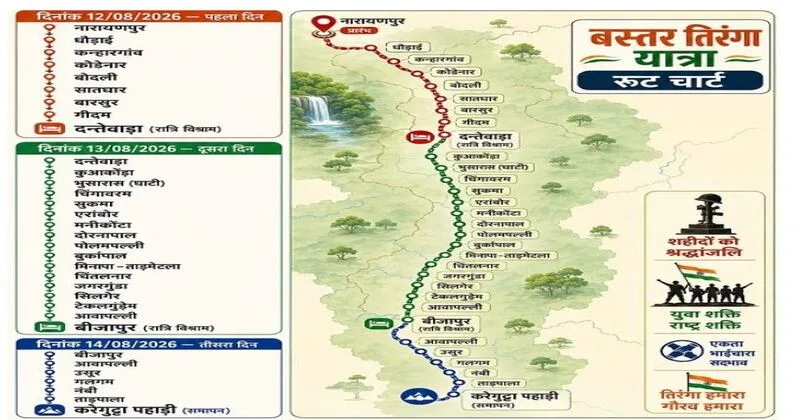
Jagdalpur: In a powerful reflection of change in Chhattisgarh’s Bastar region, the Bastar Tiranga Yatra 2026 is set to traverse areas that were once considered strongholds of Maoist insurgency. The three-day yatra, scheduled from August 12 to 14, will begin in Narayanpur and pass through Dantewada, Sukma, and Bijapur before concluding at Karregutta.
There was a time when hoisting the national flag on Independence Day or Republic Day in parts of Bastar was seen as a major challenge. Maoist groups would oppose national celebrations by enforcing shutdowns and raising black flags. In a striking contrast, the same area will now witness youths marching with the tricolour, signalling a significant shift in the region’s socio-political landscape.
Leadership and Symbolism of the Yatra
The yatra will be led by Deputy Chief Minister Vijay Sharma, underscoring the government’s commitment to promoting national unity and confidence in areas once affected by insurgency. The journey is not merely symbolic but also represents a broader transformation in Bastar, where governance, infrastructure, and public participation have steadily improved.
What makes this yatra particularly significant is its route through villages and regions that were once deeply impacted by Maoist violence. Names like Minpa-Tadmetla, Chintagufa, Jagargunda, Silger, and Tekalgudem have historically been associated with major Maoist attacks and security operations, often making national headlines.
Route Across Sensitive Regions
On the first day, the yatra will begin from Narayanpur and proceed through Dhaudai, Kanhar Gaon, Kodenar, Bodli, Satdhar, Barsur, and Geedam before reaching Dantewada. The second day will cover some of the most sensitive stretches, including Kuakonda, Bhusaras Valley, Chintagufa, Sukma, Errabore, Manikonta, Dornapal, Polampalli, Kukanar, Minpa-Tadmetla, Chintalnar, Jagargunda, Silger, Tekalgudem, and Awapalli, eventually reaching Bijapur. On the final day, the yatra will move through Awapalli, Usur, Galgam, and Nambi before concluding at Karregutta.
Key Halt Points of Bastar Tiranga Yatra–2026 That Echo Memories of Maoist Violence
The Bastar Tiranga Yatra–2026 will pass through several locations that once witnessed some of the most intense Maoist violence, symbolising a journey from conflict to resilience.
Tadmetla (2010): On April 6, 2010, 76 security personnel were martyred in one of the deadliest Maoist attacks in the country.
Chintagufa: The Tadmetla attack zone falls under this police station area, which remained a major hub of Maoist influence and security operations in South Bastar for years.
Burkapal: In 2017, 25 CRPF personnel lost their lives in a Maoist ambush here, marking another tragic chapter.
Jagargunda: Once a remote Maoist stronghold, it has gradually seen improved connectivity and administrative outreach.
Tekalgudem: This area came into national focus after a major Maoist attack on security forces in 2021.
Karregutta: A hilly and once-inaccessible region of Bijapur, long known for Maoist dominance, now stands as the final destination of the Tiranga Yatra. Together, these sites reflect a powerful narrative of transformation, sacrifice, and the enduring spirit of national unity.
Bastar Has Paid the Price for the Tricolour
The events in Binagunda last year underscored the heavy price associated with upholding the national flag in Maoist-affected regions. In August 2025, the case of Manish Nureti from Binagunda village in Kanker district came to light. On Independence Day, he hoisted the tricolour along with villagers and children. Videos circulating on social media showed children singing the national anthem while locals raised slogans of “Bharat Mata Ki Jai.”
Following this, Maoists reportedly abducted him and executed him in a so-called “people’s court,” accusing him of being a police informant, according to police sources. The incident highlights how, for years, the tricolour symbolised a direct challenge to Maoist dominance in such areas.
Today, the passage of the Tiranga Yatra through these very regions sends a strong public message of change, reflecting Bastar’s gradual transition from conflict to confidence and reaffirming the presence of democratic governance and national unity.
A Message of Change
Today, the Bastar Tiranga Yatra passing through the same area sends a strong public message about the region’s transformation. It reflects a shift from fear and violence to participation and National Unity . As the tricolour moves through these once-troubled areas, it symbolises not just patriotism but also the restoration of confidence among the people of Bastar.
The yatra stands as a testament to how far the region has come, marking a new chapter where the national flag is no longer contested but celebrated openly.