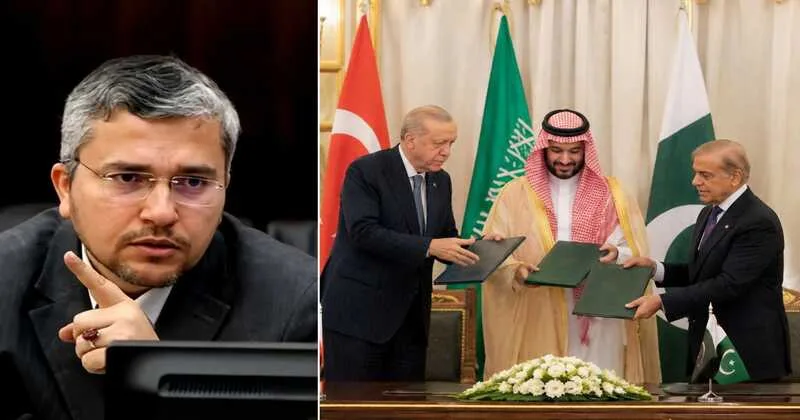
New Delhi: Iran has sharply criticised the newly signed defence pact between Pakistan, Saudi Arabia and Turkey, dismissing the agreement as a “paper” arrangement and arguing that it cannot provide Riyadh with lasting security. The remarks came from Ebrahim Rezaei, a member of Iran’s Parliament and its National Security and Foreign Policy Commission, after the three countries signed the Mecca Joint Defence Agreement in the Saudi city of Mecca on August 7.
Reacting to the agreement on X, Rezaei said Saudi Arabia should recognise that relying on external security guarantees would not resolve its security concerns. “Saudis must know that a paper agreement with Turkey and Pakistan will not bring them security, just as years of one-sided nursing to the Americans did not bring them security,” he wrote.
Rezaei further argued that Riyadh should change its policies rather than seek security guarantees from other countries. He said that if Saudi Arabia reformed its policies, it would not need to “beg” other countries for protection.
The criticism comes as the new trilateral arrangement brings together three politically distinct countries, oil-rich Saudi Arabia, NATO member Turkey and Pakistan, in a collective defence framework at a time of severe instability across West Asia.
Attack on One will be treated as an attack on all
The Mecca Joint Defence Agreement establishes a collective-deterrence principle under which an armed attack against any one of the three signatories is to be regarded as an attack against all three. Pakistan’s Foreign Ministry said the agreement is intended to strengthen collective deterrence against aggression and expand defence cooperation among the three countries. It said the pact provides for the enhancement of “all aspects of defence cooperation” between Pakistan, Saudi Arabia and Turkey.
The agreement was signed in Mecca during a meeting involving Saudi Crown Prince Mohammed bin Salman, Turkish President Recep Tayyip Erdogan and Pakistani Prime Minister Shehbaz Sharif. The choice of Mecca, Islam’s holiest city and traditionally regarded as the birthplace of Prophet Mohammed, also gives the agreement considerable symbolic significance.
Pakistan described the pact as being guided by the longstanding historical relations among the three countries and by their shared “bonds of brotherhood and Islamic solidarity”. It also cited common strategic interests and longstanding defence cooperation as foundations for the new arrangement.
New collective defense agreement signed today between Saudi Arabia, Turkey, and Pakistan, with NATO Article 5-like terms: “An attack on one of the three States shall be regarded as an attack on all of them.” It’s a fluid, tabula rasa era in the Middle East. pic.twitter.com/CXJKhgJUEi
— Brett McGurk (@brett_mcgurk) August 7, 2026
The agreement is officially presented as a defensive arrangement rather than an offensive military bloc. Recent reporting indicates that the signatories have stressed that it is not directed against a particular country. Nevertheless, its emergence against the backdrop of escalating tensions involving Iran has inevitably drawn attention in Tehran.
The pact also builds on an already established defence relationship between Pakistan and Saudi Arabia. The two countries signed a separate Strategic Mutual Defence Agreement in September 2025, under which aggression against either country would be treated as aggression against both. Türkiye’s participation now expands that framework into a three-way security arrangement.
Riyadh seeks broader security partnerships
For Saudi Arabia, the new agreement comes amid a search for stronger and more diversified security partnerships. The Kingdom has faced repeated security threats involving missiles and drones, particularly amid the wider regional conflict and attacks associated with Iran-aligned groups, including the Houthis and Iraqi militias. Saudi critical infrastructure and energy facilities have previously been targeted by drone and missile attacks, highlighting the vulnerability of the Kingdom’s oil installations and other strategic assets.
The pact may be presented as a new security shield for Riyadh, but much of its supposed strength rests on what Saudi Arabia expects its partners to bring to the table. Turkey is expected to add its military capabilities and defence industry, while Pakistan is expected to contribute its military experience and longstanding ties with Riyadh. Saudi Arabia, meanwhile, is expected to bring its financial muscle, strategic location and importance to global energy markets.
For Pakistan, the arrangement could be portrayed as another opportunity to elevate its role as a security partner to the Gulf kingdom, building on decades of military ties, training, defence cooperation and deployments. But whether this carefully packaged triangle amounts to a meaningful security guarantee, or merely another grand declaration of solidarity, is a question that remains unanswered.
Tehran questions Riyadh’s search for another security shield
Turkey’s role is being projected as another pillar of the arrangement, with Ankara’s growing defence industry and capabilities in drones, missiles and naval systems expected to add military weight to the pact. Yet Turkey’s much-touted drone capability also faced a real-world test during India’s 2025 Operation Sindoor, when Pakistan employed Turkish-origin drones against India and Indian air-defence systems successfully intercepted and destroyed the incoming threats. That episode offers a sobering counterpoint to the promotional language surrounding Ankara’s defence capabilities.
A catalogue of weapons and an impressive defence industry may look formidable on paper, but whether they can deliver a credible security guarantee in an actual conflict is a very different question. The three-way alignment may therefore appear formidable in diplomatic statements, while its effectiveness as a collective military deterrent remains to be proven.
That gap between expectation and reality is at the heart of Ebrahim Rezaei’s criticism. The Iranian Parliament’s National Security and Foreign Policy Commission member has dismissed the arrangement as a “paper agreement”, arguing that Saudi Arabia cannot secure lasting protection simply by repeatedly turning to outside powers.
Rezaei’s criticism also draws an unflattering comparison with Riyadh’s longstanding dependence on Washington. His argument is essentially that if years of Saudi reliance on the United States failed to provide the security Riyadh sought, there is little reason to assume that replacing or supplementing that arrangement with another collection of security partners will suddenly solve the problem.
تُرسّخ اتفاقية مكة للدفاع المشترك بين السعودية وباكستان وتركيا 🇹🇷🇵🇰🇸🇦 التي تم توقيعها في مكة المكرمة، إطارًا لشراكة دفاعية طويلة المدى، تُعزّز الردع والتنسيق والتكامل بين بلداننا الشقيقة، وتسهم في دعم أمن واستقرار المنطقة والعالم. https://t.co/WqThOPF3j7 pic.twitter.com/oeK47tRcZh
— Khalid bin Salman خالد بن سلمان (@kbsalsaud) August 7, 2026
The timing makes the new pact even more politically loaded. The region is already facing heightened tensions amid the conflict involving the United States and Iran, while the security situation has affected shipping through the Strait of Hormuz and the Red Sea. Against this backdrop, the announcement of another defence arrangement risks looking less like a settled security architecture and more like another attempt to assemble guarantees from outside powers.
Pakistan, Saudi Arabia and Turkey have presented the agreement as a mechanism for collective deterrence, but the real test lies beyond the language of the agreement. Whether the three countries would actually coordinate military planning, intelligence, exercises and operational responses during a serious crisis remains to be demonstrated.
For Riyadh, the pact is expected to broaden its security options as it reassesses traditional alliances and confronts a difficult regional environment. Yet the arrangement’s promised protection remains largely an expectation rather than a tested reality.
That is precisely where the Iranian criticism strikes at the pact’s weakest point: that a declaration that an attack on one will be treated as an attack on all may sound impressive on paper, but the real question is who would actually act, how, and at what cost when a crisis arrives. Rezaei’s “paper agreement” jibe therefore puts the grand language of the Mecca pact against the much harder question of whether three governments can turn ceremonial solidarity into credible security.