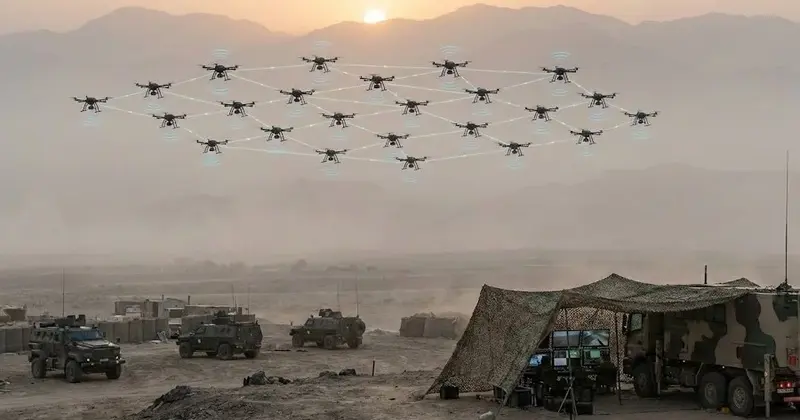
The Defence Research and Development Organisation(DRDO), has scripted a giant leap in the path of defence indigenisation and countering the challenges of emerging warfare. The country’s premier defence think tank has called the private firms, especially the defence start ups/MSMEs, to indulge in the manufacturing of swarm drones. These are AI-enabled, low cost group of Unmanned Aerial Vehicles(UAVs), which are capable of real-time communication and launching precision attacks, thereby successfully neutralising the intruding enemy aerial threats.
As the fundamental attributes of modern warfare and geopolitical contestations undergo a significant change, which is predominantly airborne, such home-grown swarm drone networks are a strategic necessity to consolidate national security. With DRDO’s inclusion of MSMEs in the process of manufacturing swarm drones, India is set to take a giant leap in Atmanirbharata or defence indigenisation goals, coupled with revolutionising private sector footprint in the defence supply chain and national security apparatus.
The project rolled out by DRDO is titled as “Development of Close Formation Flying of Multiple Drones” under the Technology Development Fund (TDF) scheme. This scheme is designed specifically to help domestic Micro, Small and Medium Enterprises (MSMEs) build cutting-edge defence technology and facilitate grassroots innovation.
Strategic merits of swarm drones
- Swarm drones is a group of 50 drones that can fly within half a metre of each other
- They have one master drone plus 50 slave drones and forms a critical component of modern warfare as UAVs are emerging at the epicentre of battlefield intelligence & combat tactics
- It is easy to track and shoot down a single drone by the enemies. However, the security shield provided by a group of 50 drones operated under a complex and coordinated strategy, is difficult for the enemies to breach. This is the strategic merit of swarm drones
- The master drone acts as the central brain, receiving instructions from a ground station and then organising the other drones into a precise grid, to thwart enemy weapons, thus acts as national security grid
- When swarm drones fly in a cluster, they function as “virtual antennas”. The military can use a distributed swarm to generate powerful radio frequencies for sensing or jamming enemy communications. If one drone gets shot down, the rest of the swarm can automatically readjust and continue the mission. Thus, swarm drones are jam proof
- They can fly upto 5,000 metres and operate in a cluster even in difficult terrains and mountainous border regions. They even remain stable amid heavy wind speed
- Each drone can carry specialised payloads like cameras or electronic warfare equipment, intended to track or destroy enemy targets
- It is cost effective for the Indian Armed Forces, instead of relying on one heavy military weaponry
They are capable of precision strikes and decoy missions. - While operating in a cluster with spacing of half a metre, these swarm drones are capable of correcting or rectifying positional errors within 500 milliseconds, thus highly effective
- It will be equipped with more than 70 per cent indigenous content, thus cyber secure
Capable of carrying out reconnaissance missions, artillery correction, kamikaze strikes and coordinated swarm attacks, while flying below the radar envelope of conventional systems - Swarm drones has both “soft kill” and “hard kill” capabilities in a multi-layered aerial defensive operation
- It can track and detect more than 100 drones simultaneously
The swarm drones thus, are set to define the military future of India’s offensive and defensive capabilities. In the emerging nature of warfare the low-cost, reliable indigenous swarm drones will act as a game-changing cutting-edge technology. With DRDO’s new roll out, MSMEs will be integrated into the path of building national security capabilities, thus generating significant economic opportunities as well.