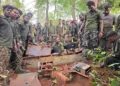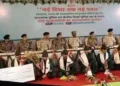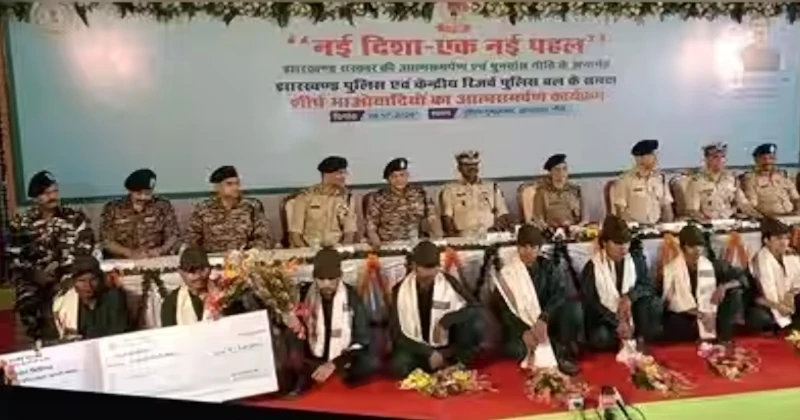
RANCHI: In what Jharkhand Police described as a “golden day” in the fight against Left-Wing Extremism, 16 active CPI (Maoist) cadres including some of the outfit’s most senior commanders operating in the Kolhan, Saranda and Latehar regions laid down their arms before security forces in Ranchi on July 28 under the state government’s surrender and rehabilitation policy.
The surrender marks one of the biggest setbacks for the outlawed Maoist organisation in recent years, coming months after sustained anti-Naxal operations severely weakened its leadership structure across Jharkhand.
Among those who surrendered was Regional Committee Member Santosh alias Basudev, carrying a reward of Rs 15 lakh, along with three Zonal Committee Members, three Sub-Zonal Committee Members, six Area Committee Members and three cadre-level operatives. Collectively, six of the surrendered Maoists carried rewards amounting to Rs 39 lakh.
The surrendered cadres were associated with squads led by senior CPI (Maoist) leaders, including Politburo member Misir Besra and Central Committee member Asim Mandal, both among the most wanted Maoist leaders still active in eastern India.
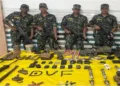
Along with their surrender, the Maoists deposited a significant arsenal of sophisticated firearms allegedly looted from security forces over the years. The cache included:
- Six INSAS rifles
- Two AK-47 rifles
- One HK33 rifle
- One US Carbine
- One M16 rifle
- 38 magazines
- 1,562 rounds of ammunition
The surrender is the outcome of Operation Navjeevan-II, a coordinated campaign jointly conducted by the Jharkhand Police, Central Reserve Police Force (CRPF), CoBRA units and Jharkhand Jaguar. Director General of Police Tadasha Mishra hailed the development as a major milestone in the state’s battle against Maoist insurgency.
Describing the occasion as a “golden day,” she said the surrendered cadres would receive all benefits available under the Jharkhand government’s surrender and rehabilitation policy and urged other extremists to abandon violence and join the mainstream.
She also paid tribute to security personnel who lost their lives during anti-Maoist operations, saying their sacrifices had significantly weakened the extremist network in the state. CRPF Inspector General Saket Singh attributed the large-scale surrender to relentless joint operations by the Jharkhand Police, CRPF and CoBRA forces.
He noted that the killing of 17 Maoists, including Central Committee member Anal Manjhi, earlier this year had shattered the organisational structure of Maoist squads, forcing many cadres to disperse and ultimately surrender.
IG (Operations) Narendra Singh revealed that eight more commanders and squad members active in the Saranda forests are expected to surrender soon in neighbouring Chhattisgarh, indicating that security agencies are steadily tightening the noose around the insurgent network.
According to police records, the 16 surrendered Maoists were allegedly involved in around 450 criminal cases. They were linked to at least 18 major incidents in which 15 police personnel and five civilians lost their lives, while 28 security personnel sustained injuries. The surrendered weapons are believed to have been looted during previous attacks on security forces.
The surrender also offered a rare glimpse into the deteriorating conditions inside Maoist camps. Regional commander Santosh admitted that survival inside the forests had become increasingly difficult, saying cadres struggled to obtain even basic necessities such as food and shelter.
He claimed he had long intended to surrender but could not establish contact with the authorities to avail himself of the state’s rehabilitation policy.
Another surrendered cadre, Salmi, recounted how she initially joined the Maoists’ cultural wing before being inducted into an armed squad. She said cadres were forced to trek four to five hours almost every day while carrying their belongings through dense forests.