Gurupurnima 2026: Reviving the gurukula spirit
July 29, 2026
  • Read Ecopy
  • Circulation
  • Advertise
  • Careers
  • About Us
  • Contact Us
Android AppiPhone AppArattai
Organiser
  • ‌
  • Bharat
    • Assam
    • Bihar
    • Chhattisgarh
    • Jharkhand
    • Maharashtra
    • View All States
  • World
    • Asia
    • Europe
    • North America
    • South America
    • Africa
    • Australia
  • Editorial
  • International
  • Opinion
  • RSS @ 100
  • More
    • Op Sindoor
    • Analysis
    • Sports
    • Defence
    • Politics
    • Business
    • Economy
    • Culture
    • Special Report
    • Sci & Tech
    • Entertainment
    • G20
    • Azadi Ka Amrit Mahotsav
    • Vocal4Local
    • Web Stories
    • Education
    • Employment
    • Books
    • Interviews
    • Travel
    • Law
    • Health
    • Obituary
  • Subscribe
    • Subscribe Print Edition
    • Subscribe Ecopy
    • Read Ecopy
  • ‌
  • Bharat
    • Assam
    • Bihar
    • Chhattisgarh
    • Jharkhand
    • Maharashtra
    • View All States
  • World
    • Asia
    • Europe
    • North America
    • South America
    • Africa
    • Australia
  • Editorial
  • International
  • Opinion
  • RSS @ 100
  • More
    • Op Sindoor
    • Analysis
    • Sports
    • Defence
    • Politics
    • Business
    • Economy
    • Culture
    • Special Report
    • Sci & Tech
    • Entertainment
    • G20
    • Azadi Ka Amrit Mahotsav
    • Vocal4Local
    • Web Stories
    • Education
    • Employment
    • Books
    • Interviews
    • Travel
    • Law
    • Health
    • Obituary
  • Subscribe
    • Subscribe Print Edition
    • Subscribe Ecopy
    • Read Ecopy
Organiser
  • Home
  • Bharat
  • World
  • Operation Sindoor
  • Editorial
  • Analysis
  • Opinion
  • Culture
  • Defence
  • International Edition
  • RSS @ 100
  • Magazine
  • Read Ecopy
Home Bharat

Gurupurnima 2026: Reviving the gurukula spirit

In Madras Presidency (Tamil Nadu), indigenous education system was community-driven & widespread. For exceptional students, the goal was getting recognition in Gurukula system, which had multiple features that modern educational research recognised as highly efficacious. In Gurukula, students lived & studied in teacher's household. Not surprisingly, British introduced this educational system of Tamil Nadu into their schooling in 19th century

Ravi Kumar IyerRavi Kumar Iyer
Jul 29, 2026, 08:00 am IST
in Bharat, Opinion, Culture
Follow on Google News
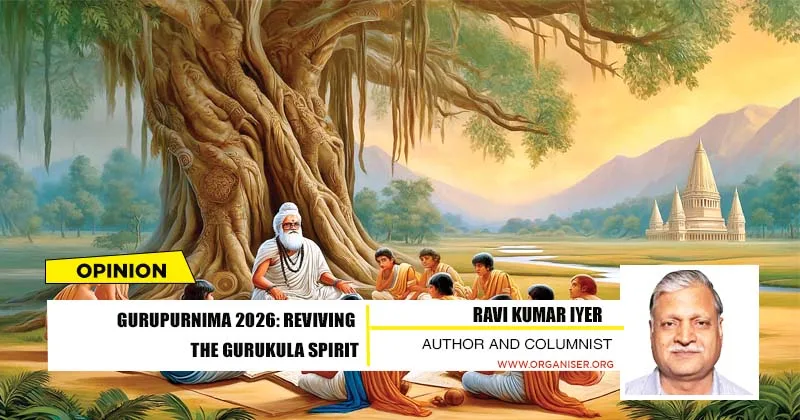
In the Gurukula, the student lived in the teacher's household, participating fully in family and community life while receiving intensive mentored instructions

In the Gurukula, the student lived in the teacher's household, participating fully in family and community life while receiving intensive mentored instructions

FacebookTwitterWhatsAppTelegramEmail

The 1822 educational census ordered by Governor Sir Thomas Munro reveals the vast scale of the indigenous education system in the Madras Presidency (Tamil Nadu). Community-driven and widespread, it sustained over 11,500 schools and 1,000 higher learning institutions, enrolling approximately 1,57,000 students across local Thinnai Pallikoodam schools and specialised Vedic, Shaivite, and Tamil centres. The word “Thinnai” refers to the raised veranda at the front of a Tamil home, and it was precisely here that most Tamil children received their first education. The schoolmaster — the Aasan or Bhattachariyar — would sit on this veranda, and children from the neighbourhood would gather before him each morning.

Thinnai: Apex of Tamil Learning

While the great universities like Madurai, Kanchipuram and Kanthalloor Salai (Nalanda of the South), served as the apex of Tamil learning, the foundation of the system was the village school — the Thinnai Pallikoodam.

The Thinnai system required no building, no budget allocation, no Government curriculum. It required only a knowledgeable elder, a community that valued learning, and children with slates. The Aasan was compensated not with a salary but with community support — grain from the harvest, festival gifts, and the deep social respect
accorded to the learned. This was education as community service, not as commerce.

Features of Thinnai System

  • Universal access — children of all communities attended the same village school
  • No dedicated building required — the teacher’s veranda served as the classroom
  • Community-funded — the Aasan received grain and gifts, not a fixed salary
  • Curriculum adapted to local context — agricultural, artisanal, or trading communities had relevant content
  • Tamil as the medium of instruction — ensuring deep comprehension
  • Thirukkural as the core ethical text — producing citizens with shared moral vocabulary
  • Peer learning — older students helped teach younger ones
  • No examinations — mastery demonstrated through recitation, composition, and practical application

Fillip to Advanced Learning

For students who showed exceptional promise, the path beyond the Thinnai was the Gurukula — residential learning with a master scholar. In the Gurukula, the student lived in the teacher’s household, participating fully in family and community life while receiving intensive mentored instruction. The Gurukula system had several features that modern educational research has validated as highly effective: continuous immersion, personalised instruction, real-world contextualisation, and the zone of proximal development model that Vygotsky would theorise in the 20th century.
One of the most underappreciated aspects of ancient Tamil education is the significant role of women as both students and teachers. The ancient Sangam texts (500 BCE to 300 CE) record approximately 30 women poets — indicating that female literacy and literary education were not exceptional but relatively normal among certain communities. Women poets like Avvaiyar, Kakkaipadiniyar, and Nakkannaiyar were not self-taught — they had received systematic poetic education of the same quality as their male counterparts.

THE MADRAS EDUCATION SYSTEM

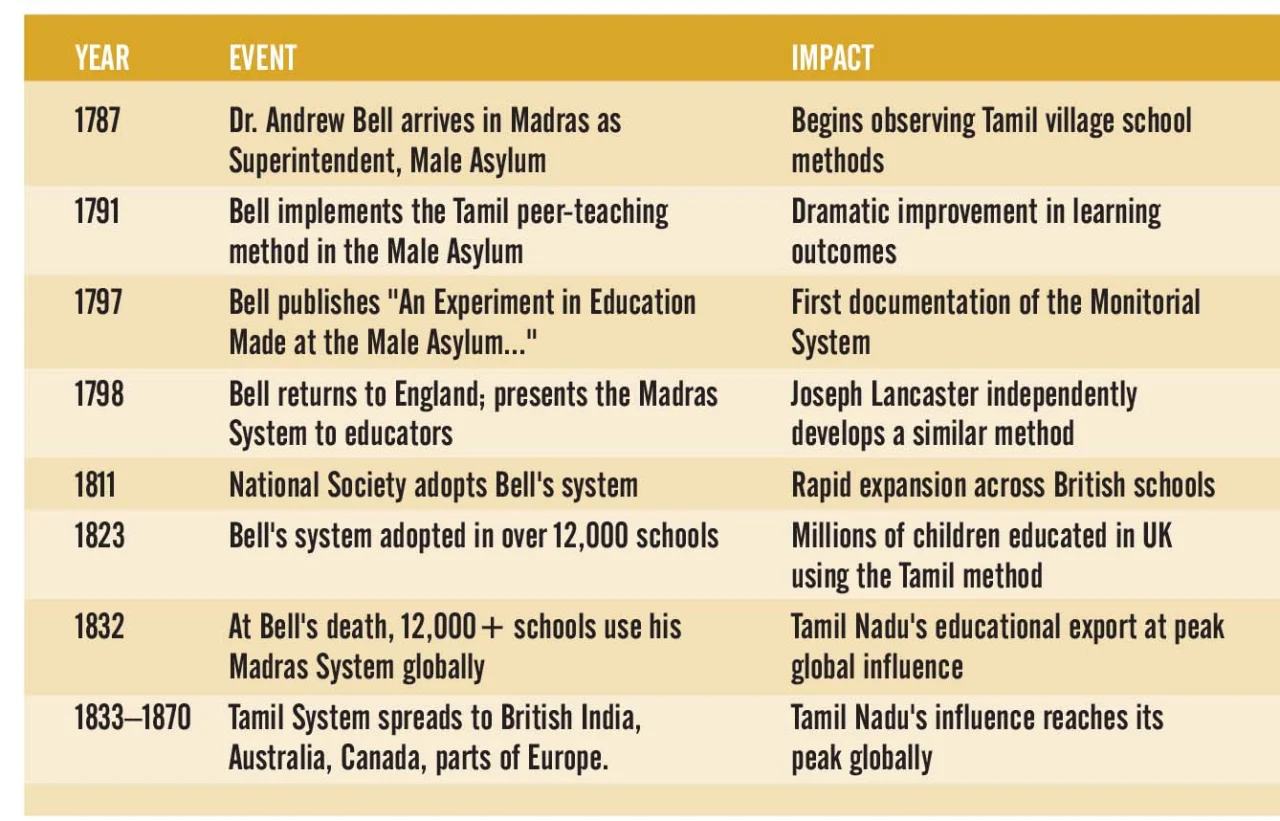
Observed by Dr. Andrew Bell in Chennai (1787–1796) and introduced to Britain where it shaped 12,000 schools and influenced the education of millions.

EXPORTED TO BRITAIN BY DR. ANDREW
BELL · 1797

One of the most remarkable episodes in the global history of education is almost entirely unknown outside Tamil Nadu: the fact that the educational method that transformed British schooling in the 19th century was directly borrowed from the village schools of Tamil Nadu.

The story begins with Dr. Andrew Bell (1753–1832), a Scottish clergyman who came to Madras in 1787 as Superintendent of the Male Asylum. Bell observed that more advanced students taught material to their peers under the guidance of the Aasan — a practice he called “mutual instruction.” He recognised immediately that it solved the perennial problem of how to educate large numbers of students with limited numbers of qualified teachers.

Bell observed this system across Tamil Nadu between 1787 and 1796, and in 1797 published his landmark pamphlet: “An Experiment in Education Made at the Male Asylum of Madras, Suggesting a System by which a School or Family May Teach Itself Under the Superintendence of the Master or Parent.” This document directly attributed the method to the Tamil practice Bell had observed, calling it “the Madras System.”
Topics: Bharatiya educationGurupurnima 2026Gurukula systemFillip to Advanced LearningMADRAS EDUCATION SYSTEMgurukula spirit
ShareTweetSendShareSend
✮ Subscribe Organiser YouTube Channel. ✮
✮ Join Organiser's WhatsApp channel for Nationalist views beyond the news. ✮
Previous News

Assam deports 13 Bangladeshi infiltrators; Over 1.40 lakhs declared foreigners missing from the state

Related News

Gita Jayanti: Untie the mental knots through real education

Representative Image

Janjatiya Gaurav Divas: In what manner are our cherished Hindu Janjati families are subjected to conversion practices?

Sarkaryavah of Rashtriya Swayamsevak Sangh (RSS), Dattatreya Hosabale addressing the event

Gyan Maha Kumbh: Nyas has become a solution provider to transform the education system – Dattatreya Hosabale

Gyan Mahakumbh in Prayagraj: Revival of tradition

Load More

Latest News

In the Gurukula, the student lived in the teacher's household, participating fully in family and community life while receiving intensive mentored instructions

Gurupurnima 2026: Reviving the gurukula spirit

Illegal Bangladeshis deported from Assam

Assam deports 13 Bangladeshi infiltrators; Over 1.40 lakhs declared foreigners missing from the state

Guru Poornima 2026: The eternal bond and sacred legacy

RSS Sarkaryavah Dattatreya Hosabale Ji , Chief Minister Shri Mohan Charan Majhi and others at the launch of the book based on the life of Swami Laxmananda Saraswati.

Book Release on Swami Laxmanananda: Dattatreya Ji says, “No force can silence defenders of Dharma in Bharat”

Bharatiya Mahila Morcha state president Adv. Navya Haridas

Keralam: Kozhikode police book transgender influencer Jaanmoni Das over abusive remarks against PM Modi

Sonam Wangchuk at Rajghat in Delhi

Sonam Wangchuk welcomes Public Examinations Bill; says law should take its own course against miscreant

Tamil Nadu: CPI(M) leaders break temple gates in Tiruppur amid land dispute, Hindu Munnani demands action

AIMIM President and MP Asaduddin Owaisi, Telangana CM Revanth Reddy

Telangana CM Revanth Reddy succumbs to Asaduddin Owaisi’s push, introduces Family Register Certificate for SIR

Bollywood, Are You Listening? The unmade story of Yellapragada Subbarow, the Indian scientist who helped save the world

Despite so many efforts, the US-Iran war does not seem to end

The retreat of the global guarantor

Load More
  • Privacy
  • Terms
  • Cookie Policy
  • Refund and Cancellation
  • Delivery and Shipping

© Bharat Prakashan (Delhi) Limited.
Tech-enabled by Ananthapuri Technologies

  • Home
  • Search Organiser
  • Bharat
    • Assam
    • Bihar
    • Chhattisgarh
    • Jharkhand
    • Maharashtra
    • View All States
  • World
    • Asia
    • Africa
    • North America
    • South America
    • Europe
    • Australia
  • Editorial
  • Operation Sindoor
  • Opinion
  • Analysis
  • Defence
  • Culture
  • Sports
  • Business
  • RSS @ 100
  • Entertainment
  • More ..
    • Sci & Tech
    • Vocal4Local
    • Special Report
    • Education
    • Employment
    • Books
    • Interviews
    • Travel
    • Health
    • Politics
    • Law
    • Economy
    • Obituary
  • Subscribe Magazine
  • Read Ecopy
  • Advertise
  • Circulation
  • Careers
  • About Us
  • Contact Us
  • Policies & Terms
    • Privacy Policy
    • Cookie Policy
    • Refund and Cancellation
    • Terms of Use

© Bharat Prakashan (Delhi) Limited.
Tech-enabled by Ananthapuri Technologies