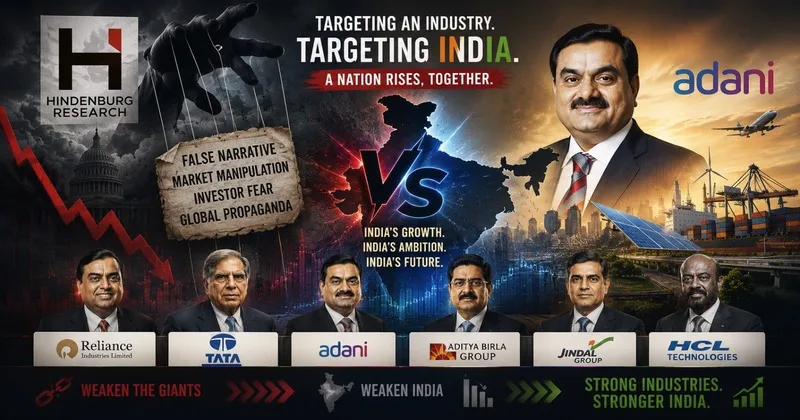
Competition has become a crucial tool in the global economy today. When serious international allegations are leveled against the largest industrial conglomerate of a rapidly emerging economy, the impact is felt not only by the company itself but also by the country with which it is directly associated. Consequently, the nation’s investment image, financial credibility and industrial reputation are all affected.
In fact, the controversy involving the Adani Group and the US should be viewed from this perspective. Recent developments, specifically the US Department of Justice (DOJ) arguing against proceeding with its own lawsuit after reconsidering the legal grounds, jurisdiction and evidence, have given a new direction to this debate. It raises the suspicion that this entire episode might have been orchestrated solely to undermine the global image of India’s rapidly rising economic power.
Today, India ranks among the world’s fastest-growing major economies. However, this success is not accidental; whether it is the goal of becoming a five-trillion-dollar economy, the resolve for an ‘Atmanirbhar Bharat’, or strides toward becoming a global manufacturing hub, a closer look reveals the extraordinary contribution of the country’s major industrial groups behind all these achievements. These industrial conglomerates serve as the strongest pillars of India’s economic strength, employment generation, innovation, exports and infrastructure.
Reliance Industries has recorded a record annual turnover of approximately ₹11.75 lakh crore for the 2025-26 financial year. The Adani Group’s consolidated turnover has reached the level of approximately ₹2.92 lakh crore. The Aditya Birla Group’s global turnover exceeds $65 billion. HCL Technologies’ annual revenue surpasses ₹1 lakh crore, while the Tata Group’s global business spans several lakh crore rupees. The O.P. Jindal Group is elevating the country’s industrial capabilities to new heights in the steel, energy and infrastructure sectors.
Many such examples of Indian companies can be cited. In essence, these figures not only symbolize corporate success but also attest to the economic strength that has earned India a new identity in the global economy. The international narrative that emerged following the Hindenburg report triggered temporary volatility in the Indian stock market and sparked various apprehensions among global investors. These international discussions impacted the Adani Group’s market valuation; the capital of millions of investors was affected and attempts were made to question India’s corporate governance standards, yet subsequent developments revealed another side of the story.
Investigations by Indian regulatory bodies, the process conducted under the Supreme Court’s supervision and now the serious legal questions raised by the US Department of Justice regarding its own case suggest that the initial allegations, which became the subject of global discourse, were not entirely beyond dispute. When the prosecution itself begins to reconsider the legal robustness of its case, it is natural to ask: did the initial narrative inflict undue damage on India’s industrial image?
It is important to understand that India’s major industrialists are not merely profit-driven businesspeople; they are also the country’s largest job creators, taxpayers and investors. Groups such as Reliance, Tata, Adani, Birla, Jindal and HCL sustain the livelihoods of millions, both directly and indirectly. These companies contribute thousands of crores of rupees in taxes to the government annually, thereby fueling initiatives in education, healthcare, rural development, infrastructure and social welfare.
These industrial groups are also making massive investments in sectors critical to the future, such as ports, airports, highways, metro networks, energy projects, digital connectivity, telecommunications, green energy, data centers, artificial intelligence, and semiconductors. If India is moving towards becoming a pivotal hub in the global supply chain, the long-term investment capacity and risk-taking courage of these industrialists play a crucial role.
Global investors do not view a single company in isolation; they assess the entire nation’s policies, regulatory framework and business environment. Consequently, if a negative narrative is created internationally against one of India’s major industrial groups, it inevitably impacts foreign investment, the stock market, capital flows and India’s economic credibility.
Today, India has evolved beyond being merely a vast consumer market to become a rising global hub for manufacturing, innovation and investment. Indian industrial groups are competing globally in sectors such as green energy, digital technology, artificial intelligence, defense manufacturing, semiconductors, logistics and modern infrastructure. This is why Indian companies are investing in numerous countries worldwide, propelling India towards global economic leadership.
At such a juncture, any allegations leveled against an Indian industrial group must be evaluated based on facts, the law and judicial processes, rather than on prejudices or international propaganda. If, at a later stage, investigative agencies themselves appear to be reconsidering their initial stance on a matter, it becomes essential to evaluate the entire sequence of events in light of the new facts.
This is because a blow to the reputation of a single industrial group is not merely confined to a corporate dispute; it leaves far-reaching consequences. Naturally, the impact of such episodes is felt across India’s economic image, the global investment climate and even the vision of a ‘Viksit Bharat’. That is why the country’s wealth creators must be evaluated impartially, based on facts, transparency and due judicial process, since, in the Indian context, their success forms a crucial foundation for the nation’s economic strength, global standing, and future prosperity.
Now that the US Department of Justice has acknowledged it is reconsidering the legal basis and jurisdiction of its lawsuit, every Indian should strive to bring the full truth to light. This is not just about the Adani Group; in reality, this was a global conspiracy to tarnish the image of India’s industrial sector. Establishing this fact is vital for strengthening India economically in the future.