

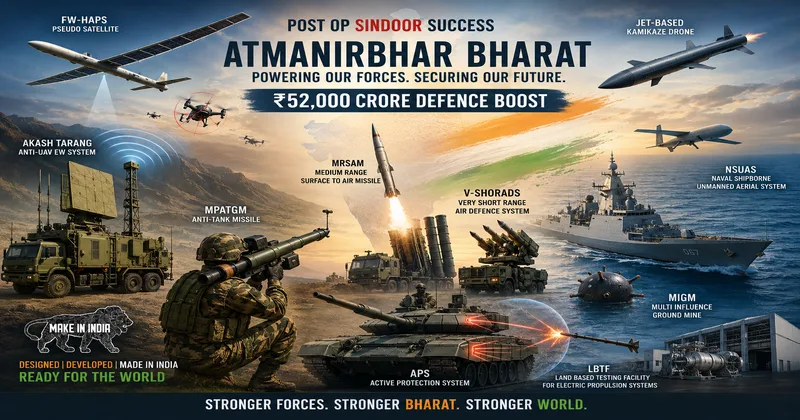
The success of Operation Sindoor has fundamentally altered the strategic conversation around Bharat’s defence preparedness. It demonstrated that future conflicts would not be fought solely through conventional firepower but through a seamless integration of drones, electronic warfare, layered air defence, precision strike capabilities, and network-centric operations. The latest approval of defence procurement proposals worth nearly ₹52,000 crore by the Government is therefore far more than a routine acquisition exercise. It is a strategic declaration that Bharat intends not merely to defend itself with indigenous technologies but also to emerge as a leading global defence manufacturing power.
For decades, Bharat figured among the world’s largest importers of military hardware. Today, that narrative is undergoing a historic transformation. Every major platform approved under this procurement package will be designed, developed or manufactured domestically under the Make in India initiative, with the Defence Research and Development Organisation (DRDO) working alongside an increasingly capable private defence industry. This marks the evolution of Bharat from a buyer of weapons to a builder of weapons.
Operation Sindoor: The strategic catalyst
Operation Sindoor validated several military trends that defence planners across the world have been observing since the conflicts in Ukraine and West Asia. Small, inexpensive drones can inflict disproportionate damage. Electronic warfare can be as decisive as kinetic firepower. Air defence requires multiple layers capable of neutralising everything from sophisticated missiles to loitering munitions.
The procurement decisions approved this week reflect precisely these operational lessons.
Rather than investing solely in traditional heavy platforms, Bharat is building an integrated ecosystem where surveillance, electronic warfare, unmanned systems, precision-guided munitions and layered air defence function together. This approach significantly enhances battlefield survivability while reducing dependence on costly foreign systems.
Building an asymmetric advantage
For the Indian Army, the acquisition package represents a major leap in next-generation warfare capabilities.
The induction of the Akash Tarang Anti-UAV Electronic Warfare System recognises that the drone battlefield has arrived in Indian Sub-continent. Instead of merely destroying hostile drones, Akash Tarang can jam, disrupt and neutralise unmanned aerial threats electronically, offering a highly cost-effective solution against mass drone attacks.
The Man Portable Anti-Tank Guided Missile (MPATGM) strengthens infantry formations with an indigenous fire-and-forget missile capable of defeating modern armour through top-attack capability. Its development signifies India’s growing confidence in producing sophisticated missile technologies without foreign dependence.
Equally significant is the induction of the Medium Range Surface-to-Air Missile (MRSAM) system, capable of engaging multiple aerial targets simultaneously at ranges of up to 70 kilometres. Together with the indigenous Very Short Range Air Defence System (V-SHORADS), Bharat is constructing a comprehensive multi-layered air defence architecture that protects troops against aircraft, helicopters, cruise missiles and drones.
The approval of the Active Protection System (APS) reflects another important lesson from recent wars. Modern tanks increasingly require defensive systems capable of intercepting incoming anti-tank missiles before impact. Such technologies dramatically improve battlefield survivability.
Perhaps the most futuristic addition is the jet-powered kamikaze drone, representing the increasing importance of loitering munitions. These systems combine reconnaissance, electronic warfare and precision strike into a single affordable platform, enabling commanders to engage high-value targets with remarkable accuracy.
Maritime security through indigenous innovation
For the Indian Navy, the procurement package reinforces maritime dominance across the Indian Ocean Region. The induction of the Multi Influence Ground Mine (MIGM) enhances sea denial capabilities by restricting adversary naval movements in strategically sensitive waters.
The Naval Shipborne Unmanned Aerial System (NSUAS) significantly strengthens maritime surveillance, allowing warships to monitor vast oceanic spaces without exposing manned aircraft to unnecessary risks.
Meanwhile, the establishment of a Land-Based Testing Facility (LBTF) for electric propulsion systems demonstrates long-term thinking. Electric propulsion will define the next generation of naval platforms, offering improved efficiency, reduced acoustic signatures and enhanced endurance.
The Indian Air Force looks beyond space
Among the most remarkable approvals is the procurement of Fixed-Wing High Altitude Pseudo Satellites (FW-HAPS) for the Indian Air Force.
These systems occupy an operational space between satellites and conventional drones. Powered primarily through solar energy, they can remain airborne for months while providing persistent Intelligence, Surveillance and Reconnaissance (ISR), communications and remote sensing capabilities.
Unlike satellites, they are relatively inexpensive and can be rapidly deployed. Unlike drones, they possess extraordinary endurance. Such technologies represent the future of strategic situational awareness and indicate that Bharat is investing in tomorrow’s battlefield rather than yesterday’s.
More Than Procurement: Building a defence ecosystem
The most important aspect of this acquisition programme is not simply the weapons themselves but the industrial philosophy behind them. Every system approved will be manufactured within Bharat.
This reflects the remarkable maturation of the country’s defence industrial ecosystem. Public sector undertakings, DRDO laboratories, private industry, start-ups, MSMEs and academic institutions increasingly function as an integrated innovation network.
The participation of private industry represents perhaps the most significant structural change. Indian companies are no longer merely licensed manufacturers assembling imported kits. They are becoming genuine technology partners contributing to research, design, manufacturing and exports.
This collaborative model mirrors the successful defence innovation ecosystems seen in countries such as the United States, Israel and South Korea.
From import dependence to export leadership
The timing of these approvals is equally significant.
Global defence markets are undergoing unprecedented restructuring. Many nations seek alternatives to traditional suppliers because of geopolitical uncertainty, supply chain disruptions and escalating costs.
Bharat is uniquely positioned to fill this emerging gap.
Indian defence systems increasingly offer three competitive advantages:
- Combat-tested operational credibility;
- Significantly lower acquisition and maintenance costs;
- Absence of politically restrictive end-user conditions often imposed by Western suppliers.
Already, Bharat exports defence equipment to over 100 countries. Indigenous missile systems, artillery platforms, radars, electronic warfare equipment, patrol vessels and aerospace technologies are steadily finding international buyers.
The capabilities being inducted today—including anti-drone systems, loitering munitions, air defence solutions and pseudo satellites—are precisely the categories witnessing the fastest global demand growth.
Operation Sindoor has further enhanced confidence in indigenous systems by demonstrating that Indian-developed technologies can perform effectively under real operational conditions.
Towards strategic autonomy
Defence production today is no longer simply about equipping armed forces. It has become an instrument of foreign policy, technological advancement and economic growth. Countries capable of designing and exporting advanced military systems enjoy greater diplomatic influence, stronger strategic partnerships and enhanced technological ecosystems.
The ₹52,000-crore procurement package therefore carries significance far beyond military modernisation. It strengthens supply chains, creates high-skilled employment, stimulates advanced manufacturing, accelerates innovation and enhances strategic autonomy.
More importantly, it sends an unmistakable message that Bharat intends to shape—not merely adapt to—the future global security architecture.
The road ahead
The transition from one of the world’s largest arms importers to a credible defence exporter will not happen overnight. Sustained investment in research and development, faster procurement cycles, stronger industry-academia collaboration, greater private sector participation and consistent export promotion remain essential.
Yet the direction is unmistakable.
The success of Operation Sindoor demonstrated the effectiveness of indigenous capabilities under operational conditions. The latest procurement approvals institutionalise those lessons into long-term military planning.
Together, they represent more than defence modernisation—they represent the emergence of a confident, technologically capable and strategically autonomous Bharat.
As geopolitical fault lines deepen and military technologies evolve at unprecedented speed, Bharat is no longer content with safeguarding its borders through imported weaponry. It is building the capacity to equip its own forces, support friendly nations and contribute meaningfully to the global defence marketplace.
The journey from “Make in India” to “Made in Bharat, Trusted by the World” has well and truly begun.