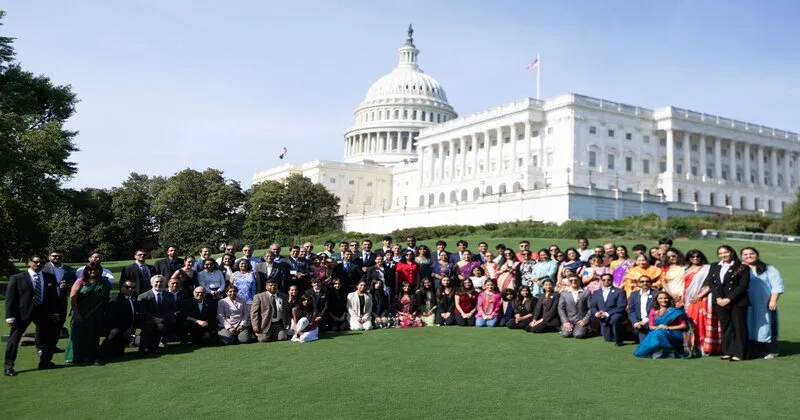
The Coalition of Hindus of North America(CoHNA) hosted the annual Hindu Advocacy Day, which was also combined with the celebration of 250th US Independence Day. More than 130 Hindu Americans hailing from 15 states of the United States of America, joined the event on the Capitol Hill. The event brought together lawmakers, community leaders, students, teachers, veterans and researchers.
During the Hindu Advocacy Day, the American hindu community conducted dialogue, discussions and deliberations about the challenges encountered by the community in the United States, despite rendering immense contributions to the American growth story for centuries. The discussions were also centered around civic participation, religious freedom and cultural liberty. The Hindu community also raised steep concerns over raising instances of targeted violence, anti-Hindu hate, discrimination and hinduphobia.
As per CoHNA report, members of the US Congress and also 12 Congressional staffers from both the Republican and Democratic party participated in the event. CoHNS also highlighted that the members of the Hindu American community have continuously held more than 50 meetings throughout the year with various Senate members and more than 120 congressional offices, to inform the US administrators about the challenges faced by the Hindu-American community and to ensure a safe shield for the Hindu populace in the US.
The President of CoHNA Nikunj Trivedi said that the gathering reflected both the diversity of the Hindu American community and its commitment to civic engagement. “It was a powerful day on Capitol Hill. We came together as Americans, sharing stories, building relationships and singing the national anthem”, Trivedi said. He highlighted the varied backgrounds of Hindu Americans, including students, entrepreneurs, healthcare professionals, engineers, veterans and scientists. He also asserted that the anniversary of America’s founding offered an opportunity to celebrate shared democratic values while engaging with the lawmakers.
Just in time for July 4th🇺🇸. More than 130 Hindu delegates traveled from 15 states across the US, to be part of CoHNA’s 5th Hindu Advocacy Day on Capitol Hill as we celebrated America at 250. 🇺🇸🇺🇸
In a bipartisan display of support, we were joined by 7 Congressional Reps and… pic.twitter.com/KtJMcGzmyB
— CoHNA (Coalition of Hindus of North America) (@CoHNAOfficial) July 3, 2026
The event featured testimonies from community members spanning multiple generations and professions. During the Hindu Advocacy Day, a youth panel was organised and young speakers spoke about advocating Hindu rights and perspectives on the campus. They highlighted how Hinduphobia is encountered in the University campus and persistent initiatives to thwart it. In many university campuses, across the United States, academic conferences were organised to enlighten about the Hindu culture and bust Hinduphobia.
Hindu philosophy & roots helped shape American life
Young speakers also spoke about the historical connections between Hindu philosophy and early American thinkers and they shared personal experiences about balancing religious identity with civic participation in the United States.
Military veteran Ruchir Bakshi described how his experiences of serving in Afghanistan and Iraq with the US Army were shaped by teachings from the Bhagavad Gita. He said that the scripture’s emphasis on discipline, integrity and selfless service influenced both his military service and understanding of civic responsibility while maintaining the Hindu identity.
US lawmakers criticised targeted attack & vandalism of temples
The members of the Hindu American community and also the US lawmakers present in the event severely condemned the attack on Hindu temples and upheld religious freedom. Representative Buddy Carter, Republican of Georgia, described freedom of religion as one of America’s foundational rights and criticized incidents of temple vandalism. He also acknowledged the role of Hindu Americans in contributing to America’s democratic experiment.
Democratic Representative Shri Thanedar of Michigan emphasised the importance of immigrant communities in shaping the country’s development and encouraged Hindu Americans to seek recognition for their contributions across science, medicine, academia and public service.
Democratic Representative Suhas Subramanyam of Virginia encouraged Hindu students and professionals to speak out against discrimination and embrace their religious identity with confidence rather than remaining silent in the face of prejudice. Representative Zoe Lofgren, Democrat of California, cautioned that caste-related legislation should be approached carefully to avoid unintended discriminatory consequences.
Representative Sanford Bishop, Democrat of Georgia, described Hinduphobia as incompatible with American values while noting Georgia’s recognition of anti-Hindu discrimination. Fellow Georgian Representative Brian Jack, a Republican, pointed to his state’s actions against anti-Hindu hate as an example of how community advocacy could influence public policy and praised the continued organization of CoHNA’s annual advocacy day.
Indians are not recent immigrants; But integral to the US for centuries
On the occasion of the 250th Independence Day of the United States, The Hindu American Foundation(HAF) highlighted that the Hindu-Americans are not a recent immigrant community, but has been an integral part of the US journey since its foundation and inception. Thus, targeted attacks on the community & spiking Hinduphobia is irrational.
“Long before Indian immigration, before yoga studios, and before Swami Vivekananda’s famous 1893 speech, America’s founders were already discussing whether religious liberty should extend to Hindus”, the HAF asserted. It further explained that in 1776, the year when the US Declaration of Independence was signed, a code of Gentoo Laws was also published. It is the maiden English translation of Hindu law.
“Published in 1776, the same year as the Declaration’s signing, it presented an ancient legal system that supported social order and stability among Hindus based on rational, universal morality. It showed that a sprawling civilization, home to myriad traditions, including Sikhism, Jainism and Buddhism could flourish under an ethical framework, regardless of one’s beliefs”, HAF further wrote about the Gentoo Law.
It was also an era, where the founders of the United States of America(USA) were in a dilemma. They were pondering whether to include religious freedom in the American experiment. As a solution to these questions, the 3rd President of the United States of America Thomas Jefferson said, “they meant to comprehend, within the mantle of its protection, the Jew and the Gentile, the Christian and Mahometan, the Hindoo and infidel of every denomination”. This is also inscribed in the autobiography of Thomas Jefferson written in 1821.
Long before Indian immigration, before yoga studios, and before Swami Vivekananda's famous 1893 speech, America's founders were already discussing whether religious liberty should extend to Hindus.
Few Americans know that in 1776, the same year the Declaration of Independence…
— Hindu American Foundation (@HinduAmerican) July 3, 2026
With this illustration, the Hindu American Foundation(HAF) thus reiterates that Hindus are not a newcomer or recent immigrant community to the United States. The association between the Hindus and the USA dates back to centuries, since its foundation. “To start, Hindu influence didn’t originate with the modern-day yoga industry, nor with the Indian gurus and philosophies that gained wide popularity in the 1960s. It also didn’t begin when Swami Vivekananda made his trailblazing speech at the first Parliament of the World’s Religions in 1893, nor with the Transcendentalists of the 1830s. Hindu influence goes back much further, all the way to the country’s very creation”, the HAF further exclaimed and refuted defaming & committing targeted violence of the Hindu community, by labelling them as recent immigrants. Hindus are very much integral to America’s growth story since its independence.