The Dang region of Gujarat, the very land of Shabari, stands today at a significant historical juncture. It is the sacred ground where, in the Treta Yuga, Bhagwan Vishnu (in the form of Bhagwan Ram) granted a direct audience to His devoted follower, Shabari, a place where devotion transcended all boundaries to draw the Divine to one’s very doorstep.
The character of Maa Shabari, as depicted in the Ramayana, embodies a unique stream of devotion; she engaged in years of unwavering spiritual practice (sadhana) solely to behold Shri Ram. Consequently, she stands as the supreme symbol of surrender, reverence and devotion for both ‘bhaktas’ (devotees) and ‘karmayogis’ (practitioners of selfless action). The present-day Dang region is linked to that very land of penance (tapobhumi) where Shabari awaited Bhagwan Shri Ram for years.
When Bhagwan Ram arrived here during His exile, Shabari lovingly offered Him ‘ber’ (jujube) fruits. In Indian culture, this episode symbolises not merely a devotee’s surrender to the Deity but also the Lord’s profound affection and dedication toward His devotee. In the contemporary context, this narrative represents social harmony and the accessibility of the Divine to all. For this reason, the Dang region holds a place of immense sanctity within the Sanatan tradition. Shabari Dham, located here, remains a focal point of faith for millions of pilgrims, even though there have long been visible attempts to undermine this faith.
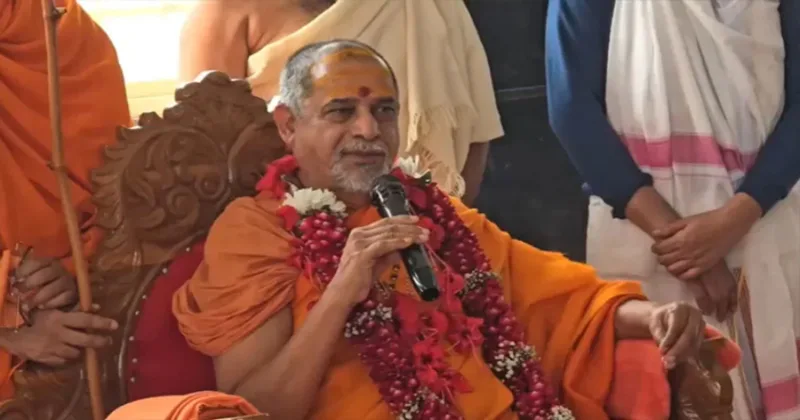
Amidst this backdrop, in a region long known as a hub for the influence of churches and Christian missionary activities, efforts are now underway to once again raise high the banner of Sanatan Dharma. Spearheading this initiative is Swami Sadanand Saraswati, the Shankaracharya of Dwarka Sharda Peeth. Far removed from silver thrones, the decorum of monasteries and traditional grandeur, he has spent months traversing the rugged trails of these tribal regions. The chant “Bhagvati Bhiksham Dehi” echoing from their lips resounds across village after village. Accepting whatever was offered as ‘Prasad’, they moved on, carrying the message of ‘Sanatan Dharma’ to the next home, the next village and the next heart. Amidst the hills and forests of Dang, a story of spiritual awakening is unfolding today. Meanwhile, inspired by this movement, the spirit of “Sanatan Dharma” is spreading from Gujarat into numerous districts across Madhya Pradesh, Maharashtra, Chhattisgarh, Jharkhand and Odisha.
वनवासी अंचलों में धर्म, संस्कार, सेवा और सामाजिक समरसता का संदेश लेकर पहुँचना केवल आध्यात्मिक अभियान नहीं, बल्कि राष्ट्रीय एकात्मता को सुदृढ़ करने का महायज्ञ है। पश्चिमाम्नाय द्वारकाशारदा पीठाधीश्वर श्रीमज्जगद्गुरु शङ्कराचार्य स्वामी श्री सदानन्द सरस्वती जी महाराजश्री। pic.twitter.com/jVR3RQ1Y2V
— rajesh kumar (@rajesh8513) July 2, 2026
Dang: A Long-Standing Arena of Ideological Contention
It is noteworthy that Gujarat’s Dang district is counted among the country’s prominent tribal regions. Characterised by dense forests, hilly terrain and remote villages, this area has long seen the active presence of various religious groups, particularly church-backed social organisations. For decades, there has been discourse regarding the work undertaken by Christian missionaries in the fields of education, health and social service; however, religious conversion, allegedly occurring under this guise, has also emerged as a major issue here. Meanwhile, Hindu organisations maintain that the region’s indigenous cultural identity must be preserved. Against this backdrop, Dang has become a focal point for significant cultural and religious discourse.
When the Shankaracharya Left the Throne to Walk the Village Paths
Typically, the image of a Shankaracharya is associated with monasteries, religious ceremonies and the preservation of Vedic traditions. However, the scene unfolding in Dang is quite different. Swami Sadanand Saraswati has been touring villages on foot for months, establishing direct dialogue with tribal families. Sitting among villagers, listening to their grievances and sharing meals in their homes are the defining features of this campaign.
#इंदौर प्रवास
मध्यप्रदेश इंदौर में श्री दत्तात्रेय प्रभु मूर्ति प्राण प्रतिष्ठा महोत्सव में आयोजित धर्मसभा में पश्चिमाम्नाय द्वारकाशारदा पीठाधीश्वर श्रीमज्जगद्गुरु #शङ्कराचार्य स्वामी श्री सदानन्द सरस्वती जी महाराजश्री के आशीर्वचन सनातन धर्मावलंबियों को प्राप्त हुए।। pic.twitter.com/tJDX7nDaNQ— Jagadguru Shankaracharya Dwarka SharadaPeetham (@DandiSwami) July 2, 2026
According to locals, the sight of the Shankaracharya himself sitting in a humble village home and sharing a meal leaves a profound impact on people’s minds. They view him, a repository of knowledge and the standard-bearer of Sanatan Dharma, as an ideal; his visits to their villages are seen as an act that sanctifies the very land.
‘Bhagvati Bhiksham Dehi’: Awakening Public Connection
The most talked-about aspect of this entire campaign is Shankaracharya’s lifestyle. During his tour, he visits villages and interacts with households in a simple manner, accepting whatever is offered to him as ‘Prasad’. He then acquaints the people with the significance of religion, culture and Indian traditions. Indeed, this approach evokes the ancient stream of the Indian ascetic tradition, wherein a saint lived among the people and provided them with guidance.
👉🏾 पहली बार मैंने देखा कि कोई शंकराचार्य सदानंद सरस्वती (द्वारकादिश मठ) अपने चांदी के सिंहासन को छोड़कर महीनों तक आदिवासी क्षेत्र में पैदल भ्रमण कर रहे हैं।
ईसाई मिशनरियों के कुचक्र को तोड़ रहे हैं आदिवासी बंधुओं को उनके मूल धर्म में वापस ला रहे हैं।गुजरात के आदिवासी जिले… pic.twitter.com/q8fgpSh8c1
— बबली R.C.Verma🚩 (@BablieVG) June 19, 2026
Taking the Message of Sanatan Dharma to Every Home
The extent of the Church’s conversion network is vast, and efforts are being made to protect the tribal community by raising awareness among them. In this context, the views of Swami Nijanand Giri, who is actively working to integrate tribal populations from Chhota Udepur and surrounding areas into the mainstream of Sanatan Dharma and foster their socio-economic development, are highly significant.
He stated, “If you travel from the Tankhaladang area of Naswadi Taluka in Chhota Udepur, Gujarat, to the remote tribal regions, you will find that representatives of the Church are everywhere, attempting to convert our tribal people through various inducements, offers of assistance and monetary temptations. They possess immense financial power and are engaged in misleading simple, trusting tribals in various ways. On the other hand, we are striving to serve these tribal brethren to the best of our ability using limited resources and the support received from the local Hindu community.”
The young ascetic Swami Nijanand Giri says, “I am a disciple of the late Padma Bhushan Swami Satyamitranand Giri Ji Maharaj, the founder of Bharat Mata Mandir in Haridwar and the former Shankaracharya. Inspired by him, I dedicated myself to serving Sanatan Dharma and working for the welfare of the Hindu community and our tribal brethren. Subsequently, I began receiving inspiration, guidance and support in this mission from Jagadguru Shankaracharya Swami Sadanand Saraswati Ji Maharaj, the head of Dwarka Sharada Peeth and I continue to receive his support to this day.”
#भगवत्पाद #आद्य #शंकराचार्य
द्वारकाशारदापीठाधीश्वर श्रीमज्जगद्गुरु शङ्कराचार्य स्वामी श्री सदानन्द सरस्वती जी महाराजश्री के करकमलों से इंदौर मध्यप्रदेश में श्री दत्त देवालय अवधूत मन्दिरम् में भगवत्पाद आद्य शंकराचार्य जी की दिव्य मूर्ति का अनावरण हुआ।#द्वारका #shankaracharya pic.twitter.com/95EKXQEihs
— Jagadguru Shankaracharya Dwarka SharadaPeetham (@DandiSwami) July 2, 2026
The Church’s deceptive door-to-door campaign: Luring families with promises of quality education, clothing and food! He said, “It is a result of this support that we are running a ‘Vidyapeeth’ for 160 children in this forest region and providing comprehensive educational facilities, along with hostel accommodation- to over 1,300 tribal children from the surrounding areas. Yet, there remains a vast number of children we ought to reach, but cannot due to our limited resources. In contrast, Christian missionary organisations, backed by local and foreign funding, manage to reach everywhere. They offer all manner of inducements, taking children from their homes under the guise of providing education, clothing and food. Consequently, despite our desire to intervene, we are often unable to do so. Eventually, many of these children grow up to return as pastors, fathers, nuns, catechists, evangelists, mother superiors, sisters, deacons and the like!”
Swami Nijanand Giri observes, “By this stage, they have become completely severed from their own religion, traditions and social systems. The sacred forests, the abodes of their deities, no longer hold any allure for them; instead, their allegiance shifts to the Vatican City. Naturally, they become uprooted from their origins. Often, the effort required to reconnect them- or keep them connected- to their roots proves futile. The only real solution is to prevent these children from falling into the hands of these missionaries and the Church in the first place. Unfortunately, that is not currently possible, and that is what saddens us.”
Shankaracharya and ‘Dharma Jagran’: A Beacon of Hope for Us
According to Nijanand Giri, a ray of hope has emerged in the form of Swami Sadanand Saraswati Maharaj, the Shankaracharya of Dwarka Sharada Peeth. Through his efforts and inspiration, people in rural areas are being introduced to various facets of Indian culture via religious rituals, ‘satsangs’, ‘kathas’ and collective events; the “Dharma Jagran” initiative is providing full support in this endeavour. Efforts to renovate temples and revive religious activities in numerous villages are currently underway with the assistance of “Dharma Jagran”, an initiative that local residents view as a cultural renaissance.
🙏जय द्वारकाधीश 🙏
पश्चिमाम्नाय द्वारकाशारदापीठाधीश्वर जगद्गुरू शंकराचार्य स्वामी श्री सदानन्द सरस्वती जी महाराज ।।
#पश्चिमाम्नाय #द्वारकाशारदापीठाधीश्वर #जगद्गुरु #शंकराचार्य #सनातन #हिंदू #धर्म #Jagadguru #Shankaracharya pic.twitter.com/bkqEEdGNk3
— Jagadguru Shankaracharya Dwarka SharadaPeetham (@DandiSwami) June 12, 2026
5,200 Villages Across 14 Districts; 8 Lakh People Converted to Christianity
When Dharmesh Mehta, the Gujarat state coordinator for “Dharma Jagran,” was consulted on this matter, he provided detailed information regarding the situation in this region of Gujarat, specifically concerning conversions linked to the Church. He states, “This region comprises 5,200 tribal villages spread across 14 districts and approximately 8 lakh people have converted to Christianity. Many of them are ‘crypto-Christians’ [individuals who practice Christianity secretly while outwardly maintaining their original identity] and their entire way of life has changed. A number of these individuals have also secured government jobs; in such a scenario, keeping the tribal community connected to its original roots is a formidable challenge.”
Dharmesh Mehta explains, “Christian missionaries are operating here through three distinct faces. The first involves priests, nuns, and pastors who directly approach tribal communities to persuade them to convert to Christianity. The second group operates by assuming a deceptive guise, much like the mythological figure ‘Putana’- approaching people under the pretexts of education, social service and healthcare to facilitate conversions. The third face of the so-called church manifests across the region as superstition; people are told that keeping a specific handkerchief in their home will bring wealth, ward off illness and ensure a happy life.”
वनवासी अंचलों में सनातन धर्म, भारतीय संस्कृति और राष्ट्रचेतना की दिव्य ज्योति प्रज्वलित करते पश्चिमाम्नाय द्वारकाशारदा पीठाधीश्वर श्रीमज्जगद्गुरु शङ्कराचार्य स्वामी श्री सदानन्द सरस्वती जी महाराजश्री का जनजाति जागरण अभियान समाज के लिए प्रेरणास्रोत है। pic.twitter.com/2pbg25rXAE
— rajesh kumar (@rajesh8513) July 2, 2026
NGOs Spreading a Web of Conversion Under the Guise of Government Services
He also highlights the role of church-backed NGOs, stating, “Many NGOs are active across these 14 districts and the majority are affiliated with the church. They facilitate access to government benefits for tribal members, handling tasks like obtaining Aadhaar cards and filling out application forms, but then leverage this to encourage them to visit the church and listen to stories about Jesus. Essentially, you can see that psychological influence and pressure are being exerted on the local tribal community from every angle to make them seek refuge in Jesus and convert to Christianity.”
He adds, “Even if a tribal individual does not openly declare their conversion to Christianity, the missionaries strive to turn them into ‘crypto-Christians’, people who practice the faith covertly. Amidst the various initiatives for religious awakening taking place here, the support received from Dwarkasharada Peethadheeshwar Jagadguru Shankaracharya Swami Sadanand Saraswati Ji Maharaj, through his ‘Dharma Yajna’, has been unprecedented. He is doing his utmost to rekindle the spirit of Sanatan Dharma in the region.”
Why is this ‘Dharma Yajna’ significant?
While the history of independent India has witnessed numerous religious pilgrimages and social campaigns, the sight of a Shankaracharya working at the grassroots level, having lived in a tribal region for an extended period, has become a subject of special fascination for the people. Many view his active presence, spanning from Dang to remote areas of Jharkhand and other states, as an effort towards cultural preservation and awakening.
दर्शन, आशीर्वाद और आध्यात्मिक प्रेरणा।
द्वारका शारदापीठाधीश्वर जगद्गुरु शंकराचार्य पूज्य स्वामी श्री सदानंद सरस्वती जी महाराज… #शंकराचार्य #shankaracharya #इंदौर #blessings #indore #TeamDJT pic.twitter.com/HMCLgPx8Po
— Deepak Jain (Tinu) (@DeepakJainTinu) July 2, 2026
In this context, one is reminded that it was once the patient waiting of Maa Shabari that inspired Bhagwan Ram to visit this very land. Today, an effort to reawaken ‘Sanatan’ consciousness is once again visible on this same soil. Amidst the chant of “Bhagvati Bhiksham Dehi” echoing through the hills of Dang, the message of ‘Sanatan’ reaching tribal settlements, the rekindling of lamps in temples, and the vision of expanding Shabari Dham, a new narrative is taking shape here. Only time will tell the extent of this campaign’s impact; however, for now, it can certainly be said that a Shankaracharya has personally traversed these rugged paths to keep the flame of ‘Sanatan’ burning bright on the land of Shabari.