A letter signed by around 60 Indian activists, academics and public figures urging Prime Minister Narendra Modi and Pakistani Prime Minister Shehbaz Sharif to resume comprehensive bilateral dialogue has triggered a political debate over its recommendations on Jammu and Kashmir.
While the document calls for restoring diplomatic engagement, people-to-people contact and trade ties, critics argue that one particular clause relating to Kashmir revives elements of the controversial India-Pakistan backchannel framework negotiated between 2004 and 2007.
What does the letter say?
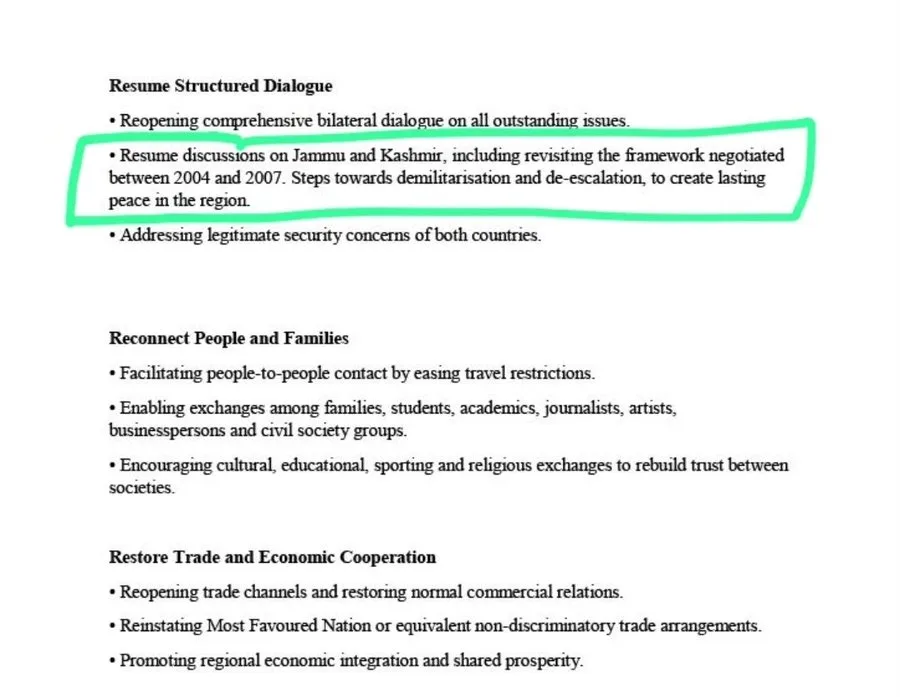
The signatories have called for the resumption of a structured bilateral dialogue between India and Pakistan covering all outstanding issues.
A key section of the document, titled “Resume Structured Dialogue,” urges both countries to:
“Resume discussions on Jammu and Kashmir, including revisiting the framework negotiated between 2004 and 2007. Steps towards demilitarisation and de-escalation, to create lasting peace in the region.”
The letter also advocates addressing the security concerns of both countries while rebuilding diplomatic channels.
Beyond Kashmir, the signatories have called for greater people-to-people engagement, including easing travel restrictions, facilitating exchanges among students, academics, journalists and civil society groups, and encouraging cultural and educational interactions.
The document further recommends restoring normal trade relations, reopening commercial channels and promoting regional economic cooperation.
Why is the Kashmir clause controversial?
The sharpest criticism has centred on the demand to revisit the 2004-07 India-Pakistan backchannel framework developed during talks between former Prime Minister Manmohan Singh and then Pakistani President Pervez Musharraf.
Although never formally signed or adopted by either government, the framework reportedly explored an alternative approach to resolving the Kashmir dispute.
Reviving discussions around this framework would reopen proposals that many believe run contrary to India’s long-standing position on Jammu and Kashmir.
What was the 2004-07 framework?
The backchannel negotiations reportedly revolved around several broad principles:
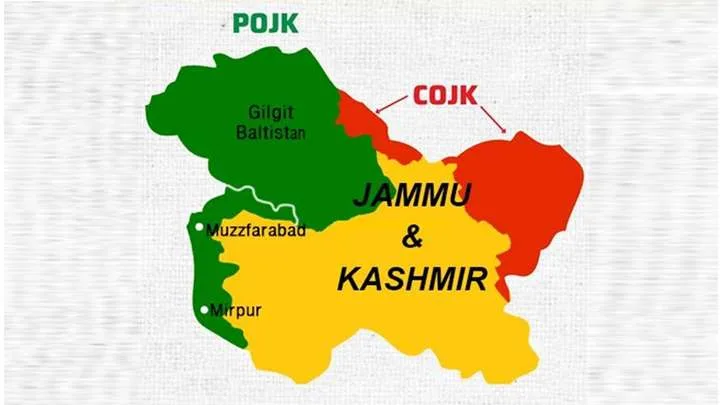
1. No Redrawing of Borders: The proposal envisaged that existing boundaries would remain unchanged, effectively treating the Line of Control (LoC) as the permanent dividing line.
Critics contend that such an arrangement would amount to accepting the status quo and abandoning India’s claim over Pakistan-occupied Kashmir (PoK), which New Delhi considers an integral part of India.
2. Self-Governance For Jammu And Kashmir: The framework reportedly discussed granting substantial self-governance to regions on both sides of the LoC.
Opponents argue that such provisions could have entrenched a special constitutional arrangement for Jammu and Kashmir indefinitely. They point out that India fundamentally altered the region’s constitutional status in August 2019 through the abrogation of Article 370 and the reorganisation of the former state into two Union Territories.
3. Joint Consultative Mechanism: Another reported feature was the creation of a consultative body comprising representatives from both sides of Kashmir.
Notably, such a mechanism could have provided Pakistan a continuing role in matters relating to Jammu and Kashmir, something New Delhi has consistently rejected. India’s official position remains that Jammu and Kashmir is an internal matter and that any issues with Pakistan relate primarily to the vacation of territories under its control.
India’s current position
India has repeatedly maintained that Jammu and Kashmir is an integral part of the country and that Pakistan’s support for cross-border terrorism remains the principal obstacle to normalisation of relations.
Since the abrogation of Article 370 in 2019, New Delhi has emphasised integration, development and security measures in the region while rejecting any third-party involvement in Kashmir-related matters.
Successive governments have also maintained that Pakistan-occupied Kashmir remains part of India and that any dialogue with Islamabad must take into account concerns relating to terrorism and security.
Notably, the call to revisit the 2004-07 framework goes beyond confidence-building measures and risks reopening proposals that they believe compromise India’s stated position on sovereignty, territorial integrity and Jammu and Kashmir.
As debate over the letter intensifies, the controversy is likely to focus less on its broader calls for peace and more on whether revisiting the Musharraf-era Kashmir framework is compatible with India’s current constitutional and strategic position.