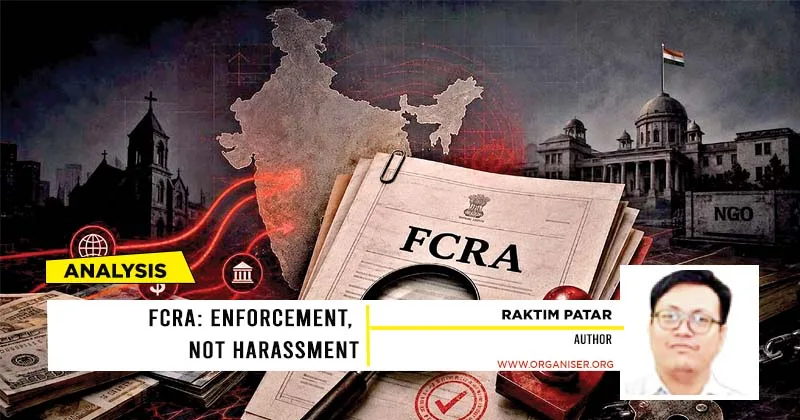
Bharat is a democracy that welcomes the world’s investment, yet one that must remain vigilant against the invisible hand of foreign interference. In no arena is this tension more acute than in the regulation of foreign contributions flowing into the country’s civil society. The Foreign Contribution (Regulation) Act (FCRA), first enacted in 1976 and substantially revamped in 2010 and 2020, is India’s legislative shield against the misuse of overseas funds. Yet, despite decades of existence, its implementation has remained inconsistent, contested, and, at times, alarmingly lax. The time for half-measures is over. FCRA must be implemented, in letter and spirit, with immediate effect.
Staggering Scale of the Problem
Numbers do not lie. Between 2019 and 2022 alone, over Rs 55,741 crore in foreign contributions were received by FCRA-registered organisations in India. In 2024–25, the figure stood at approximately Rs 20,000 crore. These are not small sums, they are resources capable of shaping public discourse, influencing electoral sentiment, funding protest movements, and swaying policy outcomes. With such enormous financial flows entering the country under the broad umbrella of “social work,” the question is not whether regulation is needed, but whether it is being applied with sufficient rigour.
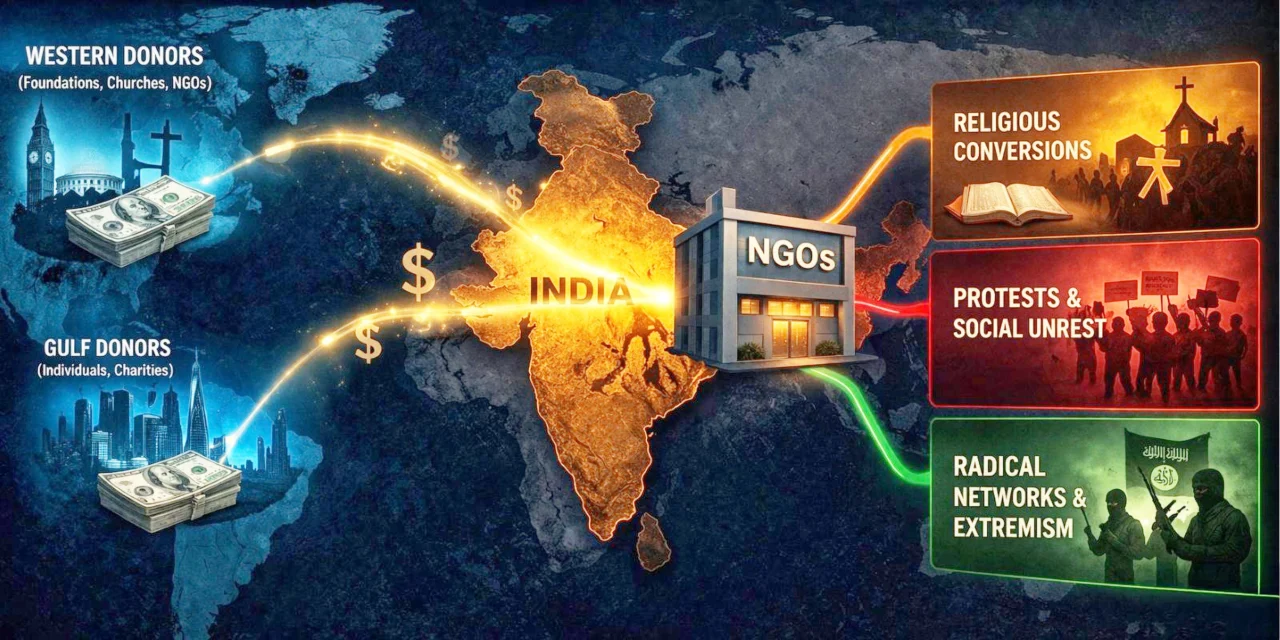
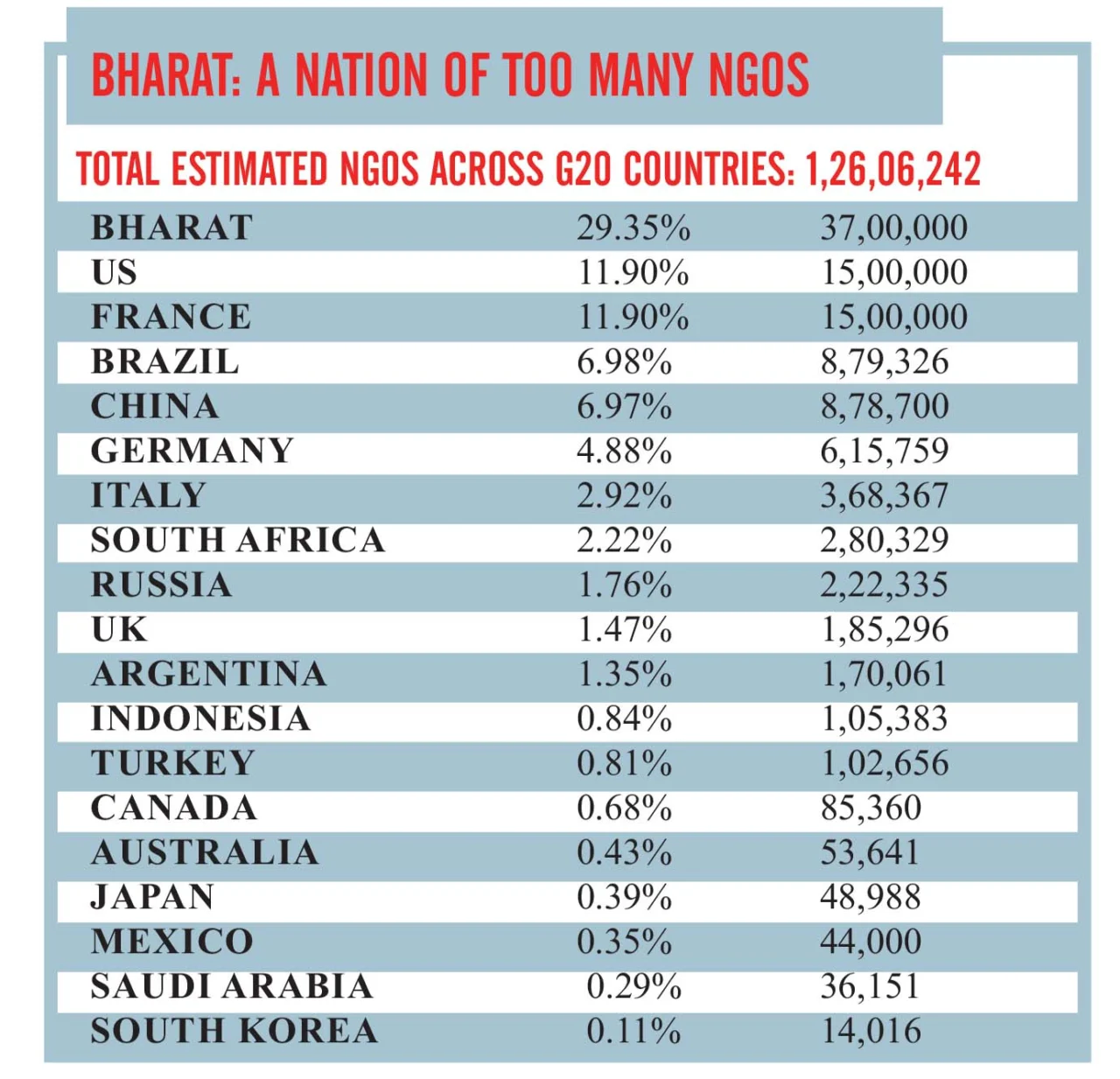
As of April 2024, over 16,242 NGOs hold valid FCRA licences. But the state of compliance paints a disturbing picture. More than 20,701 NGO licences have been cancelled since FCRA’s inception. In 2025 alone, at least 500 cancellations were reported for non-compliance. These are not bureaucratic technicalities, they represent real cases of organisations that failed to account for where foreign money went, or worse, diverted it toward purposes antithetical to national interest.
The most urgent argument for immediate and strict FCRA implementation is national security. Intelligence agencies have repeatedly flagged that foreign funds, routed through ostensibly charitable organisations, have been used to influence policy debates, fuel protests in sensitive sectors such as environment and energy, and create social unrest.
The Ministry of Home Affairs (MHA), which serves as the nodal regulator under FCRA, has noted in official assessments that intelligence inputs suggest foreign contributions were being used to affect public order, electoral politics, and national security. The role of the Intelligence Bureau (IB) in vetting FCRA applications, screening applicants for involvement in illegal, anti-national, or communally sensitive activities, underscores the state’s recognition that foreign money and national security are inextricably linked.
Concrete examples abound. Greenpeace India had its FCRA registration cancelled following allegations that it was using foreign funds to conduct campaigns against India’s energy policies and coal sector, activities that the Government determined were against national economic interest. Amnesty International India faced action for alleged violations in reporting foreign inflows and using funds for purposes beyond its permitted mandate. World Vision India came under scrutiny for alleged religious conversion activities conducted under the cover of foreign-funded development work. These are not isolated incidents — they reveal a pattern of vulnerability that an under-enforced FCRA allows to flourish.
India cannot afford to ignore the verdict of the global financial watchdog. In 2024, the Financial Action Task Force (FATF) found India only “partially compliant” on safeguards for non-profits. The FATF’s assessment is a significant red flag; it signals that India’s framework for preventing the misuse of non-profit channels for money laundering and terror financing remains inadequate by international standards. Countries on FATF grey lists face reputational damage, restricted access to global financial systems, and pressure from foreign investors. The immediate, robust implementation of FCRA is not just a domestic imperative, it is a prerequisite for India’s credibility as a responsible global financial actor.
A Step in the Right Direction
The Foreign Contribution (Regulation) Amendment Bill, 2026, introduced in the Lok Sabha on 25 March 2026, represents the government’s most ambitious attempt yet to close the loopholes that have allowed misuse to persist. The Bill proposes the creation of a Designated Authority, a specialised body empowered to manage, control, and dispose of assets created using foreign funds when an organisation’s FCRA registration is suspended, cancelled, or expires. It also broadens the definition of “key functionary” to expand individual accountability, and mandates that State governments and law enforcement agencies obtain prior Central government approval before launching FCRA-related investigations, ensuring coordinated, non-fragmented enforcement.
These provisions are not draconian. They are logical. When an organisation loses its FCRA licence, its assets, schools, hospitals, community centres, and places of worship built with foreign money, cannot simply be left in limbo or quietly transferred to entities without oversight. The Designated Authority ensures continuity of public services while preventing misappropriation. The government has been clear: only those who violate FCRA norms and engage in anti-national activities will be checked. Organisations that comply have nothing to fear.
Aligning With Global Standards
India is not alone in regulating foreign contributions to civil society. Across the world, democracies have enacted similar frameworks, the United States has the Foreign Agents Registration Act (FARA), the European Union requires transparent disclosure of foreign funding, and Australia has its Foreign Influence Transparency Scheme. Even Germany has laws requiring registration of foreign-funded political advocacy. What distinguishes India’s challenge is the sheer scale, a billion-plus population, a complex social fabric, and a geopolitical environment in which several foreign actors have demonstrable interest in influencing domestic outcomes.
Policy analysts note that stricter rules will align India with global standards and reduce the risk of foreign misuse. India’s alignment of FCRA with international anti-money laundering and counter-terror financing norms is not regulatory overreach, it is responsible governance.
Critics argue that strict FCRA implementation imposes excessive compliance costs on small NGOs doing genuine social work. This is a legitimate concern that deserves a thoughtful response, not a reason to abandon enforcement. The FCRA Amendment Rules of 2024, effective January 2025, have already moved in this direction: allowing unspent administrative expenses to be carried forward to the next financial year, clarifying TDS refund procedures, and streamlining reporting requirements. The government has demonstrated that it is capable of making targeted reforms to reduce friction for compliant organisations while tightening the noose around those who misuse the system.
Bringing Transparency
The Union Ministry of Home Affairs, under Amit Shah, have notified a number of amendments in the Foreign Contribution (Regulation) Act, tightening the noose around vague operations by non-governmental organisations (NGOs) “Every application for registration shall mention the purpose or purposes for which registration is sought, chosen only from such list of purposes as specified in the Schedule appended to these rules; and the states or Union territories in which the association proposes to undertake the activities,” reads a Gazette notification issued by the Ministry of Home Affairs on June 23 What are the new rules?
These amendments aim to enhance transparency, ensure the active utilisation of funds, and refine the eligibility criteria for foreign contributions. Under the new framework, associations are now required to align their operations with a predefined schedule of purposes, disclose ultimate donors, and adhere to stricter financial and reporting mandates
Definition of Key Functionaries: The definition has been broadened to include company directors, partners, trustees, the ‘Karta’ of a Hindu Undivided Family, and any individual exercising management control
Restriction on Foreign Nationals: Associations with foreign nationals (excluding those of Indian origin) as key functionaries will generally not be eligible for registration or prior permission, though the government retains the power to grant exceptions via official orders
Predefined Activity Schedule: Applicants must now select their area of operation and specific purposes from a “Schedule” covering religious, cultural, economic, educational, and social categories
Proselytisation Clause: While various religious activities (such as construction of religious places or conducting satsangs) are permitted, the rules explicitly exclude ‘proselytisation’ from categories like religious education, documentation of faith traditions, and preservation of indigenous beliefs
Operational Spending Requirements: To prevent inactive NGOs from holding licenses, a minimum spending limit of Rs 10 lakh of foreign contribution over the last two financial years has been introduced
Fund Utilisation & Monitoring: For NGOs under “Prior Permission,” subsequent fund installments will only be released after at least 75% of the previous installment has been utilized, subject to government field inquiry verification
Social Media: Applications must now include details of the organisation’s social media accounts
Ultimate Donor Disclosure: NGOs must disclose the original source of funds if contributions arrive via intermediary remittance vehicles or Donor Advised Funds
Detailed Reporting: Annual returns must now be accompanied by a “detailed activity report” in addition to standard financial statements
Compliance Timeline and Fees: Existing associations registered before 2026 have one year to disclose their specific purposes and states of operation to the government. Additionally, a fee of Rs 300 will be charged for every extra state or purpose added to an application.
Genuine NGOs that maintain transparent records, file timely returns, and utilise foreign contributions for their stated purpose have nothing to fear from strict FCRA implementation. As legal experts reviewing the 2025 amendments observe, increased compliance may impose a short-term burden but ultimately builds credibility, for organisations, for donors, and for the sector as a whole. The answer to compliance costs is better support for small organisations, not regulatory laxity.
Sovereignty Is Non-Negotiable
At its heart, the debate around FCRA implementation is a debate about sovereignty. Can a nation, especially one of India’s size, complexity, and geopolitical significance, afford to allow foreign money to flow unchecked into the hands of organisations that shape public opinion, mobilise communities, and influence policy? The answer, emphatically, is no.
The FCRA does not prohibit foreign contributions. It regulates them. There is a fundamental difference. India remains open to foreign philanthropy, international development assistance, and cross-border charitable giving, provided it is transparent, accountable, and directed toward genuinely social purposes. What the Act correctly guards against is the weaponisation of foreign money to undermine India’s democratic institutions, communal harmony, and ˘ national security.
As Union Home Minister Amit Shah observed at the “No Money for Terror” conference in 2022, there is a pressing need to prevent non-profit organisations from being used to propagate terror ideologies and highlighted the importance of global cooperation in combating terror financing. India’s FCRA framework, when strictly implemented, is precisely the kind of tool that enables this cooperation from within. India stands at an inflection point. Foreign contributions are rising. The methods of misuse are evolving, from straightforward fund diversion to sophisticated “pocket funding” techniques designed to evade detection. The geopolitical stakes are higher than ever. In this environment, a robust, transparent, and immediately enforced FCRA is not a luxury, it is a necessity.
Strict enforcement does not mean harassment of legitimate civil society. It means zero tolerance for those who exploit the generosity of foreign donors and the openness of India’s regulatory framework to pursue agendas inimical to the nation. It means that every rupee of foreign contribution that enters India is traceable, accounted for, and deployed for the purpose it was intended. India’s sovereignty, its democratic integrity, and its national security demand nothing less. The FCRA must be implemented, firmly, fairly, and with immediate effect. n