
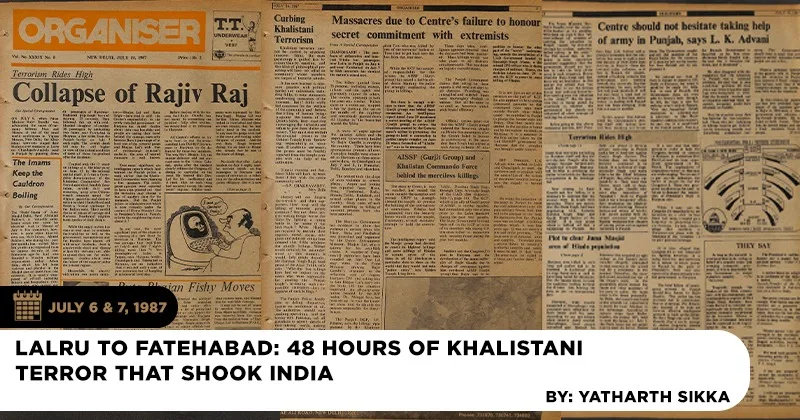
By the summer of 1987, Punjab had entered one of the darkest phases in its modern history. Nearly three years after Operation Blue Star, the state remained trapped in an unrelenting cycle of violence. President’s Rule had been imposed in May 1987 after the dismissal of the Surjit Singh Barnala Government, with the Centre promising that decisive action would restore law and order. Instead, terrorist violence escalated.
Khalistani organisations such as the Khalistan Commando Force (KCF) and factions of the All-India Sikh Students Federation (AISSF) had intensified their activities. Their targets were no longer confined to police personnel or Government officials. Increasingly, ordinary civilians, particularly Hindus became their prime targets.
The strategy was calculated. Rather than isolated assassinations, terrorist groups sought mass-casualty attacks that would spread fear far beyond Punjab. Public places, railway stations, marketplaces, buses and pilgrimage routes became potential killing grounds. The objective was not merely to eliminate individuals but to send a message, no civilian travelling through Punjab or its neighbouring states could consider himself safe.
Official claims suggested that hundreds of militants had been neutralised or arrested following President’s Rule. Yet the violence told another story. Reports from the period indicated that despite intensified security operations, terrorist killings continued to rise. Security forces failed in stopping the attacks, while intelligence agencies struggled to anticipate the methods employed by militant groups.
It was against this backdrop that July 1987 witnessed two massacres within forty-eight hours. Punjab’s Lalru and Haryana’s Fatehabad witnessed two attacks that shocked the nation.
July 6, 1987: The Lalru Bus Massacre
The evening of July 6, 1987 began like any other for dozens of bus passengers travelling along the Chandigarh-Ambala highway. Among them were families returning home, traders completing business trips, labourers, and pilgrims travelling towards Haridwar and Rishikesh. They boarded the Haryana Roadways bus but never reached their destination.
Near Lalru, close to the Punjab-Haryana border, five heavily armed Khalistani terrorists intercepted and highjacked the bus. Their act displayed planning rather than spontaneity. Travelling in another vehicle, they blocked the highway, forcing the bus to stop and within moments, the passengers realised they were not victims of a robbery.
Eyewitness accounts from the time described how the terrorists separated passengers according to their religious identity. Sikh passengers were spared, while Hindu passengers were identified and ordered aside.
What followed remains one of the most chilling episodes of the Punjab insurgency. The terrorists opened indiscriminate fire at close range. Men collapsed instantly. Elderly passengers fell beside young travellers. Pilgrims heading towards sacred shrines became victims of hatred. Several passengers died before they could even guess what had happened. Others, despite sustaining injuries, survived only by lying motionless beneath the bodies of the dead. The extremists opened fire on the passengers, killing 38 people and injuring 33 others.
The Lalru massacre represented that the attackers deliberately chose a public highway linking Punjab with neighbouring states. They targeted an ordinary passenger bus rather than a government convoy or police vehicle.
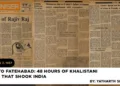
An archival report published by Organiser shortly afterwards described the massacre as part of a broader campaign intended to spread terror across Punjab and Haryana. The terrorists used automatic weapons, reportedly of Chinese origin, while selecting Haryana Roadways buses carrying pilgrims and civilian passengers.
The then Rajiv Gandhi Government had repeatedly argued that terrorism was weakening following the imposition of President’s Rule. However, Lalru suggested precisely the opposite. According to Organiser’s reporting from July 1987, public anger was directed not only against the Khalistani terrorists but also against the Government failure.
Even before the news of the Lalru Bus Massacre could reach people across the country, the terrorists struck again. Less than forty-eight hours after the attack at Lalru, another group of armed Khalistani terrorists carried out a similar massacre in neighbouring state Haryana’s Fatehabad. Once again, the victims were ordinary Hindu passengers travelling on public buses. The pattern was familiar, five young gunmen armed with automatic weapons intercepted buses on the highway, identified Hindu passengers, and opened indiscriminate fire. The back-to-back attacks made it clear that Lalru was not an isolated incident but part of a coordinated campaign of terror. The incident took the combined death toll of the two attacks to 74 in less than forty-eight hours.
Lalru to Fatehabad: The 48-hours of terror that shook the nation
Fatehabad Bus Massacre: On the evening of July 7, 1987, five-armed Khalistani terrorists travelled in a jeep hired from Hanumangarh, Rajasthan. This terror act also reflected planning. The terrorists began trailing a Firozpur–Delhi bus after it departed from Sirsa. Two of the terrorists quietly boarded the bus as ordinary passengers, while their accomplices continued following the vehicle in the jeep. About 12 kilometres before Fatehabad, the jeep suddenly overtook the bus and blocked its path.
Within seconds, three-armed men jumped from the jeep while the two terrorists travelling inside the bus took-out their weapons. The passengers found themselves trapped as the attackers immediately seized control of the bus.
The driver, Jagdish, became one of the first victims. He was shot dead while attempting to perform his duty. Bus conductor Ram Phal escaped by jumping through a window, surviving to recount the horror that unfolded.
Unlike a random shooting, one of the terrorists took the driver’s seat. The hijacked bus continued moving slowly along the road under terrorist control. As they drove the bus, the terrorists ordered frightened passengers to surrender their cash, jewellery and valuables. Roughly two kilometres ahead, near Dariyapur village, the hijackers brought the bus to a halt. Then they began firing from their automatic weapons.
The passengers had almost no opportunity to escape, some collapsed instantly, others attempted to shield their relatives. Many died where they sat. Thirty innocent Hindu passengers were killed.
After abandoning the first bus, the terrorists stopped an ambassador car, shot its driver and took the vehicle. Travelling further towards Fatehabad, they intercepted another Haryana Roadways bus bound for Sirsa.
This bus was overcrowded. Perhaps unwilling to waste time boarding it, the terrorists opened fire directly from outside. The indiscriminate firing killed several more civilians before the attackers sped away. By the end of the evening, 34 Hindu passengers had been killed across the two buses, while 18 others sustained injuries.
After that, the terrorists hijacked a truck and escaped towards the Punjab border. The abandoned truck was later recovered near Batala, stripped of its engine, tyres and several other parts.
Investigation revealed similarities between the Lalru and Fatehabad massacres. In both attacks:
- Five young gunmen carried out the terror attack
- Another vehicle was used to force the bus to stop
- Automatic rifles, reportedly of Chinese origin, were used
- Passengers were robbed before the killings
- Hindu civilians became the targets
- The attackers escaped using hijacked vehicles
The resemblance was so close that many observers believed both massacres had been executed by the same terrorist squad. According to contemporary reports, many felt that the authorities were reluctant to admit that a single terrorist group had managed to carry out two major massacres in two different states within less than forty-eight hours.
The Fatehabad massacre sent shockwaves across the country. Coming just a day after the Lalru killings, it created an atmosphere of fear and uncertainty across North India. Public anger grew rapidly, with protests and shutdowns reported in several towns and cities. Many people became afraid of travelling by road, especially through Punjab and neighbouring areas. Bus operators feared more attacks, while pilgrims and ordinary travellers began cancelling or postponing their journeys.
The killings drew strong condemnation from the country’s top leadership. President Zail Singh described the massacre as an “inhuman and ghastly” act, while Prime Minister Rajiv Gandhi called it “inhuman butchery” and said the attacks would strengthen the government’s resolve to fight extremism. Notably, the massacres had taken place only weeks after President’s Rule was imposed in Punjab with the promise of restoring law and order. Many people questioned how heavily armed terrorists could move freely between Punjab and Haryana and carry out two large-scale attacks. The July 1987 editions of Organiser described the Lalru and Fatehabad massacres as a major escalation in Khalistani terrorism.
The Forgotten Victims and an unrecognised history
The massacres at Lalru on July 6, 1987 and Fatehabad on July 7, 1987 marked one of the bloodiest forty-eight-hour periods of the Khalistani insurgency. Unlike many other major episodes of terrorist attack, Lalru and Fatehabad have never occupied a place in India’s collective historical memory.
The massacres immediately intensified the political debate over the Centre’s handling of Punjab. At an all-party meeting convened shortly after the attacks, Prime Minister Rajiv Gandhi maintained that every civilian option should be exhausted before calling in the Army. The then Home Minister Buta Singh argued that terrorism should primarily be dealt with through civilian forces and political forces than military intervention.
L.K. Advani, then president of the Bharatiya Janata Party, argued that the writ of the Indian state was no longer running effectively in Punjab. According to contemporary reports, he said the Government appeared paralysed without a consistent long-term strategy. The debate reflected a larger national concern. Could policing alone defeat increasingly organised terrorist groups, or had Punjab reached a stage where security measures had become unavoidable?
Notably, the Lalru and Fatehabad massacres goes beyond the number of people killed. These attacks represented a deliberate shift in terrorist strategy. Instead of targeting police officers or political leaders, the terrorists chose civilians. In the eyes of the terrorists, their only identity was that they were Hindus.
Despite the size of terror attack, the victims of the Lalru and Fatehabad massacres occupy no space in India’s public historical record. There is no official record of Hindu victims who died in attacks such as Lalru, Fatehabad, Moga and many other massacres during the Punjab insurgency.
According to figures compiled from Supreme Court proceedings and data assembled by former Punjab Director General of Police K.P.S. Gill, between 3,817 and 4,500 Hindus were killed during the peak years of militancy. However, significantly higher figures have also been cited in political discourse. Former Punjab Chief Minister Captain Amarinder Singh has referred to estimates of as many as 35,000+ Hindus killed.
The unfortunate story of Lalru and Fatehabad is not merely about two massacres that took place a day apart. It represents a larger chapter in India’s struggle against terrorism in 1980’s.