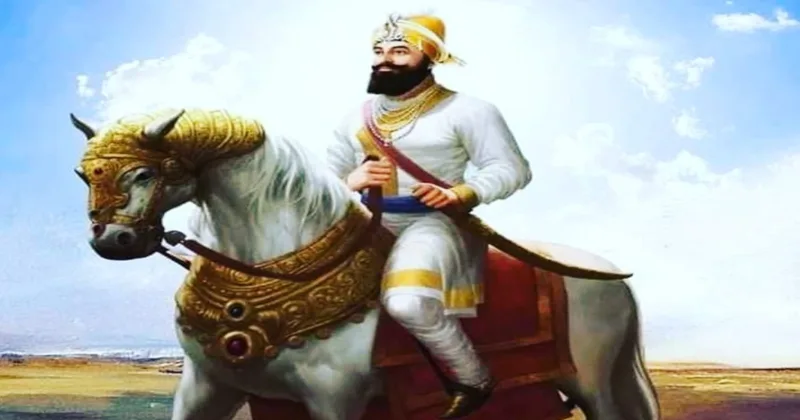
Guru Hargobind Ji (1595–1644), the sixth Guru of Ten Guru Tradition, occupies a pivotal position in the history of Punjab. His leadership transformed the community from a purely spiritual fellowship into a spiritually grounded yet militarily prepared society capable of defending justice, religious freedom, and human dignity. While his predecessors emphasized devotion, equality, and social reform, Guru Hargobind Ji expanded these ideals by introducing the concept of righteous resistance against oppression. His most significant contribution was the doctrine of Miri-Piri, symbolized by two swords representing temporal authority (Miri) and spiritual authority (Piri). This philosophy established that spirituality and responsible participation in worldly affairs are inseparable. Through this vision, Guru Hargobind Ji laid the ideological foundation that would later culminate in the formation of the Khalsa by Guru Gobind Singh Ji.
Early Life and Family Background
Guru Hargobind Ji was born on 19 June 1595 at Guru Ki Wadali to Guru Arjan Dev Ji and Mata Ganga. His birth fulfilled the prayers of the entire Nanak naam leva community, and from an early age he displayed remarkable intelligence, courage, humility, and leadership.
His childhood education combined spiritual instruction with physical training. Alongside studying Bharat’s scriptures and philosophy, he learned horse riding, wrestling, swordsmanship, and archery. This balanced education reflected the ideology that intellectual wisdom and physical strength complement one another. The influence of Baba Buddha Ji, one of the earliest and most respected Sikhs, proved particularly significant in shaping his character and preparing him for future leadership.
Ascension as the Sixth Guru
The martyrdom of Guru Arjan Dev Ji in 1606 marked a watershed in Punjab’s history. Ordered by the Mughal Emperor Jahangir, Guru Arjan Dev Ji was subjected to severe torture and attained martyrdom rather than compromise his principles or faith.
Following this event, Guru Hargobind Ji became the sixth Guru at the age of eleven. During the investiture ceremony, Baba Buddha Ji placed two swords upon the young Guru instead of one. Guru Hargobind Ji declared that these represented Miri and Piri, signifying the harmonious union of spiritual wisdom and temporal responsibility. This marked the beginning of a new era in Sikh history, where the defense of righteousness became an integral aspect of religious duty.
The Philosophy of Miri-Piri
The doctrine of Miri-Piri remains one of Guru Hargobind Ji’s greatest contributions. Piri symbolizes spiritual authority, emphasizing devotion to God, ethical conduct, humility, compassion, and meditation. Miri represents temporal authority, encouraging individuals to participate actively in society, protect justice, defend the oppressed, and resist tyranny. Guru Hargobind Ji rejected the notion that spirituality required withdrawal from worldly affairs. Instead, he taught that genuine spirituality inspires moral courage and social responsibility. The Sikh ideal of the Saint-Soldier (Sant-Sipahi) emerged directly from this philosophy. A Sant-Sipahi is spiritually disciplined while remaining physically prepared to defend righteousness whenever necessary.
Construction of the Akal Takht
One of Guru Hargobind Ji’s most enduring achievements was the establishment of the Akal Takht in 1606 opposite the Harmandir Sahib. While Harmandir Sahib symbolizes spiritual enlightenment, the Akal Takht represents justice, governance, and temporal authority.
From the Akal Takht, Guru Hargobind Ji addressed social, political, and military matters affecting the Sikh community. The institution became the highest seat of temporal authority in Sikhism and continues to play a vital role in Sikh religious and community affairs. This dual institutional structure beautifully reflects the balance between spirituality and worldly responsibility.
Formation of the Sikh Military
Recognizing the growing persecution under Mughal rule, Guru Hargobind Ji organized the entire community for self-defense. He encouraged Punjabis to: Learn martial arts, Ride horses, Practice archery, Master swordsmanship, Maintain physical fitness, Acquire arms for defensive purposes. Importantly, Guru Hargobind Ji emphasized that weapons should never be used for aggression or personal gain. Their purpose was solely to protect justice, defend the innocent, and preserve religious freedom. He maintained a standing force of trained soldiers while continuing to guide the community spiritually through prayer and ethical teachings.
Imprisonment at Gwalior Fort
Guru Hargobind Ji’s growing influence aroused suspicion within the Mughal administration. Emperor Jahangir ordered his detention at Gwalior Fort. Historical traditions differ regarding the duration of his imprisonment, but all agree that during this period Guru Hargobind Ji earned the admiration of numerous imprisoned Hindu princes. When Jahangir eventually ordered his release, Guru Hargobind Ji refused to leave unless the imprisoned princes were also freed.
According to Folklore, fifty-two kings were released alongside him after they held onto the specially designed robe worn by the Guru. This remarkable event earned him the title Bandi Chhor, meaning “Liberator of Prisoners.” The occasion continues to be commemorated annually as Bandi Chhor Divas, symbolizing freedom, compassion, justice, and moral leadership.
Battles Fought by Guru Hargobind Ji
Contrary to popular misconception, Guru Hargobind Ji did not seek warfare. However, when peaceful coexistence became impossible due to repeated aggression, he defended the society. Among the significant battles associated with his leadership are:
The Battle of Amritsar, The Battle of Rohilla, The Battle of Mehraj, The Battle of Kartarpur
These conflicts demonstrated that resistance against injustice could coexist with deep spirituality and ethical discipline. Guru Hargobind Ji instructed his followers to avoid harming civilians and to fight only when every peaceful option had failed.
Religious Tolerance and Universal Brotherhood
Although remembered as a military leader, Guru Hargobind Ji consistently promoted interfaith harmony. He respected people of all religious traditions and welcomed dialogue with Hindus, Muslims, and others. His military preparations were never directed against any religion but against oppression and injustice. He upheld the principle of Guru Tradition, that every individual possesses equal dignity regardless of caste, creed, ethnicity, or social status.
Teachings and Contemporary Relevance
His teachings remain relevant in the twenty-first century. Miri-Piri encourages ethical leadership in public institutions; the Sant-Sipahi ideal promotes courage with compassion; seva inspires volunteerism; equality challenges discrimination; and religious freedom supports pluralistic democracies. His message also encourages youth to cultivate physical fitness, intellectual excellence, and moral integrity while rejecting hatred and violence.
Critical Analysis
Modern scholarship interprets Guru Hargobind Ji’s military preparations as defensive rather than expansionist. His philosophy integrates spirituality with civic ethics and has influenced discussions on human rights, responsible leadership, and resistance to oppression. Contemporary educators may draw upon his life to teach value education, constitutional ethics, and social responsibility.
Conclusion
Guru Hargobind Ji transformed the Indian history by harmonizing contemplation with action. His teachings demonstrate that authentic spirituality demands justice, service, humility, and courage. Their relevance extends beyond Sikh history to contemporary debates on ethical governance, communal harmony, and responsible citizenship.