
“The nineteenth century had witnessed the birth of several spirited men in different corners of India. Swami Vivekananda was the greatest among them. The message of the Swami still resonates in the Indian hearts. Only in his chalked out path India can achieve absolute national rejuvenation” – Dr Syama Prasad Mookerjee, as quoted by Sankari Prasad Basu in his Bengali work Vivekananda o Samakalin Bhartbarsha, Mandal Book House, Vol. 7, pp. 252–253
West Bengal is getting national attention beyond political developments. June 20 has been commemorated, and from 2026 onwards it will be celebrated as ‘Paschimbanga Divas’, or West Bengal Day. On the same day, the Kolkata Municipal Corporation notified that Suharwardy Avenue, a key crossing in Kolkata, has been renamed as Gopal Mukherjee Road. Both these decisions sparked a national debate over history and the spirit of Bengal. When we will remember Swami Vivekananda on Samadhi Divas on July 4, what does his legacy teach us, and whether these decisions are contrary to what they preached and practised is worth exploring.
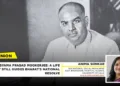
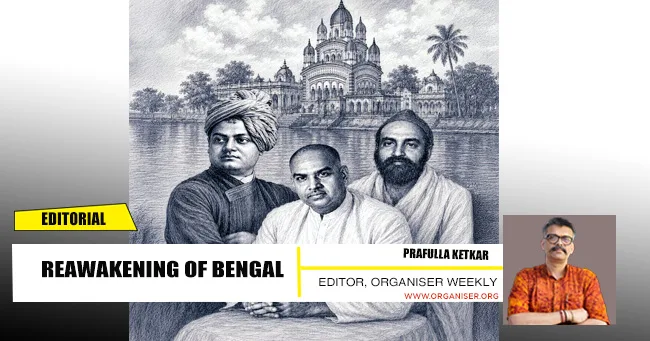
After the glorious struggle to nullify the partition of Bengal on religious lines from 1905-11 with the slogan of Vande Mataram, accepting the line of division in 1947 was a painful and bloody affair. Dr Syama Prasad Mookerjee, the architect of this partition, was both logical and emotional in this endeavour. As a strong follower of Swami Vivekananda’s vision for Bharat, that is spiritually vibrant, materially prosperous, and religiously accommodating, Dr Mookerjee opposed the idea of partitioning the Motherland. However, once the idea of Pakistan was accepted by Congress buckling under the violent pressure of the Muslim League, he realised that sacrificing entire Bengal to the Islamist idea of state was fatal to the legacy of Chaitanya Mahaprabhu, Ramakrishna Paramhans, Swami Vivekananda, Gurudev Rabindranath Thakur and Sri Aurobindo. As experienced after the waves of atrocities in East Pakistan and later Bangladesh, Hindus of Bengal would not have any option but to forcefully get converted or butchered, in a united Bengal without the spirit of Bengal. To save that spirit, Hindus had to be saved and to save the Hindus; West Bengal had to be created. Commemorating June 20 as the foundation of West Bengal is a remembrance of that historic struggle under the leadership of Dr Mookerjee, which has been systematically diluted over the last eight decades.
Gopal Mukherjee, – popularly known as Gopal Patha, also represents the same legacy. He built the army of youth to save loot, rapes and murders during the riots. He was made a villain by the Congress-supported Communist distortionists, while the crimes of Suharwardy and his family were conveniently whitewashed. After whom or for what do we name roads and places? As a common understanding goes – to commemorate the inspirational memory of a person, a historical incident, or a thought. Can Suharawardy Avenue be that inspiration? Communists have mastered an art – confuse when you can’t convince. Whether Hassan or Hussain, Suharwardy’s name is associated with the Islamist brutalities and the idea of Pakistan propagated by the Muslim League. Even if the street was not named after the executor of a mass murderer of Hindus during the August 1946 genocide, his uncle was part of the same league. Why do we need an Avenue in the name of a family that was associated with the partition of our Motherland and worked as British agents to target the revolutionaries? On the contrary, Gopal Patha developed a defensive mechanism against the brutality, saved thousands of lives, and eventually protected the true spirit of Bengal. Remembering him can inspire youth to stand up for the honour of women, rather than disrobing them.
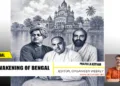
Bengal during the freedom struggle was not just a geographical or linguistic region, but symbolised the pulsating cultural and intellectual heart of a resurgent Bharat. Dr Mookerjee and Gopal Patha fought vehemently to save that spirit. None of them was exclusionary in thought. In fact, they believed in an inclusive civilisation, and this resonated with the preaching of Guru Ramakrishna Paramhans, which taught Joto mot, toto path, meaning ‘As many faiths, so many paths’. When this civilisational philosophy was perceived as a weakness and targeted by monotheist, exclusionary forces, Bengal produced armed revolutionaries to defend it. Protecting Dharma from Adharma is also an act of Dharma. Bengal is reawakening to its real Dharma by recognising the contributions of Dr Syama Prasad Mookerjee and Gopal Patha, and it is perfectly in tune with Swami Vivekananda’s legacy.