Every year, the sacred city of Puri witnesses one of the most magnificent and spiritually uplifting festivals in the Jagannath tradition—Snana Yatra, also known as Deva Snana Purnima, Snana Purnima or Snana Jatra. Celebrated on the full moon day (Purnima) of the Hindu month of Jyeshtha, the festival marks the ceremonial public bathing of Mahaprabhu Jagannath, Mahaprabhu Balabhadra, Goddess Subhadra, and Sudarshana Chakra. In 2026, Snana Yatra falls on June 29, approximately fifteen days before the world-renowned Rath Yatra, making it the ceremonial beginning of the annual chariot festival.
More than a religious observance, Snana Yatra is a profound expression of devotion, symbolism, ritual and cultural continuity. It is the first occasion each year when the deities emerge from the sanctum sanctorum of the Shree Jagannath Temple to offer public darshan from the Snana Mandap, allowing lakhs of devotees to witness the divine siblings before they enter a period of ceremonial seclusion. For pilgrims, witnessing Snana Yatra is regarded as an act of immense spiritual merit, while for scholars and cultural enthusiasts, the festival reflects centuries of living tradition that continue to define the religious identity of Odisha.
Religious significance of snana yatra
According to the Skanda Purana, Snana Yatra commemorates the divine appearance day of Mahaprabhu Jagannath. It is believed that on this auspicious day the Mahaprabhu grants His first public audience of the year outside the sanctum, making the occasion one of extraordinary spiritual significance.
The festival embodies the principles of purification, renewal, humility and divine compassion. Unlike many temple rituals confined to the sanctum, Snana Yatra brings the deities into the open, symbolising the Mahaprabhu’s willingness to bless all devotees without distinction. This openness has contributed to the festival’s universal appeal, attracting pilgrims from across India and visitors from around the world.
Snana Yatra also inaugurates the sacred sequence of rituals culminating in Rath Yatra. The ceremonial bathing, the subsequent Anasara period, the Netrotsav or Nava Jaubana Darshan, and finally the Chariot Festival together form one continuous spiritual journey that celebrates the intimate relationship between the Mahaprabhu and His devotees.
The grand Pahandi procession
The day’s rituals begin before dawn with Mangala Arati, followed by Dwaralagi and Pushpanjali. As the first rays of sunlight illuminate the temple complex, the atmosphere resonates with Vedic chants, the rhythmic beating of traditional drums, the blowing of conch shells and devotional kirtans.
The highlight of the morning is the Pahandi Bije, the ceremonial procession in which Mahaprabhu Jagannath, Mahaprabhu Balabhadra, Goddess Subhadra and Sudarshana Chakra are carried from the Ratna Singhasana inside the sanctum to the Snana Mandap. The deities sway rhythmically as they are carried by temple servitors in a unique movement characteristic of Jagannath tradition.
The procession is accompanied by thousands of devotees chanting “Jai Jagannath,” creating an atmosphere charged with devotion and celebration. For many pilgrims, witnessing the Pahandi is among the most emotionally moving moments of the festival, symbolising the Mahaprabhu stepping out to meet His devotees.
The sacred bathing ceremony
Once the deities are seated on the Snana Mandap, the ceremonial bathing begins with elaborate Vedic rituals performed by designated temple servitors.
The deities are bathed with 108 pitchers of sanctified water drawn from the sacred Suna Kua (Golden Well) located inside the temple complex. The water is ritually purified and infused with sandalwood, aromatic herbs, flowers and other sacred ingredients before being offered to the deities.
Every aspect of the bathing ceremony follows traditions that have been preserved for centuries. The number 108 holds profound spiritual significance in Hindu philosophy, representing completeness and cosmic harmony. The ritual therefore symbolises not merely physical purification but the renewal of divine energy before the commencement of the annual Rath Yatra season.
As the sacred water flows over the deities, devotees witness one of the most visually striking ceremonies in the Jagannath tradition. The Snana Mandap becomes the focal point of devotion as thousands gather to receive darshan of the Mahaprabhu in this rare public ceremony.
The divine mystery of Anasara
One of the most distinctive aspects of Snana Yatra is what follows the bathing ritual.
Temple tradition holds that after receiving the ceremonial bath with 108 pitchers of cool water, the deities develop a divine fever. Consequently, Mahaprabhu Jagannath, Mahaprabhu Balabhadra, Goddess Subhadra and Sudarshana Chakra withdraw from public view for approximately fifteen days in a period known as Anasara or Anavasara.
During this time, the temple’s sanctum remains closed to devotees.
The deities are shifted to the Anasara Pindi, often described as the Mahaprabhu’s “sick chamber,” where they receive traditional Ayurvedic treatment from designated temple servitors. Herbal medicines, medicinal preparations and specially prepared foods are ceremonially offered to restore their health according to age-old customs.
While this practice may appear symbolic, it reflects one of the most endearing aspects of Jagannath culture—the Mahaprabhu is worshipped not as an abstract deity but as a living divine being who experiences human emotions, illness, rest and recovery.
For devotees, Anasara represents a profound lesson in devotion through separation. Deprived of the Mahaprabhu’s darshan for fifteen days, they experience spiritual longing that culminates in immense joy during Netrotsav or Nava Jaubana Darshan, when the rejuvenated deities reappear shortly before Rath Yatra.
The splendour of Hati Besha
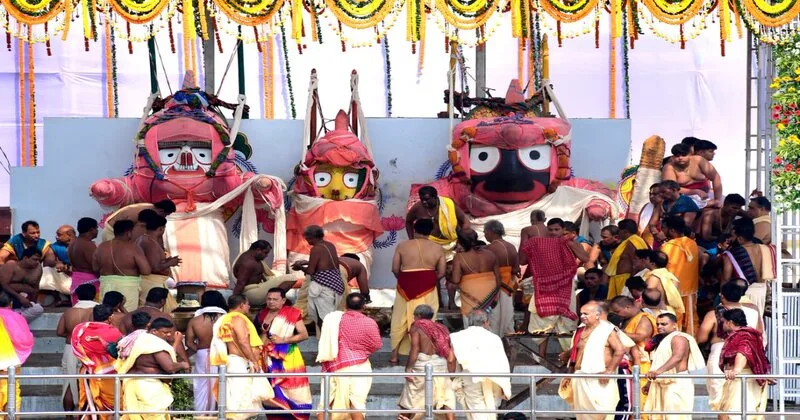
Following the ceremonial bath, Mahaprabhu Jagannath and Mahaprabhu Balabhadra appear in one of the most celebrated adornments of the Jagannath tradition—the Hati Besha, also known as Gaja Besha or Gajanana Besha.
In this unique attire, the sibling deities are dressed to resemble Mahaprabhu Ganesha. Mahaprabhu Jagannath and Mahaprabhu Balabhadra wear magnificent elephant-faced decorations, while Goddess Subhadra appears in an elegant lotus flower adornment.
The Hati Besha is not merely decorative. It reflects the deeply rooted Hindu tradition of invoking Mahaprabhu Ganesha before the commencement of every auspicious undertaking. Since Snana Yatra marks the beginning of the Rath Yatra rituals, the elephant attire symbolically invokes the blessings of Ganesha for the successful completion of the sacred festivities.
The colourful appearance of the deities in Hati Besha draws lakhs of devotees to Puri every year, making it one of the most photographed and cherished moments in the annual temple calendar.
The legend of Ganapati Bhatta
The origin of Hati Besha is closely associated with the famous legend of Pandit Ganapati Bhatta, a devoted worshipper of Prabhu Ganesha who visited Puri during the fifteenth century.
Deeply devoted to Ganesha, Ganapati Bhatta desired to see Mahaprabhu Jagannath in the elephant-headed form of his chosen deity. Initially disappointed after witnessing the deities on the Snana Mandap, he prepared to leave the temple.
According to temple tradition, Mahaprabhu Jagannath, disguised as a temple priest, persuaded him to return for another darshan. When Ganapati Bhatta re-entered the Snana Mandap, he witnessed the extraordinary sight of Mahaprabhu Jagannath and Mahaprabhu Balabhadra manifesting in the form of Prabhu Ganesha.
Overwhelmed with devotion, he realised that the Supreme Mahaprabhu responds to sincere faith in whatever form His devotees seek Him.
Another version of the legend narrates that Ganapati Bhatta was invited by the King of Puri to witness Snana Yatra. Though reluctant because of his exclusive devotion to Ganesha, he eventually attended and experienced the same divine vision. Since then, the annual Hati Besha has remained an inseparable part of Snana Yatra, symbolising the universal and compassionate nature of Mahaprabhu Jagannath.
Puri ready for the grand celebration
As Deba Snana Purnima 2026 approaches, the holy city of Puri has entered the final phase of preparations for one of the most significant festivals in the Jagannath tradition. Anticipating the arrival of several lakh devotees from across India and abroad, the Shree Jagannath Temple Administration (SJTA), in coordination with the district administration and Odisha Police, has implemented extensive arrangements to ensure the smooth conduct of rituals, efficient crowd management, and comprehensive security.
Snana Yatra is regarded as the ceremonial beginning of the annual Rath Yatra. On this sacred occasion, Mahaprabhu Jagannath, Mahaprabhu Balabhadra, Goddess Subhadra and Sudarshana Chakra leave the sanctum sanctorum of the Shree Jagannath Temple and proceed to the Snana Mandap, where they receive the ceremonial holy bath before appearing before devotees in the magnificent Hati Besha. The festival is not merely a religious event but a remarkable demonstration of centuries-old temple traditions, administrative planning and collective devotion.
Comprehensive administrative review
Ahead of the festival, the Shree Jagannath Temple Administration convened a high-level coordination meeting involving senior officials from the temple administration, district administration, magistracy and Odisha Police. The meeting reviewed every aspect of the festival, including ritual management, security deployment, crowd regulation, emergency preparedness, traffic arrangements, sanitation and public convenience.
SJTA Chief Administrator Dr. Arabinda Kumar Padhee, accompanied by senior officials, conducted an extensive inspection of the temple premises, the Snana Mandap, Bada Danda (Grand Road), security installations and crowd-control infrastructure.
Addressing the media after the review, Dr. Padhee stated that the foremost priority of the administration was to ensure that every ritual is performed strictly according to the traditional timetable approved by the Niti Sub-Committee, Chhatisa Nijog, and the temple’s Managing Committee.
He emphasised that continuous coordination has been maintained with all categories of temple servitors whose cooperation is essential for the successful conduct of the festival. Expressing confidence in the preparedness, Dr. Padhee said that by the grace of Mahaprabhu Jagannath, every ritual and administrative arrangement would be executed smoothly in accordance with established temple traditions.
Detailed ritual schedule
The administration has finalised a carefully planned ritual schedule to ensure the timely completion of every ceremonial observance. The day will commence with Mangala Arati at 4:30 AM, followed by Dwaralagi and Pushpanjali rituals.
The much-awaited Pahandi Bije procession will begin at 5:00 AM, during which the sibling deities will be ceremonially carried from the Ratna Singhasana inside the sanctum to the Snana Mandap amidst devotional chants, traditional music, conch shells and temple bells.
After the completion of the procession, Mangala Arati will again be performed at the Snana Mandap at 9:00 AM. The principal bathing ceremony, known as Jala Bije, will take place between 12:00 noon and 2:00 PM, during which the deities will be ceremonially bathed with 108 pitchers of fragrant sanctified water drawn from the sacred Suna Kua inside the temple.
Following the traditional Chera Pahanra ritual at approximately 3:30 PM, the deities will be adorned in the iconic Hati Besha between 4:00 PM and 5:00 PM. The revered Sahana Mela, allowing devotees close public darshan of the deities, will be held between 7:30 PM and 9:30 PM
The Hati Besha will be ceremonially removed at 10:00 PM, following which the deities will return to the sanctum during the Bahuda Pahandi, scheduled to commence at 11:00 PM
Special darshan arrangements
Considering the expected influx of pilgrims, the administration has introduced special arrangements to facilitate orderly darshan while ensuring the uninterrupted performance of temple rituals. General devotees will be permitted to enter the temple only through the Singhadwara (Lion’s Gate). After offering prayers and having darshan at the Snana Mandap, they will exit through the remaining three gates of the temple complex.
Devotees possessing special Pahandi tickets will be allowed entry exclusively through the Dakshina Dwara (Southern Gate). Approximately 1,500 to 2,000 tickets will be issued, with a maximum limit of two tickets per individual.
General darshan inside the temple will remain suspended until around 2:00 p.m. to facilitate the uninterrupted conduct of rituals. Once the ceremonies are completed, the temple administration will announce the reopening of darshan.
Thereafter, devotees will be allowed Bahara Katha Darshan until 7:00 p.m., while limited relaxations will be provided for members of servitor families in accordance with long-established temple traditions.
To enhance visibility, devotees will also be able to witness the deities from the specially constructed elevated viewing platform near the Snana Mandap. Portions of the temporary sheds erected over barricades near the Singhadwara and along the Grand Road will be removed, enabling pilgrims standing on Bada Danda to obtain an unobstructed view of the sacred ceremonies.
Extensive security measures
With lakhs of devotees expected to gather in Puri, Odisha Police have implemented one of the most comprehensive security plans for the festival. The city has been divided into multiple operational sectors covering the temple premises, surrounding areas, traffic regulation, crowd management and emergency response.
According to Central Range Inspector General Satyajit Naik, as many as 79 platoons of police personnel will be deployed during the festival. The security deployment will be supervised by 15 officers of Superintendent of Police and Commandant rank, assisted by 30 Deputy Superintendents of Police and nearly 340 Sub-Inspectors and Assistant Sub-Inspectors.
Close to 200 CCTV cameras have been installed across the city for continuous surveillance. The security strategy also includes rooftop deployment of police personnel, plainclothes officers, anti-sabotage teams, traffic regulation units and round-the-clock monitoring through a central control room.
Special emphasis has been placed on ensuring that devotees receive a clear view of the deities during the Pahandi procession while preventing physical contact with the deities, thereby preserving both security and temple traditions.
Temple servitors complete ritual preparations
Temple servitors have confirmed that preparations for the festival have been completed in accordance with centuries-old traditions. The Basunga Pata, a special ceremonial cloth required for decorating the deities during the Hati Besha, has already arrived from Athagarh, while artisans have completed the preparation of the elaborate elephant attire.
Senior servitor Hajuri Krushna Chandra Khuntia said that every category of servitor is fully committed to ensuring that the rituals are conducted with discipline and devotion.
He noted that Mahaprabhu Jagannath would bless devotees in the rare Gajanana Besha, adding that devotees would not be permitted to remain directly in front of the Snana Mandap during the rituals in order to ensure both security and the orderly completion of the ceremonies.
The beginning of the Anasara Period
The conclusion of Snana Yatra marks the beginning of another unique chapter in the Jagannath tradition—the Anasara period.
Temple belief holds that after the elaborate ceremonial bath with 108 pitchers of sacred water, the deities develop a divine fever. They are therefore taken to the Anasara Pindi, where they remain away from public view for approximately fifteen days.
During this period, temple servitors administer traditional herbal medicines and specially prepared restorative foods as part of an ancient ritual of healing. Devotees experience a symbolic period of separation from the Mahaprabhu, deepening their spiritual longing until the deities reappear during Netrotsav (Nava Jaubana Darshan) on the eve of Rath Yatra.
A living heritage of faith and devotion
Snana Yatra is far more than a ceremonial bathing festival. It is a living expression of spiritual heritage, preserving rituals, craftsmanship, music, temple traditions and devotional practices that have evolved over centuries.
The festival beautifully illustrates the unique philosophy of Jagannath culture, where the Supreme Mahaprabhu is worshipped as a living deity who shares the emotions and experiences of humanity—emerging before devotees, accepting ceremonial bathing, falling ill, recovering through traditional care and finally embarking on the grand chariot journey during Rath Yatra.
As the holy city prepares to welcome devotees from across the world on 29 June 2026, Snana Yatra once again reaffirms the timeless bond between Mahaprabhu Jagannath and His devotees. From the sacred Pahandi procession and ceremonial bathing to the majestic Hati Besha, the solemn Anasara period and the anticipation of Rath Yatra, every ritual reflects an unbroken tradition of faith, devotion and cultural continuity. More than a festival, Snana Yatra is a celebration of divine compassion, universal spirituality and the enduring legacy of Mahaprabhu Jagannath, whose message of inclusiveness and grace continues to inspire millions across generations.