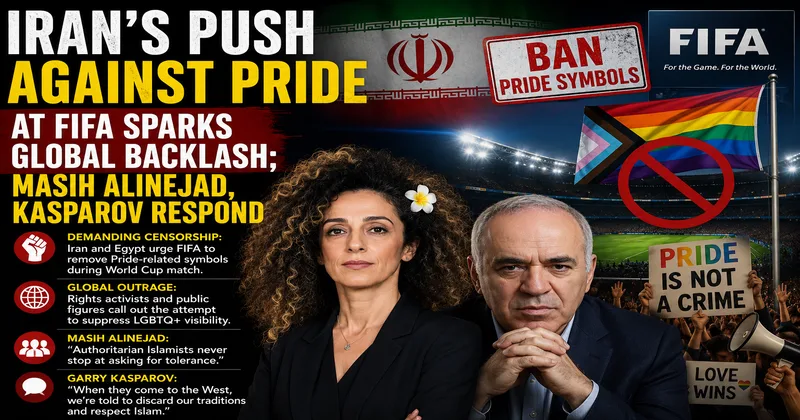
Iranian women’s rights activist Masih Alinejad and chess grandmaster Garry Kasparov have sharply criticized efforts by Iran and Egypt to pressure FIFA into removing Pride-related symbols during a World Cup match in Seattle, framing it as part of a broader pattern of Islamist authoritarianism seeking to impose its values on host societies.
Wow, now Iran’s regime and Egypt have objected to Seattle’s Pride Match and urged FIFA to remove Pride-related symbols.
This is exactly what I’ve been warning about: authoritarian Islamists never stop at asking for tolerance.
First: “Respect our religious practices. Respect our…
— Masih Alinejad 🏳️ (@AlinejadMasih) June 26, 2026
In a widely viewed post, Alinejad warned that such objections represent a familiar escalation: initial calls for “respect” of religious practices quickly evolve into demands that free societies suppress their own traditions, symbols, and freedoms.
“Authoritarian Islamists never stop at asking for tolerance,” she stated, highlighting how regimes that enforce harsh punishments, (including lashes for women singing, executions of gay individuals, and violence against protesters,) expect Western nations to self-censor.
🎯 And when Westerners travel to repressive Islamic countries, they’re told to respect Islamic traditions. When representatives from these nations come to the West, Westerners are told to discard their traditions and freedoms and respect Islam. https://t.co/CWIETNWnr0
— Garry Kasparov (@Kasparov63) June 26, 2026
Kasparov echoed this in his retweet, marking a “Bulls eye” emoticon while pointing out the asymmetry: “When Westerners travel to repressive Islamic countries, they’re told to respect Islamic traditions. When representatives from these nations come to the West, Westerners are told to discard their traditions and freedoms and respect Islam.”
Speaking on a TV show Jake Tapper of CNN, Alinejad later in the day urged her followers to watch her speak on TV show host Jake Tapper’s interview of her on CNN “o see why the regime is now asking America to respect Islamic values on American soil.”
When you Westerners visit Iran, the Islamic regime say: “Our country, our rules.” Wear the hijab. Cover your hair. No handshakes.
But when they come to the West, somehow it’s still their rules. Cover the nude statues. Hide the wine. Tone down your traditions. Don’t offend Islam.… pic.twitter.com/RlIY76ek7Y
— Masih Alinejad 🏳️ (@AlinejadMasih) June 27, 2026
She writes: “When you westerners visit Iran, the Islamic regime say: “Our country, our rules.” Wear the hijab. Cover your hair. No handshakes.
But when they come to the West, somehow it’s still their rules. Cover the nude statues. Hide the wine. Tone down your traditions. Don’t offend Islam, she pointed out.
A Pattern of Cultural Imposition and Demographic Shift
Alinejad’s critique aligns with observable historical patterns.
Many regions now predominantly Muslim were once Christian-majority or hosted thriving non-Islamic civilizations.
Turkey (formerly Anatolia, a cradle of early Christianity), Egypt (with its ancient Coptic Christian heritage), Syria, and Lebanon underwent profound transformations following Islamic conquests and subsequent social, legal, and demographic pressures over centuries.
Indigenous Christian populations declined dramatically through conversion, dhimmi status restrictions, emigration, and conflict.
Indonesia, today the world’s largest Muslim-majority nation, saw Islam spread from earlier Hindu-Buddhist and animist traditions primarily via trade but consolidated dominance over time.
Critics argue this reflects a supremacist dynamic where Islamic doctrine and practices expand, often marginalizing or replacing prior cultures rather than coexisting equally.
In modern contexts, this manifests as demands for accommodation in the West (ranging from prayer rooms and halal mandates to restrictions on free speech and cultural displays) coupled with accusations of “Islamophobia” against any resistance.
Personal Testimonies of One-Way “Respect”
High-profile examples illustrate the imbalance Alinejad describes.
British socialite Jemima Goldsmith (formerly Khan), during her marriage to Pakistani politician Imran Khan, navigated life under strict Pakistani norms and laws. She later reflected on the cultural and personal constraints, eventually leaving the marriage and country. Her experiences underscored the challenges of adapting to Sharia-influenced expectations in a Muslim-majority society.
Similarly, Princess Diana adapted her attire with head coverings during visits to Pakistan and other Muslim contexts to show respect, a common practice for Western visitors. Yet reciprocal expectations in the West often face pushback when traditional symbols like Pride flags appear.
In Europe, the normalization of the hijab in public spaces, schools, and even fashion has proceeded amid debates over integration.
While presented as multicultural inclusion, critics see it as one direction of accommodation: Western societies adjusting to Islamist sensitivities while receiving little flexibility in return on issues like blasphemy, gender norms, or LGBTQ visibility.
This dynamic extends into everyday cultural and dietary spheres. In the UK and parts of Europe, there have been widespread shifts toward halal-only meat options in schools and public institutions, (often including bans or removals of bacon, sausages, and pork products) even in areas with small Muslim populations, to avoid offending sensitivities.
Traditional British foods are side-lined to accommodate Islamic dietary rules. Parallel to this is resistance rooted in Islamic views of dogs as ritually impure (najis), manifesting in campaigns or informal pressures for “dog-free zones” in parks, housing areas, and public spaces, alongside taxi drivers refusing dogs.
National symbols face scrutiny too, with the St. George’s Cross on the English flag — a Christian emblem, drawing objections or being reframed as provocative in some communities.
In India, despite the 1947 Partition creating Pakistan (and later Bangladesh) as Muslim-majority states carved from undivided British-ruled India, segments of the Muslim population have created disturbances during Hindu festivals like Holi and viewed temple prasad as haram, rejecting participation in the cultural mainstream of the secular republic.
Warnings Against Appeasement
Alinejad, a prominent voice against Iran’s compulsory hijab and regime repression, has long argued that yielding to such demands does not foster harmony but invites further erosion of liberal values. Her campaigns, including #MyStealthyFreedom, highlight the regime’s domestic brutality toward women and minorities—realities that clash fundamentally with Pride celebrations.
Kasparov, known for his outspoken defence of freedom against authoritarianism (from Soviet communism to contemporary threats), reinforces that reciprocity is absent.
Free societies hosting international events are pressured to hide rainbow flags or mute their cultural expressions, while visitors from restrictive regimes face no parallel expectation to tolerate Western norms.
The episode in Seattle underscores a recurring tension in global events: whether multicultural hosting means celebrating the host’s values or subordinating them to the least tolerant participants.
Alinejad and Kasparov contend that surrender signals weakness, encouraging further marches through institutions rather than genuine integration. As Alinejad noted, the goal for such authoritarians is not peaceful coexistence but transformation, changing “your traditions” to fit “our ideology.”
Western responses, they imply, should prioritize defending their own principles of openness, individual rights, and secular public space over reflexive appeasement.
Alinejad and Garry Kasparov warn against bending too much backward, especially in a one-way cultural conquest that erodes host societies’ traditions, values, and freedoms while advancing supremacist impositions, as seen in historical takeovers and modern accommodations like halal mandates and symbol bans.