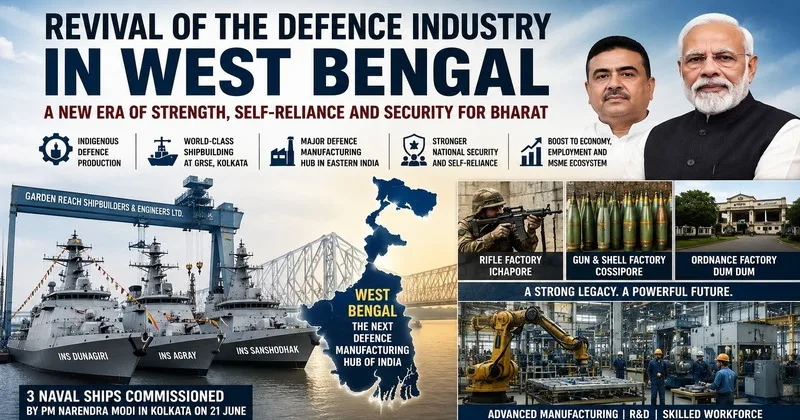
The commissioning of three naval ships by Prime Minister Narendra Modi in Kolkata on 21 June was not another routine event that was merely an addition to the Indian Navy fleet. The event was a signal that West Bengal, under the new BJP government, is now going to be the next major defence manufacturing hub in India. The induction of INS (Indian Naval Ship) Dunagiri, INS Agray and INS Sanhsodhak will not only strengthen the Indian Navy’s combat, anti-submarine and survey capabilities but also give a boost to the indigenous shipbuilding capability. All three naval ships have been designed by the Navy’s Warship Design Bureau and built by Garden Reach Shipbuilders & Engineers in Kolkata.
Though not much known, West Bengal has a rich history of defence manufacturing, but the state did not get any major encouragement to boost defence production under the Left Front or TMC governments in the past. Under the new BJP government led by CM Suvendu Adhikari, the state is all set to become a major focus for expanding India’s defence production and reviving the dormant ecosystem with localised value chains. West Bengal has the best location advantage because it has sufficient land and coastal areas. In addition, West Bengal has been the major educational, technical and medical hub for the eastern region of India. Thus, a huge qualified workforce with a technical bent of mind is available in West Bengal and in the neighbouring states.
For the Indian Army, Rifle Factory & Metal and Steel Factory, Ichapore, near Kolkata, have been producing small arms and critical ferrous/non-ferrous metals for military applications. In the 1980s, when I joined the Indian Army, the 7.62 mm SLR (Self Loading Rifle) manufactured at Ichapore was the main personal weapon of an Indian soldier. Though a bit heavy, it was a reliable rifle, and I recall many encounters with the LTTE in Sri Lanka where this rifle took on the more famous AK-47 rifle held by the terrorists. During our Indian Peace Keeping Force (IPKF) operations with the LTTE between 1988-89, the rifle gave a good account, though a need to have a fully automatic and lighter rifle was felt during the operations.
As a result, the INSAS (Indian Small Arms System) rifle was introduced in the Indian Army in the mid-1990s. As a Captain instructor in the Infantry School, Mhow, I was involved in testing and in the field trials of this weapon. The INSAS rifle was much lighter and fully automatic, and this rifle, too, was manufactured by Rifle Factory Ichapore. INSAS rifles played a major role with the infantry soldiers during the 1999 Kargil war. I recall that the INSAS rifles were further improved by the factory with timely value additions. I was fortunate to be associated again with this project in the year 2006.
After serving the Indian Army for more than three decades, the INSAS rifle is being replaced by the domestically manufactured AK-203 rifles under Russian collaboration at Amethi as part of the Lucknow defence corridor. Under a more proactive government, such a project would have come to West Bengal. Gun & Shell Factory (GSF), Cassipore is also one of the oldest defence manufacturing units in India, producing artillery shells, smoke and illuminating projectiles. Then there is Ordnance Factory Dum Dum (OFDD), which also manufactures key military components and equipment. In short, West Bengal has the necessary ecosystem for defence manufacturing that should have grown over the years.
But Garden Reach Shipbuilders & Engineers Ltd. (GRSE) based in Kolkata, is a premier warship building facility that designs and manufactures naval frigates, anti-submarine ships and hydrographic survey vessels for the Indian Navy. GRSE remains a major contributor to the growing Indian Navy fleet. Not only that, GRSE has secured a major export order to build 12 advanced multi-purpose vessels (MPVs) for a German shipping company. The presence of PM Modi to commission three Indian Naval Ships at Kolkata on 21 June was also a recognition of the major contribution of the GRSE towards national security, as well as to bring the focus back on West Bengal as the next major defence manufacturing hub in India’s eastern region.
CM Suvendu Adhikari has displayed a keen interest towards the national security. Within a week of assuming power, his government handed over 121 hectares of land in the sensitive Siliguri Corridor to the central government. At the same time, his government has allotted more than 600 hectares of land to the BSF to construct 569 km of fence along the Indo-Bangladesh border. The new WB government’s first budget has announced plans to establish two major defence manufacturing hubs in Gangajalghati (Bankura district) and Sainthia (Birbhum district). The initiative is part of a broader Rs. 5000 crore investment plan aimed at boosting defence manufacturing, incentivising private industry and integrating West Bengal into the global defence supply chain.
Under the new BJP government, West Bengal is now poised to find its premier place as the next industrial corridor for defence manufacturing. The boost to defence manufacturing is also a signal to our adversaries in China and the growing Pakistan-Bangladesh nexus in the defence sector. West Bengal has the right mix of large-scale defence projects like the GRSE and a huge number of MSMEs to strengthen the logistics and supply chain ecosystems. With the encouragement of ease of doing business by the state government, the revival of defence manufacturing in West Bengal is going to be a major force multiplier for Bharat.