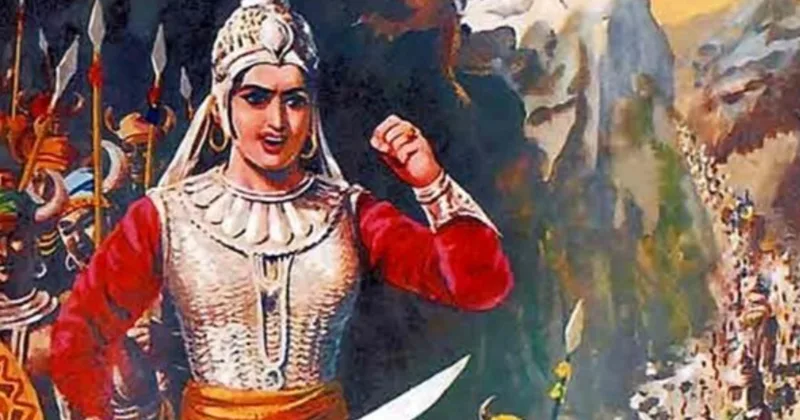
In the vast firmament of Indian history, there are certain luminaries whose radiance transcends the boundaries of time. While they remain a part of history, they also become an integral part of the collective consciousness of generations. Rani Durgavati was one such radiant figure. She was not merely a warrior-queen skilled with the sword; she was a remarkable confluence of maternal affection and valor, tenderness and steely resolve, empathy and self-respect.
Picture a young woman who learned the language of weaponry in her father’s courtyard during childhood, rose to become the queen of a vast empire in her youth and after being widowed, took her young son by the hand, shouldered the future of the entire Gondwana kingdom and set forth to forge a new destiny! Had she wished, she could have bowed to circumstances or surrendered amidst the myriad crises; instead, she chose the path of struggle. That is why history remembers her not merely as a queen, but as a fierce warrior-goddess, a ‘Ranchandi’- of the battlefield.
From Princess of Kalinjar to Empress of Gondwana
Born on October 5, 1524, in the Kalinjar Fort to King Kirtisingh Chandel of the Chandel dynasty, Durgavati was extraordinary from childhood. She was named Durgavati because she was born on the auspicious day of Durgashtami. In an era when princesses were often confined to the boundaries of royal palaces, Durgavati attained exceptional proficiency in horse riding, archery and the martial arts.
In 1542, she married Dalpat Shah, the Crown Prince of the Gondwana kingdom. This union represented the convergence of two powerful traditions: the Rajput Kshatriya lineage on one hand and the forest-dwelling tradition, known in contemporary parlance as tribal culture, on the other. A few years into her marriage, her son Veer Narayan was born, but fate soon subjected her to a severe test. The untimely demise of Dalpat Shah plunged Durgavati into deep grief; yet, it was at this very moment that the empress, hitherto hidden behind a wife’s tears, awakened. She took the reins of Gondwana as the regent for her young son, Veer Narayan and altered the course of history.
The Golden Age of Gondwana
Rani Durgavati’s reign is regarded as the golden age of the Gondwana kingdom. While defending its borders, she transformed the state into a model of prosperity, good governance, and public welfare. The administrative system was strengthened, and the network of forts and ‘parganas’ (administrative units) was expanded. She established a vast standing army comprising approximately 20,000 cavalrymen, 1,000 elephants and a large contingent of infantry.
A distinctive feature of her rule was that Gondwana was one of the few kingdoms in India at the time where a female military contingent played a significant role. The Queen believed that a state’s true strength lay not only in its army but also in its people; consequently, she placed agriculture, water conservation and public welfare at the heart of her administration.
A Remarkable Vision for Water Management
Rani Durgavati was as much a visionary ruler as she was a heroine of the battlefield. The schemes for water conservation and environmental management implemented during her reign remain a source of inspiration today. Historical records indicate that around a thousand ponds and five hundred stepwells were constructed across her kingdom. A well-organized water system comprising 52 lakes and 40 stepwells was developed in the Jabalpur region. Under the ‘Panchasar’ scheme, various water bodies were interconnected via underground canals. Today, as the world grapples with a water crisis, Rani Durgavati’s vision appears even more relevant.
An Unparalleled Expert in Strategy and Warfare
Rani Durgavati’s military strategy and diplomatic acumen were considered extraordinary. She was well-versed in the nine traditional battle formations (vyuhas) of ancient warfare and was particularly adept at the ‘Kraunch Vyuha’ and the ‘Ardhachandra Vyuha’. Proficient in wielding swords and arrows with both hands, the Queen employed strategies involving surprise attacks. Her leadership on the battlefield served as a source of inspiration for the soldiers. She fought numerous battles during her lifetime and emerged victorious in most of them. Defeating a powerful ruler like Baz Bahadur twice and driving him back to Mandu stands as a testament to her military genius.
Even an Empire Paled Before Her Self-Respect
In the 16th century, the Mughal Emperor Akbar was engaged in expanding his empire. When news of Gondwana’s prosperity reached the Mughal court, plans were made to conquer it. Akbar sent a message to the Queen implying that a woman’s role was merely to spin yarn. In response, the Queen sent back a golden cotton-carding bow, signaling that a ruler’s duty is to govern, not to usurp the freedom of others. This reply was more than just a political response; it was a bold proclamation of the self-respect of Indian womanhood.
The Battle of Narrai: An Immortal Chapter in History
Akbar could not tolerate this retort and in 1564, the Mughal commander Asaf Khan invaded Gondwana with a massive army and artillery. While the Mughal army was far superior in terms of resources, Queen Durgavati possessed courage, strategic acumen and unwavering devotion to her motherland. A prolonged series of skirmishes ensued, stretching from Singaurgarh to the Gaur River and Narrai. On several occasions, the Queen’s forces compelled the Mughals to retreat.
She inflicted heavy losses on the enemy by employing military formations such as the ‘Ardha-Chandra’ and ‘Krauncha-Vyuha’. The decisive battle took place on the soil of Narrai on June 24, 1564. The Queen herself led the vanguard, while her son, Veer Narayan, stood firm on the battlefield. During the conflict, she was struck by arrows in her eye and neck, yet she refused to abandon the battlefield.
When it became evident that she was critically wounded and at risk of being captured by the enemy, she chose to sacrifice her life to uphold her self-respect and freedom.
Honor Mattered More Than Life
Queen Durgavati’s sacrifice remains an inspiration for all who cherish self-respect; it was not merely the death of an individual, but an immortal declaration of freedom and dignity. She demonstrated that the true dignity of life lies not in power or opulence, but in remaining steadfast to one’s values. Her life conveys the message that no matter how adverse the circumstances, they can be confronted with courage and self-confidence. She demonstrates that a woman is not merely a symbol of compassion but also a force capable of standing up against injustice when the need arises.
An Inspiration for Today’s Generation
Thus, the name of Rani Durgavati, etched in history, remains as relevant to every Indian today as it was in the sixteenth century. Her life exemplifies female leadership, self-respect, patriotism, environmental conservation, and good governance. She teaches us that the ultimate purpose of power is public welfare and that the value of freedom far exceeds any material achievement; indeed, Rani Durgavati stands as a living symbol of India’s cultural consciousness for us all.
Furthermore, Rani Durgavati proved through her life that history does not remember those who bow before circumstances; instead, it immortalizes those who fight for their principles until their very last breath. A hundred salutations at the feet of Rani Durgavati…