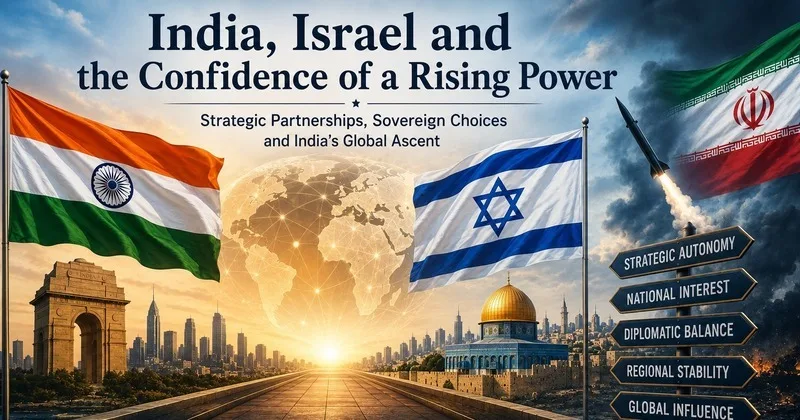
Every major international crisis reveals something about the countries directly involved. Occasionally, however, it reveals something equally important about countries that stand outside the immediate conflict. The current confrontation between Israel and Iran is one such moment. While global attention is understandably focused on the military, diplomatic and strategic consequences for West Asia, the crisis also offers a revealing glimpse into the transformation of Indian foreign policy and the growing confidence with which India now engages the world.
For New Delhi, the significance of the conflict extends beyond concerns about regional stability, energy markets or maritime security. It illuminates a broader reality: India today possesses a degree of diplomatic flexibility, economic influence and strategic confidence that would have been difficult to imagine a generation ago. The manner in which India has responded to the unfolding crisis reflects the evolution of a country that increasingly acts on the basis of its own interests rather than the expectations of competing geopolitical camps.
This marks a significant departure from the circumstances that shaped much of India’s foreign policy during the twentieth century. In the decades following Independence, economic limitations, security challenges, and the rigid structure of the Cold War inevitably narrowed strategic options. Non-alignment served an important purpose in preserving national sovereignty amid intense superpower rivalry, but it also reflected the realities of an era in which many developing nations had limited room for manoeuvre. Contemporary India occupies a very different position. It is among the world’s leading economies, an influential voice in international forums, a key player in the Indo-Pacific and an increasingly important participant in shaping global conversations on trade, technology, security and development.
The Israel-Iran crisis demonstrates how profoundly that transformation has altered India’s conduct of foreign affairs. The tendency among commentators is to interpret every international dispute through the language of loyalties and alignments. Nations are often expected to declare where they stand, as though diplomacy were little more than an exercise in choosing sides. History suggests otherwise. Successful states rarely advance their interests by inheriting the quarrels of others. They do so by cultivating partnerships, preserving flexibility and retaining the ability to make decisions guided by long-term national priorities rather than transient geopolitical pressures.
India’s relationship with Israel provides a compelling example of this approach. When New Delhi established full diplomatic relations with Israel in 1992, the decision reflected a wider reassessment of India’s place in a rapidly changing world. Economic liberalisation was underway, the Cold War had ended, and Indian policymakers increasingly recognised the need for a more pragmatic foreign policy. What followed was one of the most successful and consequential partnerships in India’s contemporary diplomatic history.
While defence cooperation naturally receives considerable attention, the relationship extends far beyond military affairs. Few countries have transformed adversity into innovation as effectively as Israel. Faced with scarce natural resources, challenging geography and persistent security threats, it developed world-class capabilities in agriculture, water management, technology, cybersecurity and scientific research. These strengths have found natural resonance in India. Agricultural centres of excellence, advances in irrigation techniques, collaboration in innovation and expanding technological partnerships have generated practical benefits that reach far beyond the realm of diplomacy. The relationship has endured because it has consistently delivered results.
Trust, however, remains the true foundation of any lasting strategic partnership, and trust is tested not during periods of stability but during moments of uncertainty. The Kargil conflict of 1999 remains a defining chapter in the history of India-Israel relations. At a time when India faced urgent operational requirements, Israel responded with speed and reliability. The significance of that support extended well beyond the immediate military context. It reinforced the perception that Israel was a partner willing to stand by its commitments when circumstances demanded action rather than rhetoric. Over the years, that confidence has deepened through sustained cooperation across multiple sectors, creating a relationship built as much on trust as on shared interests.
Recognising Israel’s importance does not require India to view West Asia through a single lens. A nation of India’s scale and aspirations cannot afford such a narrow perspective. The region remains central to India’s economic well-being and strategic security. Millions of Indians live and work across the Gulf, contributing to local economies while supporting families and communities at home. Energy supplies from the region continue to play a significant role in sustaining growth, while vital maritime routes connect India to markets across Europe, Africa and beyond. Stability in West Asia, therefore, carries direct implications for Indian prosperity. Developments in the region affect trade, investment, energy security and the welfare of Indian citizens abroad.
It is within this broader context that India’s response to the Israel-Iran confrontation must be understood. New Delhi’s objective is neither to participate in regional rivalries nor to reduce complex geopolitical disputes to ideological choices. Its primary responsibility is to safeguard Indian interests while supporting conditions that contribute to regional stability. Such an approach is sometimes described as balancing between competing actors. In reality, it reflects the confidence of a country that no longer feels compelled to define its foreign policy through the preferences of others. India today possesses wider diplomatic options, stronger economic foundations and more extensive international partnerships than at any previous point in its modern history. Those strengths provide the space necessary for independent judgment.
The wisdom of this approach becomes even clearer when viewed against the backdrop of a changing international order. The world that emerged after the Cold War is steadily receding into history. Power is becoming more diffuse, regional actors are exercising greater influence, and longstanding assumptions about alliances are being reassessed. Even in West Asia, developments such as the Abraham Accords demonstrated that some of the region’s most entrenched political divisions could be reshaped by pragmatism and shared interests. Across the international system, countries increasingly seek flexible partnerships rather than rigid alignments. In such an environment, diplomatic agility becomes a strategic asset.
India’s rise has been accompanied by a growing appreciation of this reality. Whether engaging the United States, Israel, the Gulf states, Europe, Southeast Asia or Africa, New Delhi increasingly approaches international affairs through the lens of national interest rather than ideological conformity. The objective is not to avoid difficult choices but to ensure that those choices remain sovereign decisions. The ability to maintain a strong and trusted partnership with Israel while simultaneously protecting broader interests across West Asia is not evidence of contradiction. It is evidence of maturity. It reflects a foreign policy establishment that understands both the opportunities and the responsibilities associated with India’s expanding global role.
The true significance of the Israel-Iran crisis, therefore, lies beyond the immediate dangers of escalation. It reveals the arrival of an India that engages the world with greater confidence than at any previous point in its modern history. The country that once sought room to manoeuvre between rival camps now possesses the capacity to cultivate relationships across them. That is not merely a diplomatic achievement. It is one of the clearest indicators of India’s emergence as a consequential power in the twenty-first century.
For decades, India’s foreign policy was shaped by the need to preserve strategic space in a world dominated by others. Today, the challenge is fundamentally different. India is increasingly helping to shape the environment in which major international decisions are made. The true measure of a rising power is not whether it chooses between rivals, but whether rivals increasingly seek its friendship even when they remain at odds with one another. Judged by that standard, the current crisis in West Asia tells us less about the divisions of the region than about the quiet but unmistakable coming of age of Indian diplomacy.