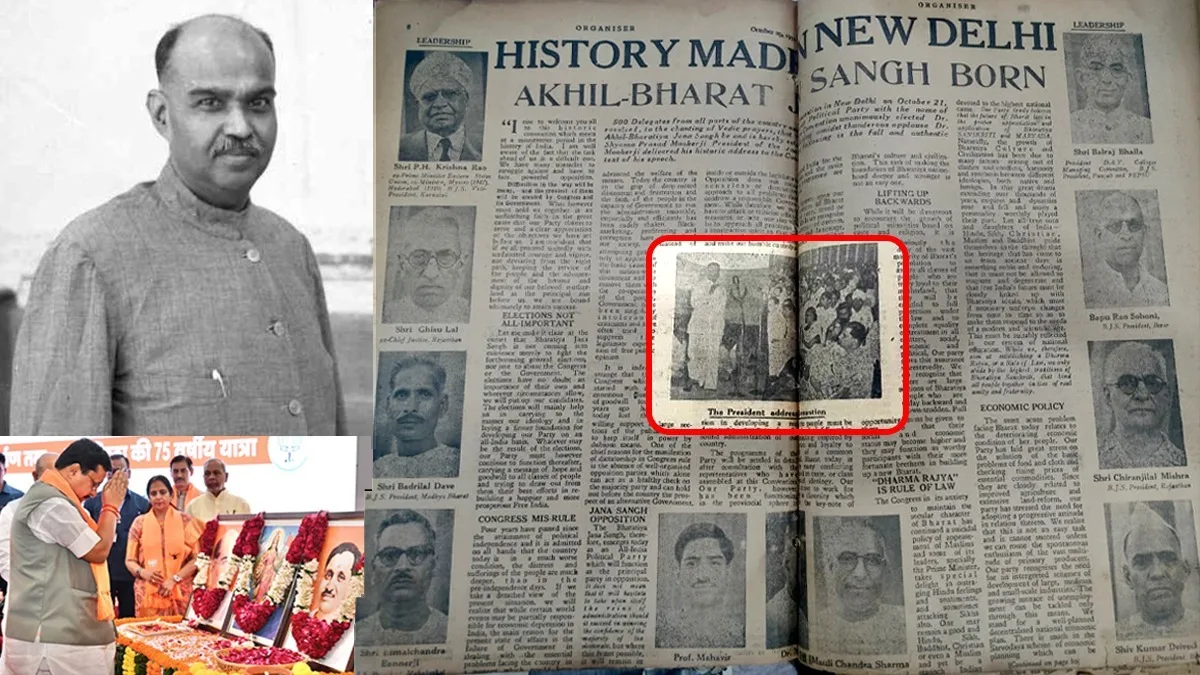
On October 21, 1951, Dr Syama Prasad Mookerjee welcomed around 500 delegates to the Ist convention of the Bharatiya Jana Sangh at Raghumal Arya Kanya Vidyalaya in Central Delhi. Elected as the organisation’s first president, with Pandit Deendayal Upadhyaya as its general secretary, Dr Mookerjee outlined a vision that extended beyond electoral politics, emphasising national interest, public service and the building of a stronger and more prosperous India.
“I rise to welcome you all to this historic convention which meets at a momentous period in the history of India. I am well aware of the fact that the task ahead of us is a difficult one. We have many obstacles to struggle against and have to face powerful opposition,” Dr Mookerjee said in his address.
Emphasising the need for unity and unwavering commitment to the organisation’s objectives, he said, “Difficulties in the way will be many and the greatest of them will be created by Congress and its Government. What however must hold us together is an unflinching faith in the great cause that our Party claims to serve and a clear appreciation of the objectives we have set before us. I am confident that if we all proceed unitedly with undaunted courage and vigour, not deviating from the right path, keeping the service of the people and the advancement of the honour and dignity of our beloved motherland as the principal aim before us, we are bound ultimately to attain success.”
Dr Mookerjee also made it clear that the Jana Sangh was not being established merely to contest elections or oppose the Congress government. He said:
“Let me make it clear at the outset that Bharatiya Jana Sangh is not coming into existence merely to fight the forthcoming general elections, nor just to abuse the Congress or the Government. The elections have no doubt an importance of their own and wherever circumstances allow, we will put up our candidates. The elections will mainly help us in carrying to the masses our ideology and in laying a firmer foundation for developing our Party on an all-India basis. Whatever may be the result of the elections, our Party must however continue to function thereafter, carrying a message of hope and goodwill to all classes of people and trying to draw out from them their best efforts in rebuilding a happier and more prosperous Free India,” he said.
The Jana Sangh’s early leadership included P H Krishna Rao, Ghisu Lal, Badrilal Dave, Bimalchandra Banerji, Prof. Mahavir, Mauli Chandra Sharma, Balraj Bhalla, Bapu Rao Sohoni and Chiranjilal Mishra, who contributed to building the organisation in its formative years.
The Bharatiya Jana Sangh’s manifesto outlined its vision across a wide range of national priorities, including the improvement of rural life, industrial policy, large-scale industries, decentralisation, small-scale and cottage industries, Swadeshi, industrial relations, industrial finance, trade, controls, domestic policies, backward classes, civil liberties, national language, education, healthcare, taxation and economy in government expenditure. It also addressed foreign policy, Pakistan, Kashmir, defence and rehabilitation, reflecting the organisation’s approach to nation-building, economic development, national security and the challenges facing India in the early years after Independence.
75-years-later, at the same historic venue, Bharatiya Janata Party National President Nitin Nabin, reflected on the organisation’s journey, Nabin said that the seed planted by pioneers such as Dr Syama Prasad Mookerjee and Pandit Deendayal Upadhyaya, guided by the spirit of Rashtra Pratham and Antyodaya, had grown into a large banyan tree in the form of the world’s largest political party.
Calling upon the younger generation to draw inspiration from the selfless struggles and sacrifices of their predecessors, Nabin urged karyakartas to work with dedication under the leadership of Prime Minister Narendra Modi to realise the vision of Viksit Bharat and transform India into a Vishwaguru.
Nabin said that millions had sacrificed their lives during the freedom struggle with the common objective of securing India’s independence and establishing a democracy in which every individual mattered, development reached the last person, cultural roots remained strong, and the nation stood with self-respect. Reflecting on the Jana Sangh’s journey, he appreciated the phrase Jana Sangh se Jan-Jan ki Yatra, used by the Delhi BJP, and said that the same spirit of commitment and dedication must guide the journey towards national development and progress.
Recalling the early years of the organisation, Nabin said that when the Jana Sangh was established in 1951, it had neither offices nor adequate resources or proper means of transportation. On many occasions, karyakartas did not even have sufficient space to keep receipts. Despite these limitations, their resolve to take the organisation and its ideology to every citizen remained unshaken.
Reflecting on the circumstances that led to the Jana Sangh’s formation, Nabin said that Dr Syama Prasad Mookerjee, despite serving as a Union Minister, possessed a broad national outlook and believed that the objectives and ideals with which India had attained Independence were gradually deviating from their intended path. He felt that the government of that period was increasingly influenced by Western and Leftist ideas and lacked the necessary commitment to nationalist thought and national interests.
Under these circumstances, Dr Mookerjee, after consultations with his colleagues, resigned from the Union Cabinet and conveyed to the nation his determination to struggle for the fulfilment of the original objectives of India’s freedom. Nabin said that the Bharatiya Jana Sangh emerged from this nationalist consciousness and resolve.
Highlighting the enduring relevance of the Jana Sangh’s ideological foundations, Nabin said that the journey of its senior leaders brought to mind the vision of Ek Bharat, Shreshtha Bharat and Pandit Deendayal Upadhyaya’s philosophy of Antyodaya, aimed at ensuring that the benefits of development reached the last person in society. He said that Prime Minister Narendra Modi had incorporated this resolve and philosophy into government policies and programmes, enabling even those who had never imagined opening a bank account to become part of the banking system.
Nabin also highlighted the efforts of senior leaders who travelled across states, despite severe resource constraints, to expand the organisation down to the district and mandal levels. He said that the BJP’s emergence as the world’s largest political party was the result of the years of hard work, dedication and sacrifice of Pandit Deendayal Upadhyaya, Atal Bihari Vajpayee, Lal Krishna Advani and countless other senior leaders.
From Dr Syama Prasad Mookerjee’s founding vision in 1951 to the BJP’s journey over the subsequent 75 years, the programme at the historic venue recalled the organisation’s legacy of nationalism, ideological commitment and public service.
