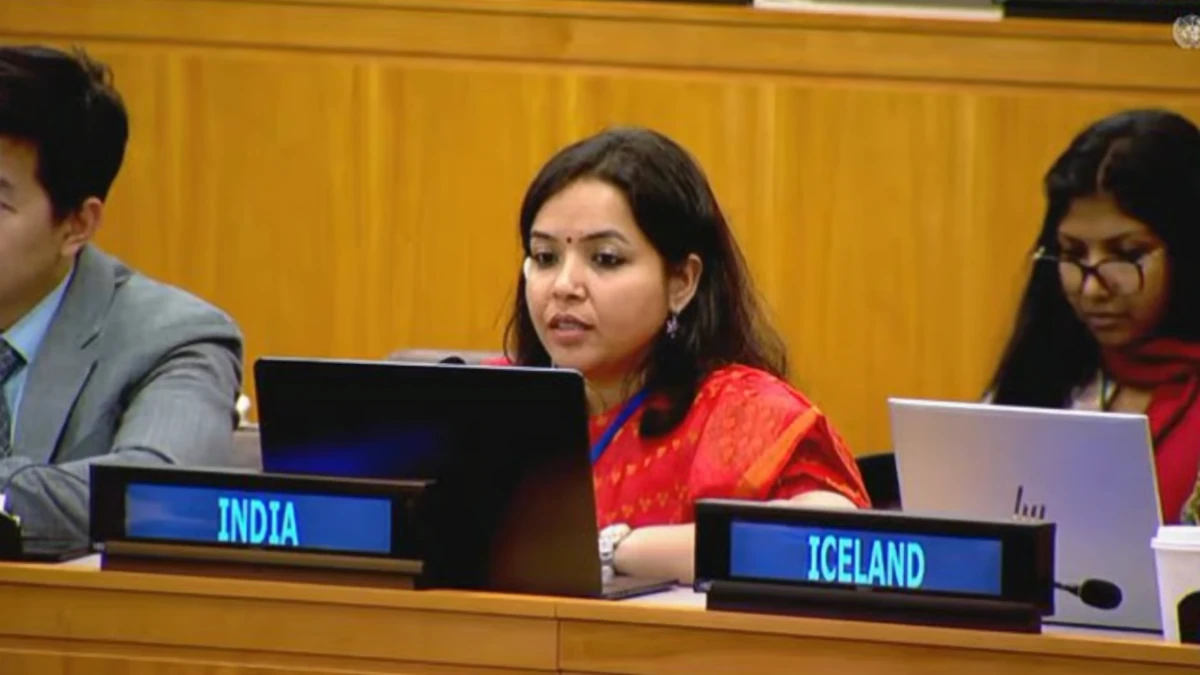
Barkha Tamrakar, Deputy Secretary, Ministry of External Affairs
NEW DELHI: India has delivered a strong rebuttal at the United Nations, warning against attempts to use unverified allegations, incomplete statistics and selective scrutiny to portray the country negatively on human rights. New Delhi asserted that human rights must not become an instrument of political pressure or country-specific targeting, insisting that international assessments must be based on verifiable evidence, transparency and impartiality.
Barkha Tamrakar, Deputy Secretary in the Ministry of External Affairs (MEA), delivered India’s statement on October 20, during discussions at the United Nations General Assembly’s Third Committee on the Working Group on Enforced Disappearances. She urged member states to distinguish between humanitarian communications and established findings, cautioning against drawing conclusions that go beyond the contents of official reports.
“India firmly opposes any attempt to convert unverified allegations, incomplete statistics, or a report that contains no India country observation into a negative characterization of the world’s largest democracy,” Tamrakar said.
India called on UN delegations to interpret reports accurately rather than present allegations as established facts. “We call on delegations to cite the report faithfully, not to inflate a humanitarian communication into a verdict,” Tamrakar said.
She reiterated that India remains willing to address specific cases supported by proper documentation through established channels. However, she stressed that international human rights engagement must be guided by dialogue, consultation, cooperation, non-selectivity and transparency.
The Indian position centres on the distinction between allegations that warrant examination and findings supported by credible evidence. New Delhi has maintained that claims should not be used to draw sweeping conclusions about the country without adequate verification.
India’s strong response comes amid renewed international scrutiny of the authorities’ handling of youth-led demonstrations in New Delhi.
More than 20 UN human rights experts in Geneva expressed concern over what they described as a repeatedly heavy-handed police response to peaceful youth-led protests. They called on Indian authorities to ensure accountability for reported human rights violations.
The experts said that restrictions on peaceful assembly, excessive use of force, arbitrary detentions, enforced disappearances and the targeting of student activists were among the concerns requiring attention.
“We have repeatedly alerted the Indian authorities to undue restrictions on peaceful assembly, excessive use of force, arbitrary detentions, enforced disappearances, and the targeting of student activists, amongst others,” the experts said.
They also called on authorities to end the alleged excessive use of force, rescind blanket restrictions on assemblies and refrain from the misuse of digital surveillance.
India, however, has challenged the basis and framing of allegations raised by UN representatives, insisting that claims must be verified and assessed through appropriate mechanisms.
The latest confrontation follows India’s rejection of a report by a UN human rights expert that referred to a satirical political movement created by young people and alleged retaliation against those involved.
New Delhi dismissed the allegations as “hearsay” and called on the expert to verify claims before drawing conclusions.
India also described remarks from the Office of the UN High Commissioner for Human Rights concerning reported mass detentions of demonstrators, protest leaders, civil society members, lawyers and journalists in Delhi as “unwarranted” and an “unacceptable interference” in the country’s internal affairs.
During its intervention, India also highlighted constitutional protections, including Article 21, which guarantees the right to life and personal liberty, subject to the constitutional and legal framework.
Tamrakar pointed to the role of the National Human Rights Commission and State Human Rights Commissions in addressing human rights concerns within the country. India maintained that concerns should be examined through established institutional processes and based on documented evidence rather than incomplete information or assumptions.
The government has consistently argued that international engagement on human rights must respect impartiality and national sovereignty while allowing legitimate concerns to be addressed through appropriate channels.
The controversy has also prompted criticism of what some observers describe as inconsistent international responses to protests in different countries.
UN Human Rights Chief Volker Türk, commenting on violent demonstrations in France and elsewhere in Europe, condemned violence and vandalism while calling for dialogue and de-escalation.
“I condemn all acts of violence and call on all of those involved to reduce tensions and prevent further violence,” Türk said, adding that those exploiting protests to commit violence and vandalism against public and private property should be deplored.
India’s intervention at the UN reflects its broader objection to what it views as selective international scrutiny and the use of human rights concerns as political leverage.
New Delhi has reiterated that it is prepared to engage with international mechanisms and examine specific, properly documented cases. At the same time, it has rejected generalised allegations that, in its view, are not adequately supported by evidence.
