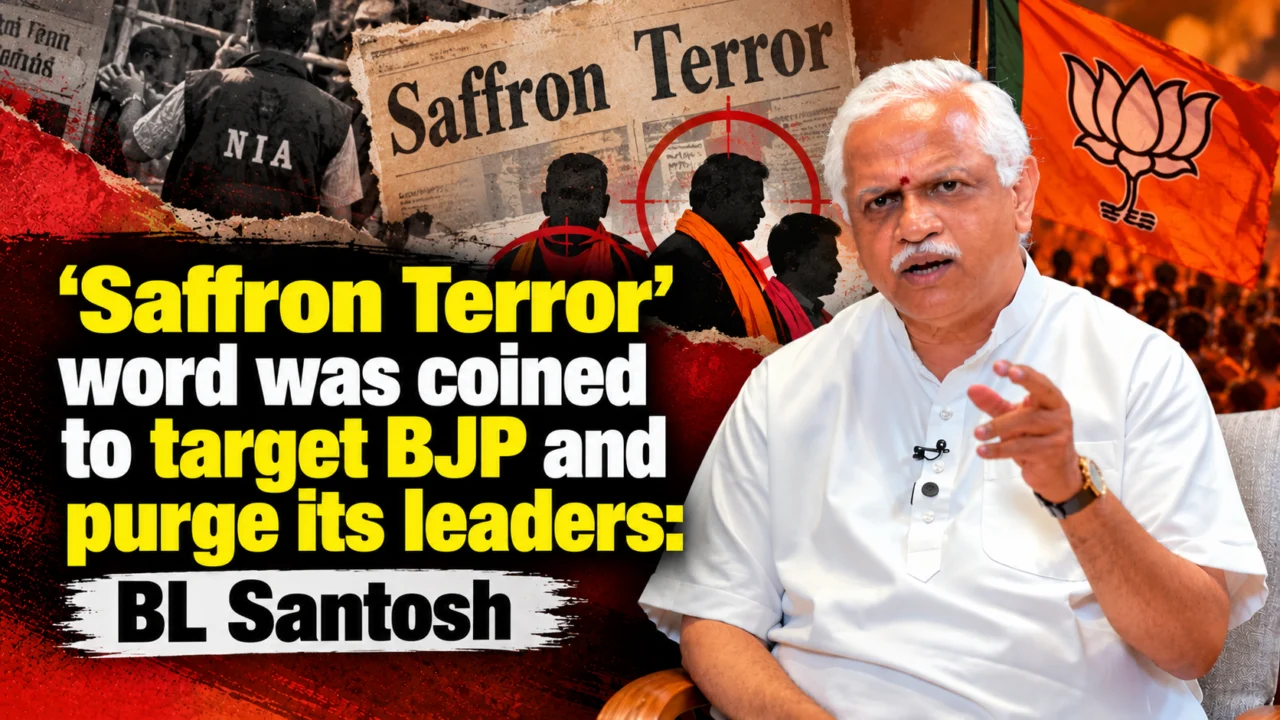
B. L. Santhosh said that the term “Saffron Terror” was coined to target the BJP and remove its leaders, revisiting the political controversy surrounding the phrase
BJP National General Secretary (Organisation) B. L. Santhosh has described the period between 2004 and 2014 as a challenging phase for the party and its ideological movement, referring to the emergence of the “Hindu terror” and “saffron terror” narratives.
In an interview with Organiser, Santhosh said that these narratives were part of a broader effort to target and sideline the BJP and its ideological ecosystem. He also criticised the portrayal of the Gujarat riots and spoke about what he described as the political targeting of BJP leaders.
Recalling the period after the Atal Bihari Vajpayee-led government, Santhosh said the decade from 2004 to 2014 had been difficult for the BJP and the wider ideological movement.
“See 2004 to 2014 had been very challenging time for our whole ideological movement. Not only a political party even the ideological movement also. All the words that were mentioned by you, saffron terror word was coined at that time,” Santhosh said.
He linked the emergence of the “saffron terror” narrative to other political developments during the period, including the establishment of the National Advisory Council (NAC).
According to Santhosh, the NAC represented an arrangement in which authority and influence existed beyond the Prime Minister’s Office. He alleged that people with their own individual, collective and party agendas used such arrangements to advance their interests.
He said the period was marked by a broader contest over the political and ideological direction of the country.
Santhosh also spoke about what he described as the way Hindu identity was characterised in public and political discourse.
“If you are a Hindu, you are called a communal,” he said.
He added: “You have non-Hindu intent and then you are called a secular.”
Explaining his argument, Santhosh referred to the use of Hindu identity within families, society and public movements. He said that identifying as Hindu during an agitation could lead to a person being labelled a criminal, while opposing Hindu positions could result in being described as secular.
He said that the Ram Janmabhoomi movement had helped ordinary people understand what he viewed as this contradiction in the use of political labels.
Santhosh alleged that the BJP faced a sustained effort to restrict its political growth during the 2004–2014 period. He referred to Congress and sections of the liberal political establishment while making this allegation.
He said the targeting of BJP leaders was not an isolated occurrence.
“This targeting was not oneoff incident,” he said.
Explaining his assessment of the period, Santhosh said: “So they wanted to not only sideline BJP I will I will use the word purge BJP.”
He further alleged that the effort extended beyond the BJP to the senior leadership of the Rashtriya Swayamsevak Sangh (RSS), with the aim of removing the BJP from India’s political framework.
Santhosh also criticised the way the Gujarat riots were portrayed during the period. He alleged that sections of the media and parts of the administration contributed to what he described as a wrongful presentation of the events.
Referring to the period, he said the way the Gujarat riots were publicised across sections of the media formed part of the wider political contest.
Santhosh also referred to inquiries faced by BJP leaders, including Narendra Modi, who was then Chief Minister of Gujarat. He said Modi appeared before the authorities and cooperated with the inquiry process.
“Now one single summons or one day detention becomes a undeclared emergency and our honorable prime minister had to face CBI inquiry for 20, 24 hours continuously for multiple days and he did not complain with anybody as a democratic practitioner. He went there submitted him in himself in front of the authorities came out unscathed,” Santhosh said.
He cited these episodes while arguing that the targeting of BJP leaders during the period was not limited to a single incident.
Santhosh said the BJP began regaining its political momentum after 2009 by highlighting governance models in states where it was in power and challenging the Congress-led United Progressive Alliance (UPA) on ideological and political issues.
He described the Gujarat model as one of the development models the party sought to present on a national scale.
“2004 to 2009 was a little dull period but after 2009 we found our rhythm again,” he said.
According to Santhosh, the BJP’s campaign between 2009 and 2014 focused on presenting state-level governance models and challenging the Congress and the UPA on both ideological and political fronts.
The BJP won the 2014 general election under Narendra Modi, who had served as Gujarat Chief Minister before becoming the party’s prime ministerial candidate.
Santhosh’s account presents the “Hindu terror” and “saffron terror” narratives as part of what he views as a wider political and ideological struggle during the decade before the BJP returned to power.
