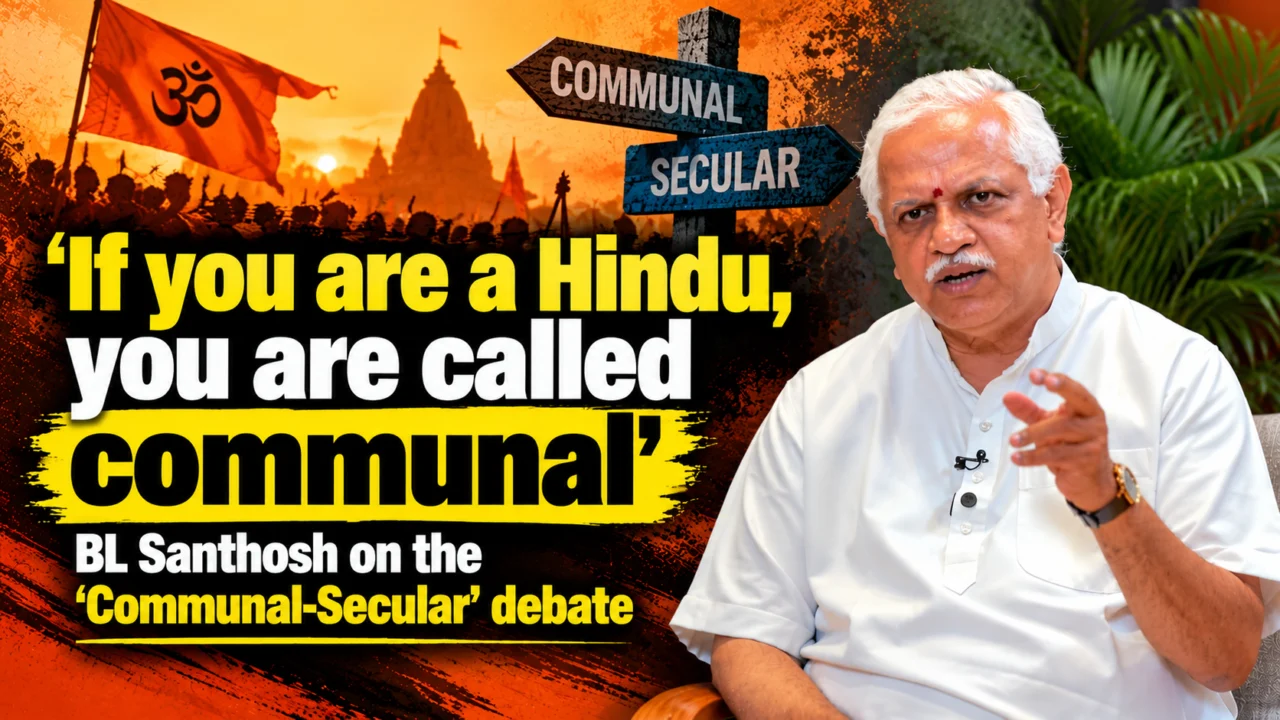
B. L. Santhosh weighs in on the “communal-secular” debate, arguing that Hindus are labelled communal for asserting their religious identity.
BJP National General Secretary (Organisation) B. L. Santhosh has argued that the terms “communal” and “secular” have acquired a particular political meaning in India, claiming that identifying as Hindu is often labelled communal while opposing Hindu traditions is presented as secular.
Speaking about the ideological impact of the Ram Janmabhoomi movement, he said it helped ordinary people question what he described as “pseudo-secularism” and understand how these labels are used in political discourse.
In an interview with Organiser, Santhosh discussed the communalism-secularism debate while reflecting on the Jana Sangh and BJP’s ideological journey and the Ram Janmabhoomi movement.
“If you are a Hindu, you are called a communal,” Santhosh said, arguing that the terms “communal” and “secular” no longer carry independent meanings in India’s socio-political life.
Explaining his argument, he said: “You tell Hindu whatever it may be inside a family you tell Hindu. Inside a society you tell Hindu on the streets while doing an agitation you tell you are a Hindu then you become a communal.”
He contrasted this with what he described as the treatment of people who oppose Hindu traditions and practices.
“If you are anti-Hindu against any tradition that are propounded in this country or any cultural tradition or any religious practices which have good of the society then immediately you become secular you oppose Hindu then you become secular,” he said.
Santhosh’s remarks were part of his broader argument that the political debate over communalism and secularism has become central to India’s ideological discourse.
Santhosh identified the Ram Janmabhoomi movement as a major factor in the BJP’s organisational expansion and in changing how the communalism-secularism debate is understood by the public.
He said the BJP’s participation in the movement was a conscious decision taken at the party’s Palampur session. According to him, the party entered it as a social, cultural and religious movement, rather than simply as a political exercise.
“We plunged into it for a social cause, for a cultural cause, for a religious cause,” he said.
Santhosh said the movement helped the party expand beyond its earlier geographical base and gain acceptance across different regions of the country.
He described the growth of the BJP’s organisation during this period as one of the movement’s major outcomes. He also pointed to the growth of nationalist organisations and the wider impact of the movement on political vocabulary.
Santhosh said the Ram Janmabhoomi movement also brought the term “pseudo-secularism” into wider political discussion.
“One thing happened that pseudosecularism word also came into existence at that time as a new word was added to the vocabulary,” he said.
He argued that the movement made people more conscious of how secularism was being defined and used in political debates.
“People got exposed by themselves today when ordinary people expose big people this is the contribution of the Ramjan movement,” he said.
According to Santhosh, the movement helped ordinary people question what he described as “real secularism” and “pseudo-secularism”, and understand why some people who identify with Hindu traditions are labelled anti-secular or communal.
Santhosh placed the debate within the longer ideological journey from the Bharatiya Jana Sangh to the BJP. He said ideas that were once outside the political mainstream had gradually become central to national politics.
He also linked the BJP’s ideological development to cultural nationalism and economic nationalism, describing them as complementary strands of its political thinking.
Reflecting on the party’s growth, he said the Ram Janmabhoomi movement helped the BJP reach regions where its organisational presence had previously been limited.
The interview’s discussion of communalism and secularism formed part of Santhosh’s wider account of the party’s ideological evolution and its expansion over several decades.
Source: Interview with B. L. Santhosh published on the Organiser YouTube channel. Quotations are drawn from the supplied transcript; some wording reflects the transcript’s automated transcription and may require checking against the original audio before publication.
