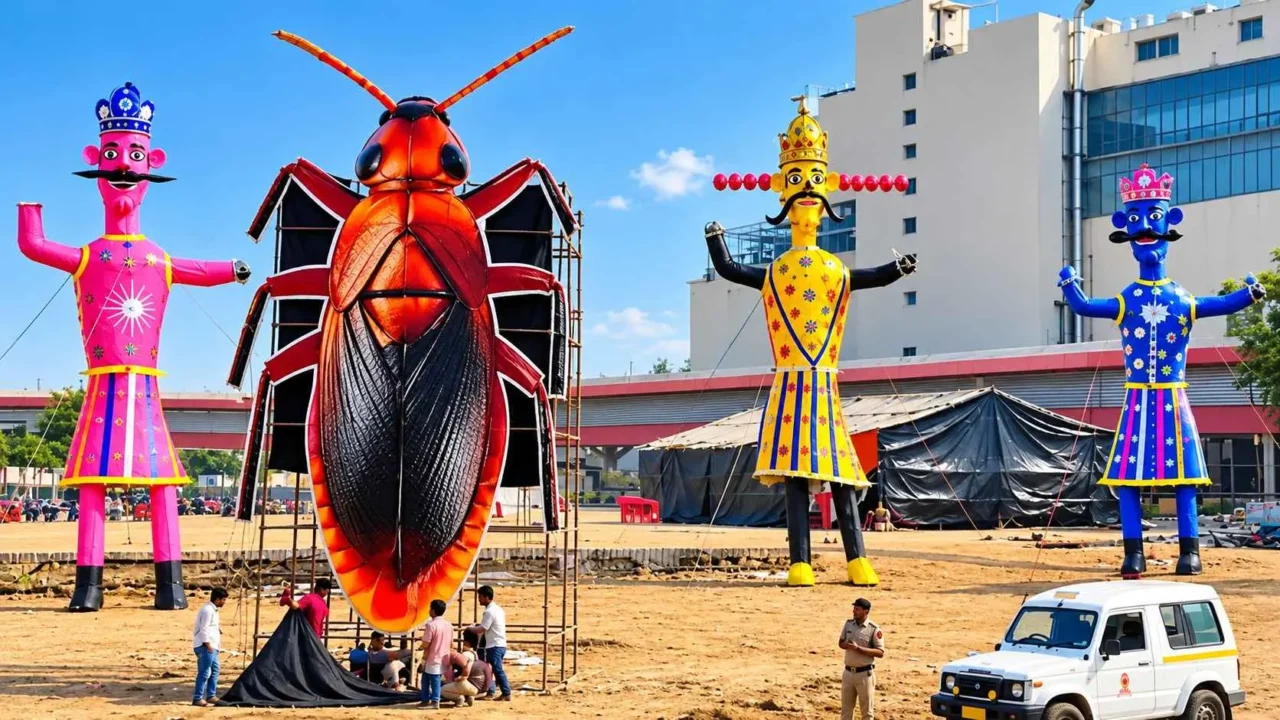
Delhi burnt a 30-foot cockroach effigy alongside Ravana on Dussehra amid CJP protests
Delhi’s Dussehra celebrations took a turn on Tuesday (October 20) evening when a 30-foot cockroach effigy was set ablaze alongside the traditional figures of Ravana, Kumbhakarna and Meghnad at the DDA ground in Netaji Subhash Place, Pitampura.
Organised by the Shri Keshav Ramlila Committee, the spectacle became a major talking point, turning a festival associated with the victory of good over evil into a controversy over symbolism, political messaging and the treatment of protesting youth.
Committee president and BJP Model Town MLA Ashok Goel Devraha defended the decision, claiming the cockroach represented filth, dirt and associated health risks, including allergies and asthma. The organisers said the effigy was intended to promote cleanliness under the Swachh Bharat and Swachh Delhi campaigns.
But the explanation raised an obvious question: why was a giant cockroach chosen to burn alongside Ravana and other figures traditionally associated with Dussehra, rather than using a conventional cleanliness campaign to convey the message?
Cockroaches are common household pests, and their association with unhygienic conditions is well established. However, placing one alongside Ravana gave the insect a symbolic significance beyond ordinary pest control. The choice attracted further scrutiny because the event took place amid protests by a group whose name itself contained the word “Cockroach”.
Goel insisted that the effigy was not directed at any individual, political party or organisation. He also cited previous symbolic effigies targeting issues such as Naxalism and terrorism. BJP Rajya Sabha MP Arun Singh, Delhi Cabinet minister Kapil Mishra and VHP Delhi unit president Kapil Khanna were among the event’s guests.
However, the organisers denial of political intent did not settle questions about how the spectacle could be interpreted. Their stated objective had to be considered alongside the timing, symbolism and political circumstances surrounding the event.
The controversy gained a political dimension because the event coincided with protests by the Cockroach Janata Party (CJP).
The group had created a ruckus in the national capital over alleged irregularities in the Special Intensive Revision (SIR) of electoral rolls and demanded the resignation of Chief Election Commissioner Gyanesh Kumar.
Against this backdrop, the appearance of a giant cockroach effigy at a prominent public festival attracted attention. Even if the organisers intended to highlight sanitation, the choice of imagery created an obvious overlap with the controversy surrounding CJP.
CJP founder Abhijeet Dipke responded sarcastically on social media, thanking the organisers for what he described as “free publicity”. The group’s legal head, Ratna Singh, also criticised the spectacle, remarking, “Tamasha Kara lo bas is desh mein” roughly, “Just keep putting on a spectacle in this country.”
Still, the available statements did not establish that the effigy had been deliberately designed to target CJP. The timing raised questions, but coincidence and intent were not the same thing. The organisers’ stated explanation needed to be distinguished from the political interpretations prompted by the event.
The controversy also prompted a response from the Aam Aadmi Party (AAP). Delhi unit chief Saurabh Bharadwaj filed a complaint with Lieutenant Governor Taranjit Singh Sandhu and Delhi Police Commissioner Anurag Kumar.
Bharadwaj alleged that the effigy had hurt Hindu religious sentiments, departed from Sanatan traditions for political purposes and risked promoting enmity between communities. He sought an FIR against Goel, Kapil Mishra and the organisers.
Notably, the political controversy surrounding the Cockroach Janata Party (CJP) cannot be examined without looking at its founder Abhijeet Dipke’s past association with the Aam Aadmi Party (AAP), which poses question to the movement’s claims of political independence. Between 2020 and 2023, Dipke worked with AAP’s social media and communications team, creating meme-based and satirical content during campaigns, including the 2020 Delhi Assembly elections. He later held roles linked to the Delhi Chief Minister’s Office and the education department under the AAP government, including work associated with senior leader Manish Sisodia.
Dipke left AAP’s political and administrative setup around 2023 to pursue a master’s degree in public relations at Boston University. He launched CJP in 2026 as a satirical protest movement. While Dipke has maintained that he never concealed his political past and insists that CJP operates independently, his previous association with AAP raises legitimate questions about the political networks behind a movement now positioning itself as a voice of protesting youth.
The controversy has gained further traction because reports have pointed to AAP links among other members of CJP’s core team. AAP national convenor Arvind Kejriwal’s appearance at a CJP protest has also fuelled questions about the relationship between the movement and its former political ecosystem. BJP leaders, including Kiren Rijiju, have questioned Dipke’s public positioning, portraying him as a former AAP functionary presenting himself as a student or an apolitical activist.
