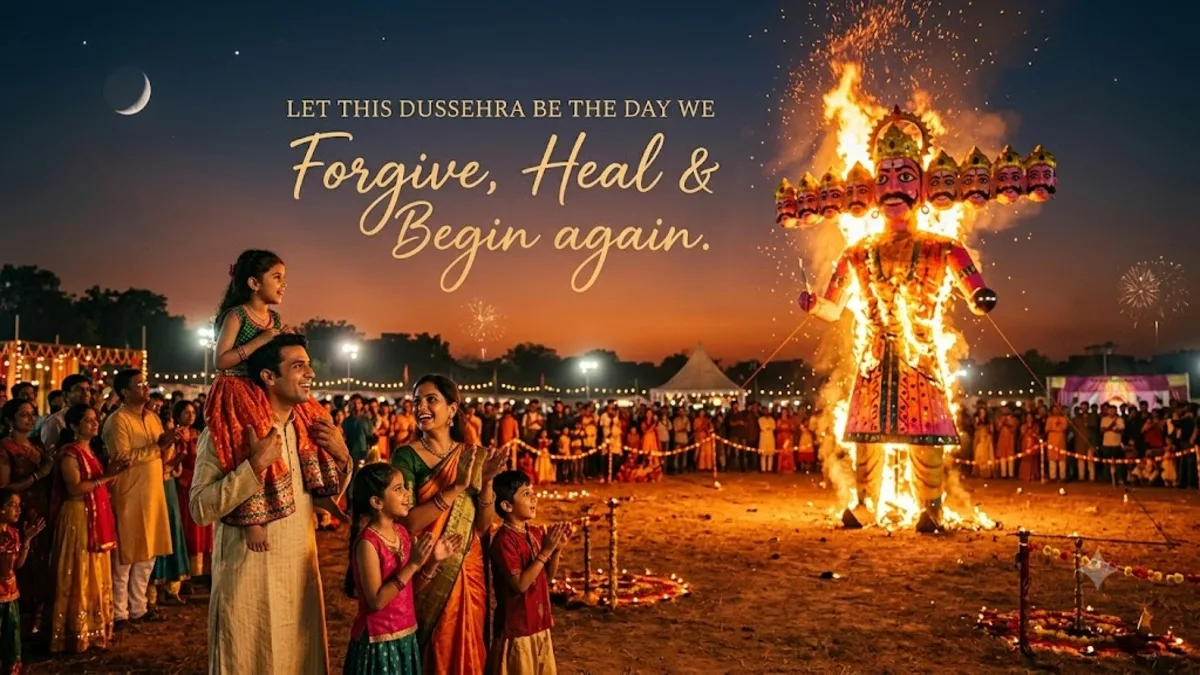
Representative Image
NEW DELHI: Vijayadashami, also known as Dussehra, will be celebrated on October 20, 2026. We remember this day through Lord Rama’s victory over Ravana and Maa Durga’s triumph over Mahishasura. But while we celebrate these victories, we have battles in our own lives that are not so easy to win. Sometimes, the people who hurt us have already moved on, while we are still struggling. We carry the memories into our everyday lives, smile when we need to, and try to move forward. Yet, a part of us still thinks: why things had to happen that way.
Sometimes, the deepest hurt comes from people we never expected to hurt us. It may be someone we trusted, we stood by, or whose place in our lives mattered more than we realised. A few words, a broken promise or the way someone treated us can stay in our minds long after the moment has passed. We may continue with our work, fulfil our responsibilities and laugh with others, but that does not always mean we are okay. Sometimes, we are simply learning to live with something we still do not understand. And when Dussehra speaks of victory and new beginnings, a difficult question comes to mind: how do we forgive someone when a part of us is still hurting?
We often tell people to forgive and move on. We say it to make them feel better, and sometimes because we genuinely believe it is the right thing to do. But when we are the ones who have been hurt, it is not that simple. How do you forget words that made you feel small? How do you trust someone who broke your trust? And how do you stop asking yourself why someone you cared about treated you that way? The truth is, knowing that we should move on and actually being able to do so are two very different things.
The truth is that forgiveness does not happen overnight. You cannot force your heart to heal simply because a festival asks you to let go of negativity. Sometimes, we keep revisiting the same memories, wondering why someone treated us that way. We imagine in our heads the conversations we wish we had handled differently. We wait for an apology, an explanation or some sign that the other person understands the damage they caused.
But life does not always give us these answers.
Some people never apologise. Some never admit they were wrong. And sometimes, the person who hurt us continues with their life as though nothing happened, while we are left trying to make peace with what they did. Perhaps the hardest part is accepting that we may never get the apology we have been waiting for. We may never hear the explanation we hoped for, or see the other person understand how much they hurt us. And that can be painful in its own way. But we cannot keep our lives on hold, waiting for someone else to give us the closure we need. Sometimes, we have to begin making peace with what happened, even when the other person never helps us do so.
And even when we decide to move on, the hurt stays. Just when we think we are doing better, a familiar place, a name, a conversation or a small incident brings back all bad memories. Anger comes again and we wonder whether we have really healed. But remember that healing does not mean forgetting what happened. It means that, slowly, the memory begins to hurt a little less. Some days will be easier than others, and on difficult days, we may feel as though we are back where we started. That does not mean we have made no progress. It simply means that some wounds need more time than others.
And there is something important we must remember: forgiving someone does not mean giving them another chance to hurt us. Sometimes, healing means letting go of the anger. At other times, it means accepting that a relationship is no longer good for us. We can do either without feeling guilty for choosing our own peace.
The festival also invites us to ask a difficult question: what are we still carrying within ourselves that is preventing us from moving forward? Perhaps it is anger towards someone who wronged us. Perhaps it is regret over a decision we wish we could change, guilt over a mistake we made, or the constant need to prove that someone was wrong about us. These feelings are human. We cannot always stop them from arising, but we can learn not to let them control the rest of our lives.
The lesson is not that we must forget every wrong or pretend that every person has good intentions. Rather, we can learn to recognise what deserves our attention, what we can change, and what we may need to leave behind.
Perhaps, this Dussehra 2026, we can begin by looking at these battles honestly.
The story of Bhagwan Ram reminds us of the courage it takes to stand by what is right, even when the journey is difficult. In our own lives, that courage may look different. It may mean refusing to respond to cruelty with cruelty, admitting when we have made a mistake, or walking away from a situation that keeps hurting us. Forgiveness does not mean saying that someone was right to hurt us. Nor does moving forward mean that what happened was acceptable. It simply means that we do not want one painful experience, or one person’s behaviour, to decide how we live the rest of our lives.
As Vijayadashami arrives, perhaps we can offer a different kind of prayer this year. Not just for the strength to overcome the difficulties around us, but also for the courage to face what still hurts within us. This Dussehra 2026, let us remember that we do not have to heal all at once. We only have to take the next step, at our own pace, towards a life in which the pain of yesterday no longer takes away the peace we deserve today.
