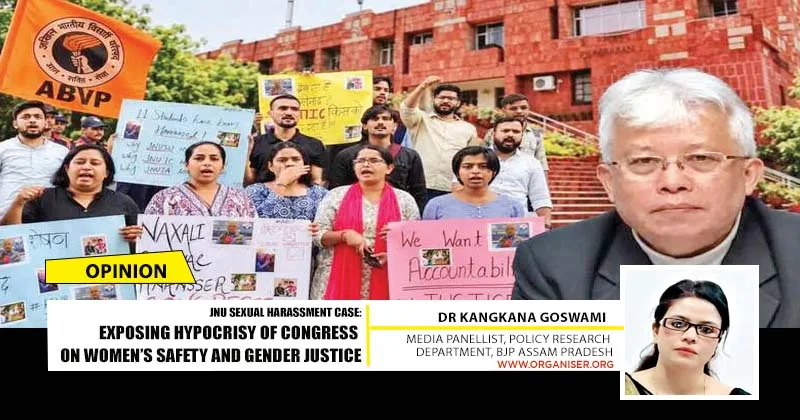
ABVP turns up heat at JNU, demands action over sexual harassment allegations against Congress MP Professor Angomcha Bimol Akoijam
The reality asteroid has hit the ground — and this time, it is about to shatter Congress’s propaganda manufacturing machinery into pieces, exposing what hypocrisy might look like if it had a face. Barely two months after Congress launched yet another campaign around the slogan “Smash the Patriarchy” in August 2026, the controversy surrounding the JNU sexual harassment row involving Congress MP Angomcha Bimol Akoijam has once again brought into focus the party’s tendency towards opportunistic moral grandstanding, selective outrage and political double standards. The incident has once again turned the spotlight on Congress, exposing the contradictions between its rhetoric on women’s safety and its response to the controversy. While Congress has maintained a conspicuous silence on the issue, turning a complete blind eye to the episode, the incident itself raises serious questions about the party’s accountability and sincerity towards the cause of women’s safety. This silence raises grave doubts about its commitment to holding its own leaders accountable. Its apparent reluctance to take action against its MP lends weight to the criticism that women’s rights serve as little more than a tool for political sloganeering and the construction of bombastic narratives for the party.
Such instances of political fence-sitting raise a fundamental question: why do the 11 female student victims at JNU not fit into the “Ladki Hoon, Lad Sakti Hoon” framework that Congress so prominently projected ahead of the Uttar Pradesh Assembly elections in 2022? The episode also raises questions about why the voices emerging from the JNU appear to carry so little weight with Rahul Gandhi, who frequently invokes “Chhatron ki Gunj” in desperate attempts to appeal to the youth, while presenting pre-selected party workers in disguise of spontaneous, independent student representatives.
This, however, is not the first time Congress has come under scrutiny over its treatment of women’s dignity and gender justice. From sexist remarks directed at Defence Minister Nirmala Sitharaman to unparliamentary language aimed at BJP MP Smriti Irani, to even stooping down to the level of disgracing the chair of the President of India with insults and innuendos, the party’s political record is marred with numerous instances in which women have been shamed, slandered and verbally objectified, exposing and dismantling the pro-women posture that they publicly flaunt.
Relying on slogans about gender justice for political gain has, therefore, proved counterproductive for Congress, as its leaders have repeatedly faced criticism for failing to uphold the very standards the party espouses. Such apparent abdication of responsibility defeats the stated purpose of its campaigns, reducing its public assertions to mere political theatrics.
A Pattern Of Double Standards
The JNU episode has once again raised questions about whether closing ranks in the face of mounting scrutiny has become a recurring practice within Congress. Adding a contemporary dimension to the debate, recent controversies involving Rahul Gandhi’s conduct towards a woman police officer and a pregnant journalist has added more fire to the fuel.
JNU dismissed Akoijam, who was associated with the Centre for the Study of Social Systems, with immediate effect on October 9 after an inquiry into sexual harassment allegations levelled against him by 11 students. The university’s Internal Committee recommended a major penalty under the Central Civil Services (Classification, Control and Appeal) Rules, 1965. The complaints reportedly included allegations of sexually suggestive remarks during vivas and classes, inappropriate advances at gatherings at the professor’s on-campus residence, and offers of higher marks in exchange for sexual favours.
On October 7, 2026, Rahul Gandhi was seen pushing a woman police officer away and allegedly touching her inappropriately during an anti-CEC protest in Delhi. Days later, on October 12, pregnant journalist Richa Parashar publicly slammed Rahul Gandhi, accusing him of manhandling her amidst the crowd outside the Supreme Court.
Such repeated incidents have renewed criticism of Congress’s response to questions concerning women’s dignity. The party’s political conduct reflects a troubling inconsistency between its public claims and its actions. Afterall, what else can be expected from a political tendency, that leaves no stone unturned to deprive a 62-year-old Shah Bano from basic compensation after divorce, just for the sake of appeasement and vote bank politics? All said and done, this is the same party that suddenly retreated into deafening silence and went on ‘mute’ mode when the world bowed down to Captain Smit Machchhar’s valour and exceptional heroism.


