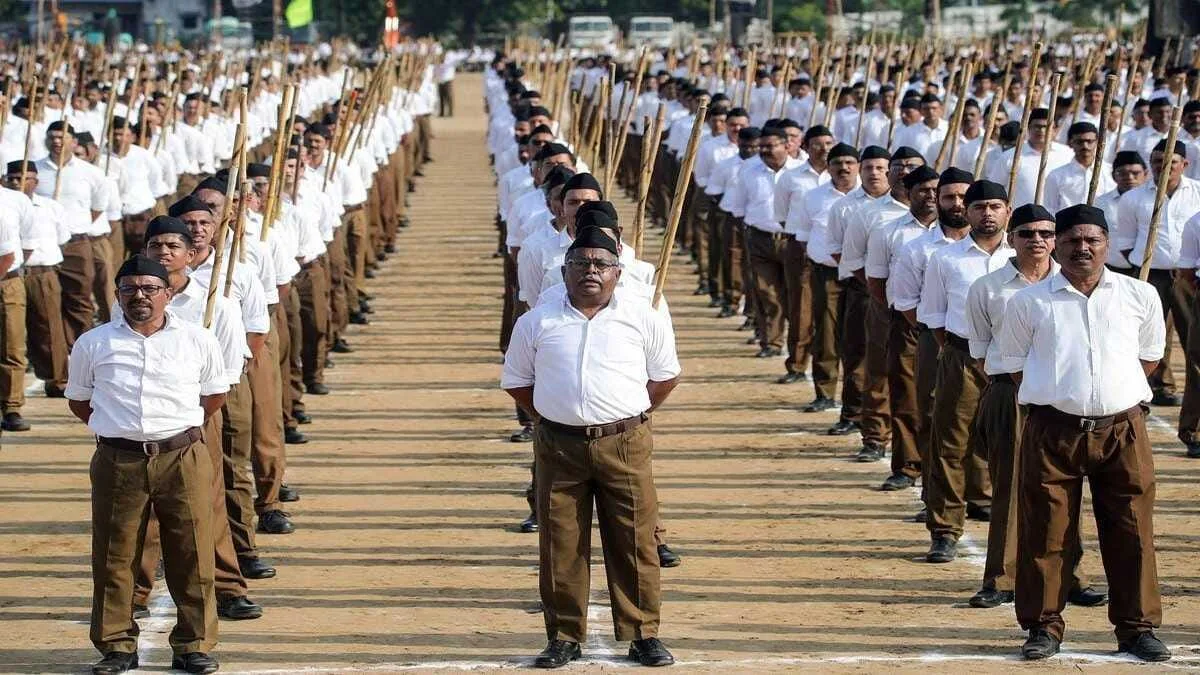
Sangathan, Seva & Shakti represent interconnected pillars of social nation-building that contribute to larger vision of Param Vaibhava Bharat
Param Vaibhava is not merely a vision of economic prosperity or greater global influence. It is a larger national aspiration: a vision of Bharat that stands stronger, rooted in its civilizational heritage, remains united in its diversity, takes responsibility for society’s welfare, and contributes to the well-being of humanity. Such a transformation cannot be achieved through government policies and institutions alone. The strength of society, its values, and people’s willingness to work together for a larger national purpose form the foundation of a strong Nation.
This is where the ideas of Sangathan, Seva and Shakti acquire significance. They can be understood as three interconnected dimensions of social nation-building. Sangathan creates the capacity for collective action; Seva gives that collective capacity a social purpose; Shakti expands that capacity by enabling women to participate actively in society and national life. Together, it leads to the aspiration of Param Vaibhav.
The work of the Rashtriya Swayamsevak Sangh (RSS) and the Rashtra Sevika Samiti become particularly important in this context. Founded by Dr Keshav Baliram Hedgewar in 1925 in Nagpur, the RSS placed social organisation, discipline, and character-building at the core of its work. Eleven years later, Lakshamibai Kelkar founded the Rashtra Sevika Samiti, intending to bring women together for national awakening, social responsibility and service.
The Significance of this journey lies in the social philosophy connecting organisation, service and participation.
A nation reaches its pinnacle when its societies are stronger. Institutions can create policies, but organised social participation determines how effectively values and responsibilities are carried into everyday life.
This explains the importance of the shakha in the RSS tradition. It became an important place to bring people together through physical activities, intellectual discussions, discipline, leadership and social interaction. The RSS calls this process Vyakti Nirman- the development of individuals who can contribute to society.
The rationale behind this is significant: social transformation begins with the development of individuals, but personal growth becomes meaningful at the national level when it fosters the capacity for collective action.
The scale of this organisational network is notable. At present, more than 1,34,000 regular local gatherings across Bharat are conducted, which include daily shakha and weekly or monthly meetings. Around 1,52,000 service initiatives in areas including education, healthcare, social welfare and self-reliance are reported. During the Centenary year, its nationwide Gruha Sampark Abhiyan has sought to establish more direct contact with households and communities.
These accounts are enough to demonstrate organisational reach. An organisation becomes socially meaningful when its members are connected to their local communities and can collaborate to address social needs.
An organisation by itself does not determine how collective strength will be used; its importance depends upon its purpose. This is where Seva becomes core. If Sangathan creates capacity to act; Seva directs that capacity towards society. The RSS’s Service activities include areas of education, healthcare, social welfare and self-reliance, which can be seen at the ground level.
The network of organisations associated with the broader Sangh ecosystem illustrates the diversity. Vanvasi Kalyan Ashram works among tribal communities through education, health and self-reliance initiatives; Vidya Bharti works in education while SAKSHAM focuses on the empowerment and mainstream inclusion of Divyangjan. Seva Bharati, guided by the principle of “Nar Seva hi Narayan Seva”, works for underprivileged communities.
Seva has become more visible at the time of crisis. During the devastating Uttarakhand floods and landslides in 2013, the Chennai floods of 2015, the Ockhi cyclone of 2017 in Tamil Nadu and Keralam, the Wayanad landslides and floods in West Bengal, Odisha and Gujarat in 2024, RSS volunteers have participated in rescue, relief and rehabilitation efforts. The instances show how an organisation built through regular social contact can quickly mobilise when communities face sudden hardship.
In the Sangh Tradition, seva is about standing with society and helping people develop the capacity to move forward and find expression in action. Seva transforms Sangathan from an organisational principle into a social responsibility.
A nation cannot fully utilise its social strength without the participation of women. They are part of the nation’s existing social capacity.
The founding of the Rashtra Sevika Samiti on 25 October 1936 in Wardha by Lakshamibai Kelkar (Mausiji) reflected an attempt to create an organisational platform through which women could participate in physical training, intellectual development, cultural awareness, organisational discipline and social activities. The concept of Shakti therefore provides an important extension to the idea of Sangathan.
The Samiti places the idea of a Tejasvi Rashtra at the centre of its work and regards women as the important foundational strength of the nation. Its approach to women’s development is expressed through three interconnected ideals- Matrutva, Kartutva and Netrutva. It can be understood as a progression from nurturing social values to taking responsibility and exercising leadership.
In 2026, the Samiti reported activities across 852 districts, with 4,886 shakhas, 1,173 milans and 2,866 service activities, providing a practical dimension to the idea of Nari Shakti.
Women’s contribution to nation-building cannot be understood by the number of women sitting in formal political positions; it also takes shape in the classroom, workplace, voluntary organisations, communities and families. Shakti is not just a slogan about Women’s empowerment. It signifies that society becomes stronger when the capabilities, responsibilities and leadership of women are recognised as an integral part of the society’s collective strength.
Sangathan, Seva and Shakti are closely connected and strengthen one another. Sangathan develops the capacity to act together. Seva directs that capacity towards social responsibility, and Shakti expands that capacity by enabling women to participate as contributors.
When organised individuals serve society, and every section of society is able to contribute, national strength becomes broader and more sustainable. In this way, Param Vaibhav is not merely an end goal; it is a continuing process of building a strong, responsible and participative Bharat.
