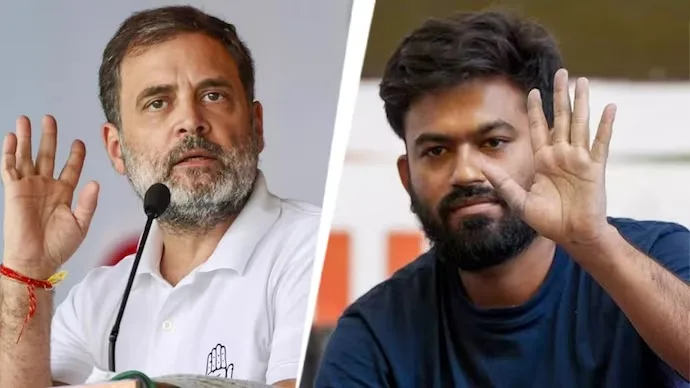
Rahul Gandhi’s reported tea invite to CJP founder Abhijeet Dipke raises questions over Congress’s latest political strategy
The Congress has reached out to Cockroach Janta Party (CJP) founder Abhijeet Dipke, inviting him and the group to a high tea hosted by Lok Sabha Leader of Opposition Rahul Gandhi for INDIA bloc leaders, civil society representatives and student leaders. The outreach marks a notable shift in Congress’s approach towards a group that sections of its leadership have reportedly viewed with suspicion.
According to reports, Congress approached lawyer-activist Prashant Bhushan to help establish contact with Dipke. The move came amid protests against Chief Election Commissioner Gyanesh Kumar and demands for his resignation. Congress has also publicly backed CJP leaders detained during demonstrations in Delhi.
But beyond the invitation and the political calculations behind it lies a question worth asking: why does the Grand Old Party need another player to keep its political spectacle running?
Rahul Gandhi and Priyanka Vadra have spent years trying to establish themselves as the faces of the Opposition. Yet, when the Congress reaches out to a group known for its social-media presence and confrontational protest style, it raises questions about whether the Gandhi siblings can sustain their political momentum on their own.
Enter the Cockroach Janta Party.
Perhaps Congress has realised that the usual slogans, press conferences and parliamentary confrontations need fresh reinforcement. Why carry the entire burden of political drama when another group is willing to take the fight to the streets?
The outreach is particularly striking because sections of the Congress leadership have viewed CJP as an offshoot or front of the Aam Aadmi Party (AAP). Now, however, the group appears to be worth inviting to Rahul Gandhi’s table.
The common ground between Congress and CJP is not difficult to identify.
Congress has repeatedly questioned the Election Commission over alleged electoral irregularities and the Special Intensive Revision (SIR) of voter rolls. CJP has also targeted Chief Election Commissioner Gyanesh Kumar and demanded his resignation.
Both have used public protests to press their demands and framed their campaigns around constitutional rights and the credibility of democratic institutions.
The similarities do not establish that their allegations are correct. But politically, the overlap provides a clear reason for cooperation.
Who needs ideological compatibility when both sides can agree on whom to target?
The high tea invitation may be an attempt to unite different protest platforms under a broader Opposition campaign. It also gives Congress another opportunity to amplify its political messaging through a group that has cultivated its own public profile.
Call it Opposition unity or political networking. The Grand Old Party appears to be expanding its collection of political performers.
The timing of the outreach is equally interesting.
According to reports, Congress was monitoring CJP’s October 10 protest against Gyanesh Kumar and assessing its mobilisation capacity. The demonstration did not unfold as planned amid extensive security restrictions and police action.
Days later, Congress sought to establish contact with Dipke through Prashant Bhushan.
What changed? Did Congress suddenly discover CJP’s political potential, or has the party decided that every group willing to challenge the BJP-led establishment deserves a place in its larger campaign?
For a party that claims to lead the Opposition, the question is whether this is a carefully planned coalition strategy or a search for additional political oxygen.
The metaphor of political parasitism is difficult to resist: one group supplies the agitation, another brings an established political brand, and both hope to gain from the arrangement.
But the relationship also raises a question for CJP. If it has developed an independent following, will it retain its own political identity, or will its campaigns increasingly become part of Congress’s broader Opposition narrative?
The outreach also invites scrutiny of Congress’s approach to parliamentary proceedings.
Since the 2024 Lok Sabha election, multiple parliamentary sessions have witnessed disruptions, walkouts and confrontations over contentious issues. Opposition parties have reasons to demand answers from the government, but repeated disruptions also raise questions about the balance between protest and legislative responsibility.
The same distinction applies to street demonstrations.
CJP’s October 10 mobilisation was followed by extensive police action and detentions. Congress condemned the arrests of CJP leaders and defended the right to peaceful protest.
Yet a broader question remains: what concrete political or institutional outcomes do these repeated confrontations seek to achieve?
When Parliament becomes a battleground of slogans and street politics revolves around barricades and high-profile protests, voters deserve more than a succession of dramatic moments.
A high tea may bring political actors together. It cannot replace a coherent programme.
Why the sudden brotherhood over Election Commission?
Congress and CJP have both made the Election Commission a central focus of their recent campaigns. Congress has raised concerns about voter rolls and the SIR exercise, while CJP has demanded Gyanesh Kumar’s resignation.
Their shared criticism offers an obvious basis for cooperation. But allegations of electoral wrongdoing must be supported by verifiable evidence, and any proposed remedies must follow constitutional and legal procedures.
The Opposition cannot expect public confidence simply by repeating accusations. It must demonstrate what went wrong, establish the evidence and explain how the alleged problems should be addressed.
Nevertheless, the political calculation behind the outreach is clear enough: organisations with similar targets and overlapping narratives can benefit from coordinating their campaigns.
Apparently, the high tea is not merely about refreshments. It is also about bringing another protest platform into the Opposition’s political orbit.
The bigger question is what Congress and CJP intend to achieve beyond meetings, joint protests and political courtesies. Is the outreach the beginning of a coordinated campaign against the government, or is it part of a broader strategy to build pressure on institutions and challenge the existing political order?
The repeated references to the “Bangladesh model” make these questions even more pertinent. Recent political controversy over remarks that Bangladesh’s Gen Z movement “showed us the way” has intensified the debate over whether sections of the Opposition see mass mobilisation as a model for bringing about political change.
Is regime change the ultimate objective? Are Congress and its new protest partners seeking to replicate the political upheaval witnessed in Bangladesh, where mass protests culminated in the fall of Sheikh Hasina’s government in August 2024?
The concern is whether a pattern is emerging in which every constitutional institution, from the Election Commission to other bodies involved in democratic governance, is drawn into a sustained campaign of political confrontation.
The outreach to CJP adds another dimension to this debate. Is Congress simply attempting to consolidate Opposition forces around electoral concerns, or does it envisage a larger movement built around institutional distrust and street mobilisation? Is the Bangladesh model being invoked as a warning, a source of inspiration or a political blueprint?
If their case against the government is supported by evidence, they should present it and identify the remedies they seek. Dramatic slogans, sweeping allegations and confrontational politics cannot substitute for a clearly articulated democratic programme.
The invitation may reflect Congress’s assessment that CJP has acquired sufficient visibility to be a useful participant in a wider Opposition campaign. For Dipke, the invitation could offer access to a larger political network. For Rahul Gandhi, it could help bring another group into the campaign against the BJP-led establishment.
The real test is whether this political courtship produces a coherent agenda or simply combines different sources of agitation.
For a party that has long claimed to be the principal Opposition force, the reported outreach invites a question: has Rahul Baba concluded that the Grand Old Party cannot sustain its political drama alone and now needs the Cockroach Janta Party to keep the show going?
After the high tea, the country will be waiting to see whether the menu includes a serious political programme or simply another serving of Opposition theatrics.
