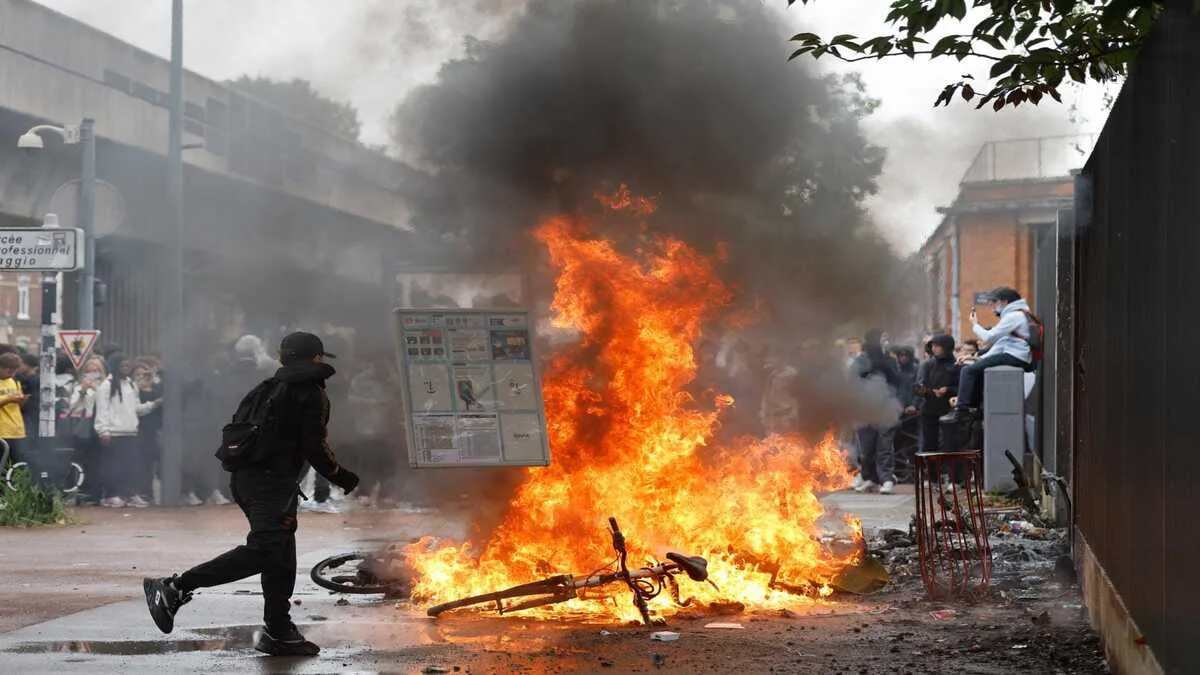
A student walks past a burning bicycle next to the Baggio High School Tuesday, Sept. 29, 2026, in Lille, France
France’s latest wave of violent protests has intensified political tensions ahead of the 2027 presidential election, exposing growing divisions between the French state, radical left-wing movements and sections of the country’s Islamic immigrant population.
What began with strikes by teachers and public-sector workers has developed into a wider confrontation involving student mobs, attacks on police, organised political mobilisation and demonstrations featuring Palestinian flags and pro-Palestine slogans.
The unrest has also drawn attention to the nexus between the radical left and Islamist-influenced political mobilisation, particularly through the activities of La France Insoumise (France Unbowed), led by Jean-Luc Melenchon.
French intelligence agencies reportedly told a government crisis meeting on 1 October 2026 that the protests originated in an organised operation involving LFI and its far-left allies. With Melenchon placing second in presidential polling and nationalist-wing leader Marine Le Pen leading the contest, the riots have added another dimension to France’s deepening political crisis.
The immediate trigger for the unrest was industrial action by left-wing teachers and other public-sector employees, including firefighters. Student protests subsequently spread to schools and public spaces, with demonstrators claiming that overcrowded classrooms and inadequate funding had left the education system in crisis.
However, the demonstrations escalated into violence, with reports of schools being set on fire, police deploying tear gas and flash-ball weapons, and hundreds of injuries and thousands of arrests. Footage circulating from the protests showed masked youths attacking police officers and engaging in violent confrontations.
Critics of the protests have questioned the methods used by demonstrators to highlight educational grievances, arguing that arson and attacks on law enforcement have overshadowed demands for improved school facilities and funding.
The unrest has also revived concerns about the role of radical left-wing organisations in mobilising young people. France already has a long history of mass demonstrations, strikes and street confrontations, but the latest violence has intensified scrutiny of whether political groups are exploiting legitimate public grievances to challenge state authority.
French intelligence agencies reportedly informed a government crisis meeting on 1 October 2026 that the unrest had originated as “an operation organized by LFI (France Unbowed) and its proxies on the far left.”
LFI rejected the allegation. Parliamentary deputy Louis Boyard responded, “LFI has always advocated non-violent demonstrations.”
Nevertheless, the conduct of several LFI representatives during the protests has prompted questions about the party’s position on political violence. LFI deputy Thomas Portes was filmed shoving police officers in Paris, while fellow deputy Bally Bagayoko, who has previously stated that “violence is legitimate,” was seen dancing with a student crowd near burning rubbish bins.
The participation of La France Insoumise representatives in demonstrations across France has brought renewed attention to the relationship between the radical left, pro-Palestine activism and sections of the country’s Muslim population.
LFI deputies reportedly joined student protests, encouraged demonstrators at barricades and participated in chants of “Free Palestine.” Some representatives also intervened during confrontations between protesters and police, prompting criticism that the party was protecting those involved in violent disorder.
“We must protect the youth from the forces of disorder,” LFI Euro-parliamentarian Anthony Smith said.
The rhetoric surrounding the demonstrations became more confrontational on 2 October 2026, when Ritchy Thibault, a former parliamentary assistant to LFI deputy Ersilia Soudais, addressed students at a school in Paris.
“We’ll attack all the police stations in the country,” Thibault told the students. “We’re going to set fire to the Elysee (France’s equivalent of the White House). We’re going to blow everything up.”
The statements have intensified concerns about the radicalisation of political protests and the potential influence of extremist rhetoric on young demonstrators.
LFI leader Melenchon also expressed support for the protesters. “What you’re doing is incredible,” he said in a message dated 6 October 2026.
Boyard, who has presented himself as an advocate of non-violence, led students at Paris-Est-Creteil University in singing “La Marseillaise,” France’s national anthem and revolutionary marching song. The demonstration reportedly included masked youths, while Boyard raised a Palestinian flag rather than the French tricolour of red, white and blue.
The episode has become a focal point in the debate over the Left-Islamist nexus in France. Critics argue that the combination of radical left-wing politics, pro-Palestine mobilisation and confrontational street activism reflects a broader political realignment.
The wider controversy concerns whether sections of the radical left are building political alliances with religious and ethnic constituencies whose grievances can be mobilised against the existing political establishment.
Beyond the immediate violence, the riots have brought renewed attention to France’s unresolved debates over Muslim immigration, national identity, integration and the political influence of its Muslim population.
The unrest has been interpreted by some nationalist politicians and commentators as another confrontation between the institutions of the Fifth Republic and a younger, increasingly diverse population that they argue remains insufficiently integrated into French society. Many members of these communities, however, are French citizens, including people born and raised in France.
The debate recalls the emergence of what French critics describe as an Islamogauchiste or Islamo-leftist alliance that a political convergence between traditional left-wing movements and sections of the Muslim population, particularly in the peripheral housing estates known as the banlieues.
Opposing groups argue that the alliance has become an important feature of electoral politics, with immigration, religious identity and opposition to nationalist parties increasingly influencing political mobilisation.
Similar strategies have been discussed in connection with left-wing electoral movements in the United Kingdom, Sweden, Germany and the United States. Critics contend that some parties have cultivated ethnic bloc voting to consolidate electoral support.
In the United States, they point to Democratic mobilisation in states such as New York and Michigan, while in Europe they cite political developments involving the British Labour Party and left-wing parties in Sweden and Berlin.
The political significance of immigration is particularly pronounced in France, where the debate over integration has become central to the contest between the radical left and the nationalists.
The Immigration and Demography Observatory, a French think tank, predicts that, if current demographic trends continue, French citizens without an immigrant parent or grandparent could become a minority around 2050.
The projection has become part of a wider political argument over demographic change and the future of French national identity.
Melenchon, a 75-year-old former communist who was born and raised in Morocco before moving to France in 1962, has emerged as one of the most prominent figures in this debate. His arrival in France coincided with a period of large-scale migration from former European imperial territories as colonial empires collapsed.
Melenchon has described French democracy as a design for “white privilege” and as “part of an already obsolete present.” He has called for a “citizen’s revolution” to establish a “new France” and labelled nationalist presidential contender Marine Le Pen a “fascist.” His political positions have reinforced the perception among opponents that the 2027 election will be a contest over immigration, national identity, the role of religion and the future direction of the French Republic.
The riots have sharpened the political confrontation between Melenchon and the radical left on one side and nationalist parties advocating stricter immigration policies on the other.
Only days before the protests began, French streets had witnessed public celebrations associated with Pope Leo XIV. The subsequent violence has highlighted the contrasting political and social currents competing for influence in the country.
Eric Zemmour, a nationalist anti-immigration politician and rival of Melenchon, described the situation as a confrontation between two visions of France.
“In just one week, we have been able to see in our streets the two Frances that now face each other on our soil,” Zemmour said on 30 September 2026.
Zemmour, the French-born son of Berber Jewish parents from Algeria, has characterised the traditional France of the Fifth Republic as “largely white, Christian, European, even if various minorities join it.” He contrasts that vision with “another France that is largely African, Arab, Muslim,” whose supporters, he argues, wave “Algerian, Moroccan or Palestinian flags” as symbols of resentment towards the existing national order.
“Eternal France against the new France: that will be the showdown of the 2027 presidential election,” Zemmour predicted.
The assessment reflects a wider political struggle over whether immigration, religious identity and integration will dominate the next presidential contest. Melenchon, Zemmour and Le Pen have all become prominent figures in the increasingly polarised debate, although they offer sharply different visions of France’s future.
The political crisis is unfolding alongside mounting economic pressures. France’s debt-laden economy and growing concerns in financial markets have added to the challenges facing the government.
As one of the European Union’s two principal powers, a nuclear-armed state and a permanent member of the United Nations Security Council, France occupies a central position in European and international affairs.
The latest riots therefore extend beyond questions of school funding and public-sector strikes. They have exposed tensions surrounding radical left-wing activism, the Left-Islamist nexus, immigration and the legitimacy of political protest.
With the 2027 presidential election approaching, the ability of French political institutions to contain violence, restore public confidence and address competing demands over national identity will become increasingly significant.
The unrest has underscored the depth of France’s political divisions and the challenges confronting the Fifth Republic as rival movements compete to define the country’s future.
