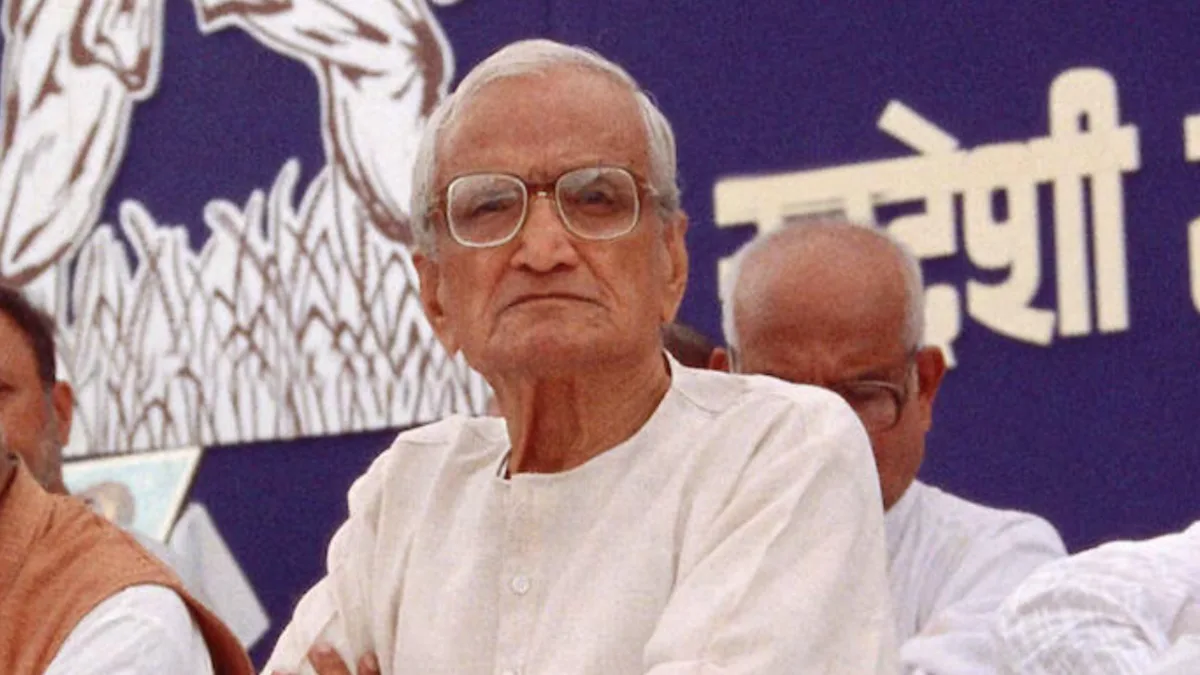
On October 14, we remember Dattopant Bapurao Thengadi Ji, who passed away in 2004. To those who knew him well, he was not merely a thinker, philosopher, or trade union leader. He was a rare nation-builder who demonstrated how ideas could be translated into institutions, institutions into movements, and movements into instruments of social and economic transformation.
Many thinkers have written profound books, developed theories and offered intellectual critiques of existing systems. Yet, too often, their ideas remain confined to libraries and bookshelves. Thengadi Ji belonged to a different category. He did not merely articulate an alternative; he built the organisational infrastructure through which that alternative could be practised.
He understood that an idea, however powerful, cannot transform society unless it finds its expression in organised human effort. It needs institutions, committed people, a clear method of working and the patience to nurture them over decades. This was perhaps one of his greatest contributions to India’s intellectual and organisational life.
Through the organisations he founded and nurtured, including the Bharatiya Mazdoor Sangh, the Bharatiya Kisan Sangh and the Swadeshi Jagaran Manch, he demonstrated his ability to translate philosophical conviction into organised action. These were not simply platforms for propagating ideas; they were instruments for putting those ideas to work in the real world.
His approach was distinctive because he understood the importance of modus operandi. He did not stop at explaining what was wrong with existing systems. He worked to develop alternative institutions, methods and organisational practices that could make his vision a living reality. He understood that enduring change requires not only intellectual clarity but also organisational capability, discipline and continuity.
At the heart of his thinking was the human being. For Thengadi Ji, the economy was not an end in itself, nor was the worker merely an input in the production process. Economic development had to serve human welfare, social harmony and national well-being. Technology, industry, markets and institutions had to be evaluated by their contribution to human life, not merely by their efficiency or profitability.
This human-centric approach was particularly evident in his understanding of labour. He rejected the idea that workers’ organisations should become instruments of political parties or remain trapped in the ideological conflicts of competing political establishments. He believed that a trade union must derive its strength and legitimacy from its relationship with workers, its commitment to their interests and its ability to improve their lives.
The organisational independence of the Bharatiya Mazdoor Sangh reflected this conviction. Its guiding principle was that workers’ interests should not be subordinated to the political calculations of any party. The worker was not a means to achieve somebody else’s political objectives; the worker was the very purpose of the organisation.
This was not merely a matter of organisational structure. It represented a deeper understanding of the dignity of labour and the autonomy of workers. It challenged the tendency of modern ideological movements to appropriate workers’ organisations for purposes extending far beyond the immediate and long-term welfare of workers themselves.
Thengadi Ji also offered an alternative understanding of economics. Through his advocacy of Swadeshi and what he described as the Third Way, he challenged the limitations of both unrestrained capitalism and communism. He sought an economic order rooted in India’s civilisational experience, social responsibilities and national requirements. His concern was not simply with who owned the means of production, but with the purpose of production, the distribution of its benefits and the place of human beings within the economic system.
His vision was neither a rejection of modernity nor an uncritical acceptance of Western models. It was an attempt to develop an indigenous framework capable of responding to contemporary challenges. He recognised the importance of technology and industrial development, but his approach invites us to ask a question that has become even more relevant today: Should human beings be adjusted to the demands of technology, or should technology be designed and deployed to serve human beings?
In the age of artificial intelligence, automation and digital platforms, this question deserves renewed attention. Technological advancement cannot be considered complete if it increases productivity while diminishing human dignity, displacing livelihoods without adequate alternatives or concentrating economic power in a few hands. Technology must expand human capabilities, improve working conditions and create opportunities for meaningful participation in economic life.
Thengadi Ji’s thought offers a valuable foundation for developing such a human-friendly approach to technological progress.
Looking back at his life and work, I believe his most enduring legacy lies in the integration of thought, organisation and action. He showed that intellectual leadership is not measured only by the originality of one’s arguments or the number of books one writes. It is also measured by the institutions one creates, the people one inspires, the methods one develops and the capacity one builds in society to carry an idea forward.
This is why his work remains relevant beyond the organisations he founded. His method offers lessons for anyone seeking lasting social transformation: develop a clear philosophy, build institutions around it, cultivate capable leadership, establish a disciplined method of functioning and ensure that the organisation remains connected to the people it exists to serve.
For those of us engaged in labour and social thought, his life presents both an inheritance and a responsibility. We must not allow his ideas to become subjects of ceremonial remembrance alone. We must study them critically, deepen their contemporary relevance and translate them into responses to the challenges faced by workers, farmers, self-employed people and the wider society.
At the Dattopant Thengadi Foundation, this responsibility acquires a particular significance. The task is not merely to preserve his writings or celebrate his contributions, but to continue the intellectual and institutional work of connecting India’s civilisational wisdom with contemporary economic realities, labour policy and technological change.
On his Punyatithi, my tribute to Dattopant Thengadi Ji is therefore not simply an expression of reverence for a great personality. It is a reaffirmation of the path he demonstrated: the path of intellectual independence, organisational creativity, national commitment and human-centric development.
He taught us that ideas acquire their real worth when they enter the lives of people. A philosophy must become a practice; a vision must acquire an institutional form; and a movement must remain faithful to the human purpose for which it was created.
Dattopant Thengadi Ji did not merely leave behind a body of thought. He left behind institutions, organisational traditions and a method of converting thought into action.
That is what makes him exceptional. That is what gives his legacy continuing relevance. And that is why remembering him must also mean carrying forward the unfinished work of making his ideas meaningful for the present and the future.
Humble tributes to Dattopant Thengadi Ji on his Punyatithi, 14 October.
His life reminds us that the true measure of an ideologue is not only what he thinks or writes, but what he builds, what he inspires and what he leaves capable of carrying on his work.