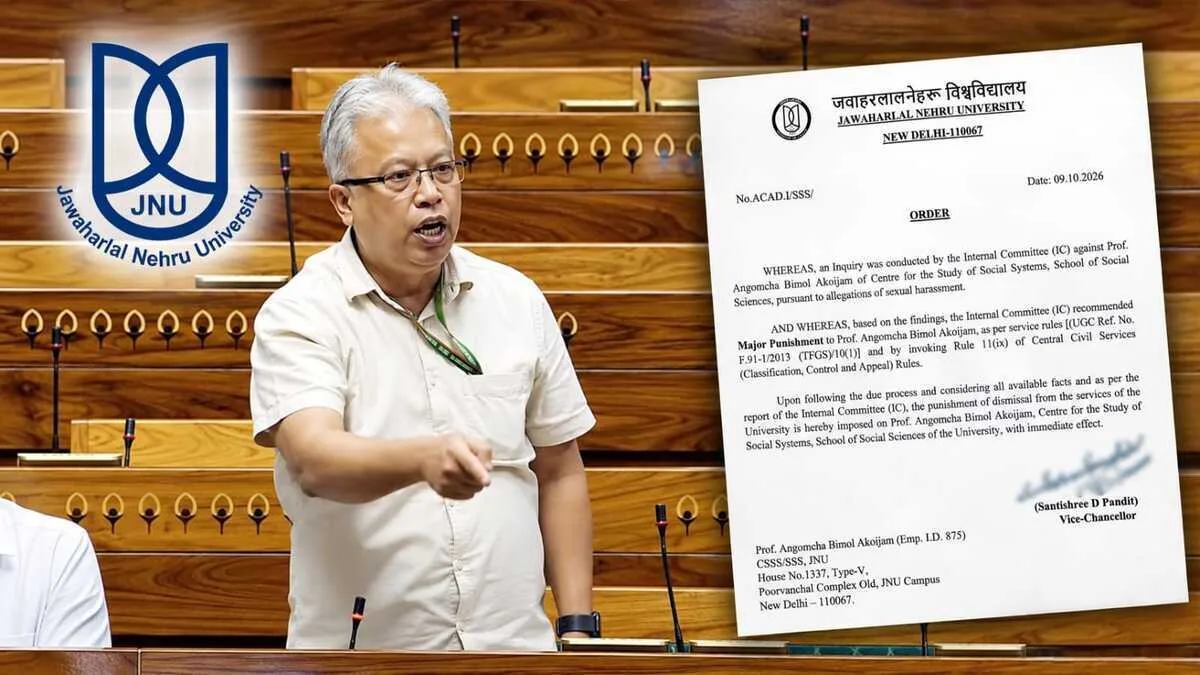
JNU has dismissed Congress MP and Professor Angomcha Bimol Akoijam following an Internal Committee inquiry into sexual harassment complaints filed by at least 10 students
NEW DELHI: Jawaharlal Nehru University (JNU) on October 9 dismissed Professor Angomcha Bimol Akoijam following an inquiry into sexual harassment complaints filed by at least 11 students. The university took the decision based on the findings and recommendations of its Internal Committee (IC), which investigated the complaints against the professor.
According to an order issued by JNU on October 9, the Internal Committee investigated the complaints against Akoijam, who was associated with the Centre for the Study of Social Systems under the School of Social Sciences.
Following the inquiry, the committee recommended major punishment under the applicable service rules. The university subsequently ordered his dismissal after considering the committee’s report and completing the prescribed process.
“Upon following the due process and considering all available facts and as per the report of the Internal Committee (IC), the punishment of dismissal from the services of the University is hereby imposed on Prof. Angomcha Bimol Akoijam,” the order stated. The dismissal marks the outcome of the university’s disciplinary proceedings into the complaints submitted by the students.
According to earlier reports, at least 11 students accused Akoijam of sexual harassment. The complaints were reportedly submitted to the university before the inquiry was initiated.
The complaints stated that the professor, who lived on the university campus, invited students to his residence for gatherings and made sexual advances towards them. Some students also reported that he made lewd or inappropriate remarks during classes. The allegations reportedly led other students, including senior students, to come forward with similar complaints. The university’s Internal Committee subsequently examined the complaints and conducted an inquiry into the allegations.
The university’s October 9 order stated that the dismissal was imposed after due process and consideration of the Internal Committee’s report. The action was taken under the applicable service rules governing university employees.
The case highlights the role of institutional mechanisms in examining complaints of sexual harassment within higher education institutions. Such committees are responsible for examining complaints and recommending appropriate action in accordance with the applicable rules.
With the dismissal order, JNU has taken disciplinary action against the professor following its internal inquiry. Further details regarding the committee’s findings and any response from Akoijam were not available in the information cited for this report.
