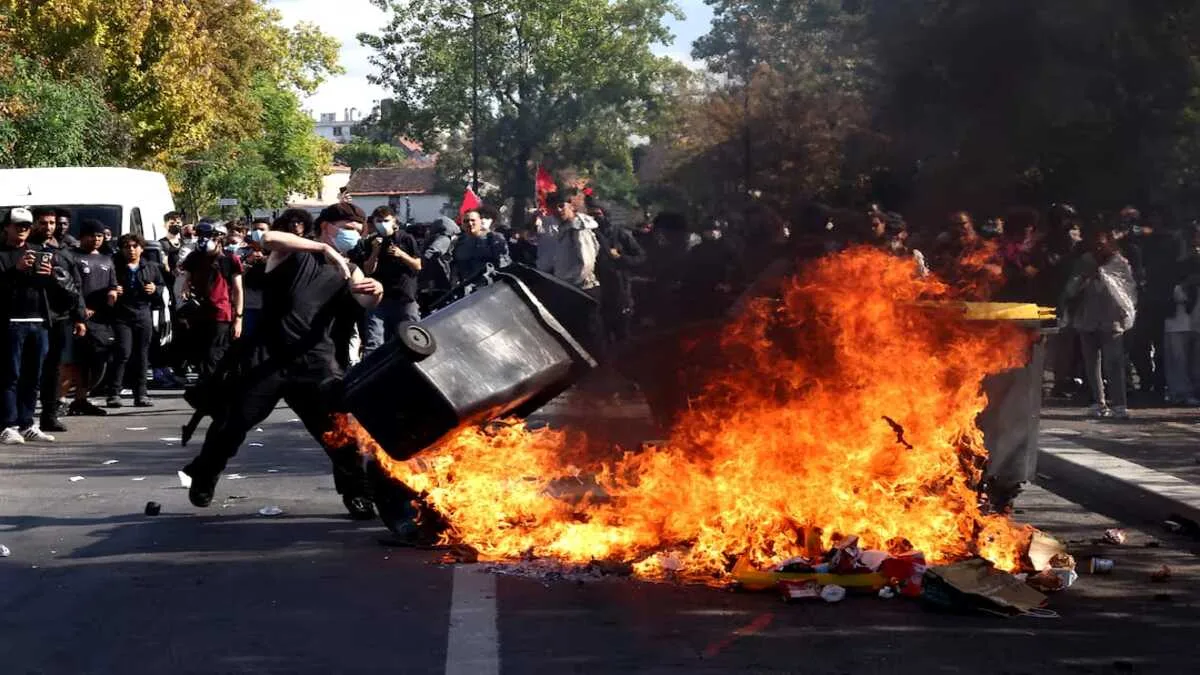
A masked protester throws a garbage bin into a burning pile of debris during clashes between the protesters and French riot police in Paris on October 8
Student protests over education funding, deteriorating school conditions and rising costs are spreading across Europe, with demonstrations and clashes reported in France and Belgium and student movements gaining momentum in Greece, Italy, Ireland, Germany and Austria.
Police and protesters clashed in Liege, Belgium, on October 7 as anger over education costs and school conditions intensified, echoing the unrest that has swept neighbouring France. Belgian police have made at least 139 arrests in Liege since the protests began on October 1.
The unrest initially erupted in France in mid-September as a localised demonstration by high-school students in Paris but has since escalated into a nationwide movement involving students, parents and teachers’ unions demanding increased education funding.
Clashes between French police and protesters have intensified in recent days. In one incident, a 15-year-old boy lost his hand after a stun grenade fired by police exploded. More than 6,500 people, most of them minors, have been arrested since the demonstrations began.
Although France remains the epicentre of the current wave of unrest, similar grievances are driving student mobilisation across the continent. Crowded classrooms, teacher shortages, university funding cuts, deteriorating school infrastructure and rising education expenses have emerged as common concerns.
In Greece, students have called for nationwide school actions on October 8, including assemblies, walkouts, demonstrations and possible occupations, according to Euronews.
Italy has also witnessed a fresh wave of student activism. High-school occupations began in Turin and Rome on October 5 under the slogan “Let’s do as in France”. Students have cited inadequate funding, deteriorating school buildings and rising living costs among their principal grievances. A delegation of Italian students also travelled to Paris to express solidarity with their French counterparts, ANSA reported.
In Ireland, thousands of university students demonstrated in Dublin earlier this month, demanding lower fees, increased higher-education funding and affordable accommodation, according to RTE.
Germany witnessed demonstrations in September involving students, teachers, parents and trade unions. Participants called for greater investment in education, more teachers and a more equitable school system, Tagesschau reported.
In Austria, student groups are preparing further demonstrations in mid-October following a warning from the country’s university association about possible cuts of approximately €1 billion from the next three-year university budget, according to ORF.
Together with France and Belgium, these developments illustrate the breadth of education-related discontent across seven European countries, although the demonstrations are not part of a single coordinated movement.
The protests come as several European governments face mounting pressure to reduce budget deficits while higher borrowing costs increase the expense of servicing public debt.
France and Belgium are each projected to record budget deficits exceeding 5 per cent of gross domestic product (GDP) this year, while Austria’s deficit is forecast to exceed 4 per cent, according to European Commission forecasts.
These fiscal constraints are forcing governments to make difficult decisions over public expenditure, including funding for schools and universities, as students and education-sector groups demand greater investment.
Despite differences in their national circumstances, demonstrators across Europe are raising similar concerns about the quality, affordability and accessibility of education.
The immediate protests remain nationally driven, with different groups pursuing their own demands. However, the spread of demonstrations highlights a common challenge facing European governments, addressing growing pressure on education systems while managing increasingly constrained public finances.
