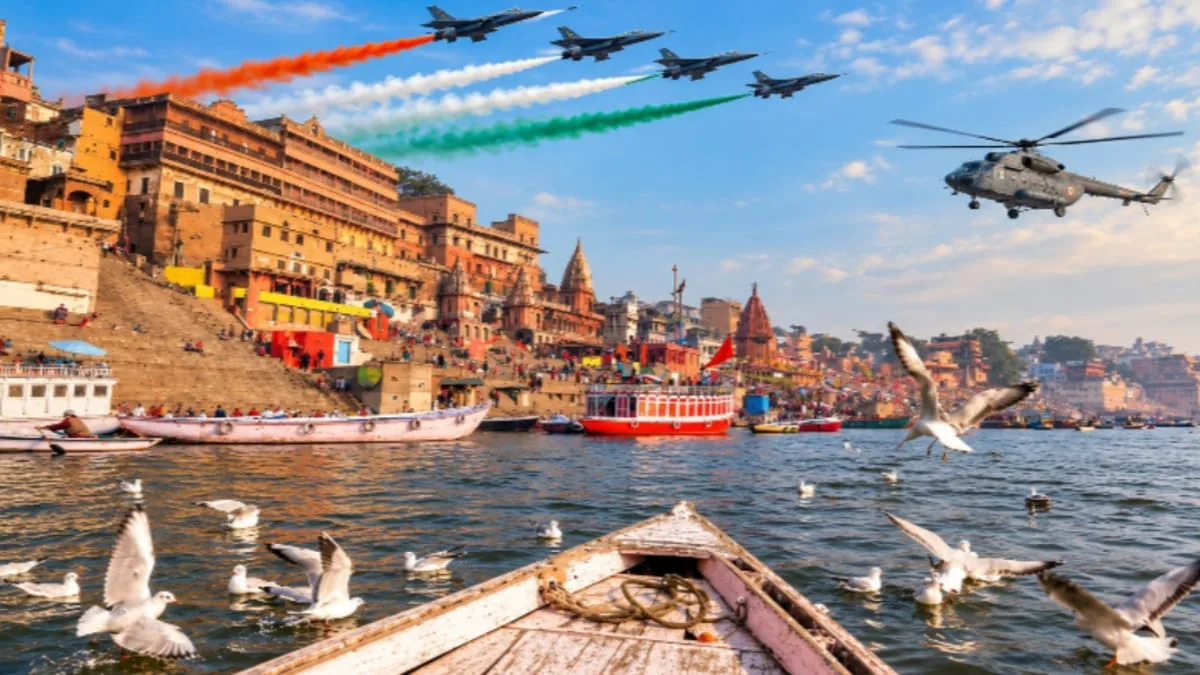
Varanasi gears up for a spectacular IAF air show over the Ganga, showcasing India’s air power and Atmanirbhar Bharat
KASHI: For the first time in its three-thousand-year history, the skies over Kashi are set to reverberate with the roar of fighter jets rather than temple bells alone. The Indian Air Force will stage its first-ever air show over the Ganga at Namo Ghat, Varanasi, from October 24 to 26.
The main ceremony is proposed for October 25, when Prime Minister Narendra Modi and Defence Minister Rajnath Singh are expected to attend.
More than three dozen aircraft, including Rafale fighters, Tejas jets, the Suryakiran aerobatic team, Rudra helicopters, C-295 transporters and vintage Dakota aircraft, will perform low-altitude manoeuvres over the river between noon and 2 pm each day. Uttar Pradesh Chief Minister Yogi Adityanath is personally reviewing security and crowd-management preparations this week.
The timeline itself has evolved as preparations intensified. Early reports in September had shared that October 22, 23 and 25 are show days, with Air Force control over Namo Ghat beginning October 16 and rehearsals from October 20.
Following the Chief Minister’s high-level review meeting on October 3, the schedule was firmed up to October 24, 25 and 26, with the Air Force displays stretching from Namo Ghat toward Assi Ghat, covering a stretch of the riverfront that takes in several of the city’s 84 historic ghats.
Officials said three to five aircraft will perform simultaneous manoeuvres during each roughly ninety-minute window, a format the Air Force has previously used at Jal Mahal in Jaipur and other heritage sites to bring its aerial capability closer to the public.
What makes the Varanasi show distinct is the aircraft on display. Tejas, India’s indigenously designed light combat fighter, and the HAL-built Rudra and Sarang helicopters will fly alongside the French-origin Rafale, giving spectators a rare side-by-side view of imported firepower and homegrown engineering.
For a country that has spent decades importing the bulk of its combat aircraft, a Make-in-India fighter sharing the same sky as a Rafale over the Ganga carries its own quiet symbolism. A reminder that India’s defence self-reliance journey, like its civilisational one, is best measured in decades rather than headlines.
Files, images, and data analysis are unavailable until usage resets at 2:21 PM. Continue chatting with text only, or upgrade for more access.
The choice of venue, Namo Ghat, formerly the modest Khidkiya Ghat, was rebuilt at a cost of about Rs 91 crore and inaugurated in November 2024 in the presence of Governor Anandiben Patel and Chief Minister Yogi Adityanath.
Spanning roughly 1.5 kilometres between Rajghat and Adi Keshav Ghat, it is the only ghat in Varanasi accessible by road, water and air, with a helipad that makes it uniquely suited to host an Indian Air Force spectacle.
Hosting an event of this scale on the Ganga’s banks is no small administrative undertaking. Varanasi Police Commissioner Mohit Agarwal has inspected Namo Ghat, Raj Ghat and Bhaisasur Ghat in recent weeks, with crowd estimates for the three days ranging from roughly 20 lakh to as high as 30 lakh visitors. These numbers are more typically associated with Dev Deepawali, Kashi’s annual festival of a million lamps. Sector-wise magistrates and police personnel are to be deployed along the riverfront, with CCTV cameras, drones and additional forces stationed at sensitive points.
Around 5,000 VIP guests from India and abroad are expected at the main event, and neighbouring districts, including Chandauli, Ghazipur and Jaunpur, have been drawn in to help manage the inflow of visitors converging on the city.
Chief Minister Yogi Adityanath has review meeting this week: it would have spectator galleries, a grandstand, zones for distinguished guests, a media arena, entry and exit routes and dedicated security-screening points were all discussed with Air Force officers, district administration and police.
The Chief Minister also directed that drinking water, first aid, sanitation and clearly marked movement routes be arranged across every sector and that emergency and security arrangements be rehearsed through mock drills so that all concerned teams can act swiftly if required. He also asked district magistrates across the Varanasi division to coordinate closely, given the scale of visitors expected from surrounding districts.
The air show does not arrive in isolation on the Varanasi calendar. It falls within a broader season of commemoration in the Prime Minister’s parliamentary constituency marking 25 years of his public life, including the BJP ‘Seva Sankalp Yatra’, which Union Home Minister Amit Shah was scheduled to receive in Kashi on October 7.
A theatrical tribute titled ‘Namo Seva – Untold Stories’ will be staged through nukkad natak performances across the city. Seen against this backdrop, the air show is as much a civic and cultural event as a military one, timed to draw visitors from across India and abroad into a city that has in recent years positioned itself simultaneously as a spiritual capital and a showcase of New India’s infrastructure ambitions.
The aerobatic centrepiece, the Suryakiran team, brings a pedigree of more than 800 air shows worldwide, its Hawk jets trailing tricolour smoke through loops, barrel rolls and formations such as the diamond and the heart shape, with a signature seen from Republic Day flypasts to Jaipur’s Jal Mahal show earlier this year.
Such displays serve a dual purpose where Air Force officers have described them as tools to inspire youth toward careers in the armed forces, while giving ordinary citizens a rare, close view of India’s aerial capability.
In Varanasi, that outreach is amplified by the city’s existing pilgrimage and tourism footfall, meaning the show will likely reach an audience far broader than aviation enthusiasts alone.
For Varanasi’s hospitality and transport sectors, the show adds a fresh surge of demand in late October. Hotels, homestays and boat operators along the ghats are bracing for footfall comparable to the city’s biggest religious festivals, with river traffic, cruise bookings and ropeway services needing coordinated scheduling alongside road arrangements.
District officials have also been directed to ensure that pilgrims visiting Kashi Vishwanath and the ghats for routine darshan are not inconvenienced by the security cordons that a VVIP event of this scale necessarily demands.
For residents of Kashi, long accustomed to the sound of temple conches and the evening Ganga Aarti, the spectacle of fighter jets banking low over the river will be an entirely new sensory experience. In a city where the Kashi Vishwanath Corridor, the Varanasi airport’s expansion and the Namo Ghat redevelopment have each, in their own way, married ancient heritage with contemporary state capacity, the air show fits a now-familiar pattern.
It ultimately draws the twenty lakh visitors first projected or the thirty lakh more recently estimated; the Indian Air Force’s three days over the Ganga will mark a historic first for a city that has spent three millennia measuring time by the river’s flow and will.
This October, the roar of Rafales and the smoke-trails of Suryakiran overhead Kashi. For a city whose ghats have witnessed emperors, saints and pilgrims across centuries, the sight of the tricolour painted across the sky by fighter jets will be remembered as one more chapter in Kashi’s long, continuing conversation between faith and the nation’s evolving strength.
