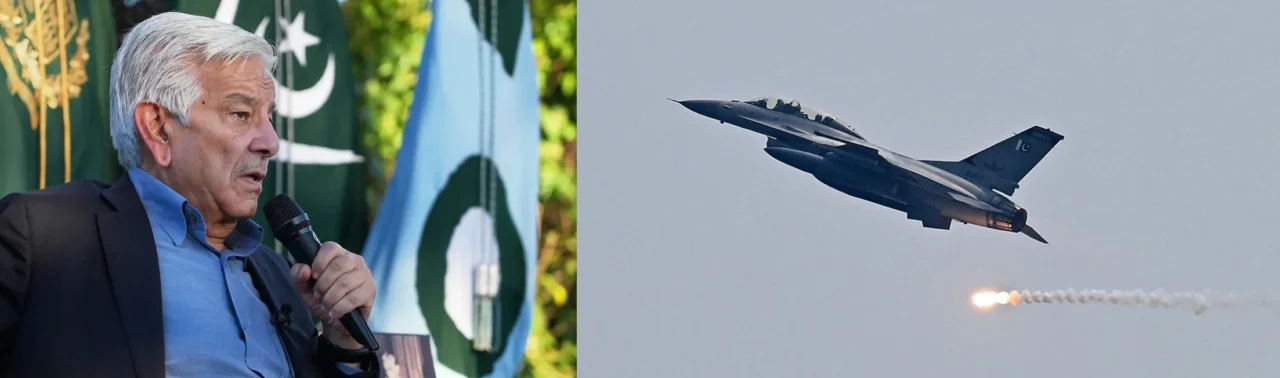
Pakistan Denies NYT Report on PAF Jet Deployment Against Houthis in Saudi Arabia
JAMMU: Pakistan’s Information Ministry has dismissed a New York Times news report claiming that Pakistan Air Force (PAF) aircraft were being used against Yemen’s Houthis as “fake and fabricated”. The NYT report, published on October 7 (Wednesday), a screenshot of which the ministry shared in an X post, cited an unnamed source as saying that PAF fighter jets were being employed against the group, amid the latter’s escalating conflict with Saudi Arabia.
The Information Ministry has denied the report, saying in a post on X that the story “attributing the employment of PAF aircraft against Houthis is fake and fabricated”, a statement issued on Thursday said, according to a Dawn report.
“International media houses are again asked to avoid speculative reporting with regards to employment of Pakistan’s military forces under the Makkah Joint Defence Agreement. Details of any deployment, if necessary, will be given by the authorities concerned,” it added.
Earlier this week, the ministry also termed an agency report claiming the deployment of 30,000 to 40,000 Pakistani troops in Saudi Arabia as “speculative”.
The development comes after Pakistan, Saudi Arabia and Turkiye agreed to the deployment of military forces and capabilities rapidly in the kingdom during an emergency meeting of the Makkah Defence Alliance in Riyadh on Monday (October 5).
The defence pact, signed by Pakistan, Turkiye and Saudia Arabia on August 7, aims to strengthen collective deterrence. It also claims to empower its signatory states to treat an attack against one of them as an attack against all of them. However, the Saudis have been fighting their own battles against the Iran-backed Houthis who are entrenched in parts of Yeman.
The Monday meeting under the alliance was held to address the security developments and threats facing Saudi Arabia.
A statement issued by the Foreign Office after the meeting said the member states had “decided to move immediately to the practical implementation of the collective defence commitments and to take the necessary measures to provide the agreed military forces and capabilities and ensure their rapid deployment in the kingdom, in accordance with the approved arrangements and the national legislation of the parties, thereby enhancing readiness, military integration, and the collective capacity to confront and counter threats”.
Separately, Defence Minister Khawaja Asif, who was part of Pakistan’s delegation in the meeting, has said Saudi Arabia had made “gains and recovered some areas” in Yemen in the ongoing fighting with the Houthis.
Asked about a possible operational role by Pakistan and Turkiye, Mr Khwaja Asif said that both nations had a “presence in theatre”, but only Saudi troops were involved in combat operations.
On Wednesday, Inter-Services Public Relations (ISPR) Director General Lieutenant General Ahmed Sharif Chaudhry also said that Pakistani troops are in Saudi Arabia, adding that they had been in the kingdom “for decades” and across multiple domains. This was interpreted as trying to maintain vagueness and strike a delicate balance.
Pakistan is trying to play peacemaker in the war that is going on in the Gulf region since February 28 this year. It has been saying that it is not taking any sides though Iranian proxies are attacking Saudi Arabia at many places, including its cities, its naval assets in the sea and oil infrastructure.
Incidentally, it needs to be stated here that Saudi Arabia and Iran are antagonistic to one another, with each trying to gather an upper hand among the Islamic nations. While Saudis are Sunni, Iran is entirely Shia, two Islamic sects violently opposed to each other since the birth of this religion.
The Houthis have declared a maritime blockade on the Saudi kingdom and they have been targeting its ships in the Red Sea. Both sides have claimed strikes on each other as tensions remain high.
On Thursday, the Houthis claimed that they had struck the Saudi capital Riyadh’s main international airport with a ballistic missile, in another attack on the kingdom claimed by the group.
A day earlier, Saudi authorities had said that three people were killed and 36 injured in attacks on two of the kingdom’s international airports including in the capital Riyadh. This happened after Yemen’s Houthis claimed to have fired on both transport hubs.
For its part, a Saudi-led coalition that backs pro-government forces in Yemen said on X that it “destroyed the ballistic missile launch platform” used in the attack on Riyadh. The Houthis, who control most of the country’s north west, are battling for territory against the Saudi-backed forces after the civil war reignited in July and they catptured swathes of coastal land.
Yemen’s internationally recognised government this week declared a major counter-offensive and said Houthi fighters were pushed out of strategic areas on the Red Sea and the port city of Mocha. But the Houthis say they are holding their territory, and military sources from both sides have not reported any major changes on the ground.
Claims by the warring parties have been impossible to independently verify with the situation moving fast and access for journalists difficult.
Islamabad hunting with hounds, running with hares
On September 18, ISPR boss Lt Gen Chaudhry had said Pakistan would go to “any extent” to defend the Gulf state, adding that Islamabad’s commitment to the kingdom’s security is “unconditional”. It is interesting that despite these tall claims, Pakistan is now denying that its forces are fighting on the side of Saudis.
Pakistan’s economy is heavily dependent on Saudi Arabia’s doles which has been keeping it afloat through repeated donations, large sums of money as also free oil. At one time, Saudi Arabia had stepped in with a $3.4 billion donation to Pakistan when UAE refused to renew its loan of the same amount.
The importance of the repeated doses of Saudi money into Pakistani economy can be gauged from the fact that it is presently trying to seal a deal with International Monetary Fund (IMF) for a tranche of $1.2 billion. This tranche is a part of the $7 billion IMF loan that the lender has agreed to give to Pakistan over several years.
Pakistan Defence Minister Khwaja Asif has also reaffirmed that Pakistan will “practically and diplomatically” stand by Saudi Arabia against Yemen’s Houthi rebels if the situation escalates. He said that Pakistan would fulfill all its obligations under the Makkah Defence Alliance in accordance with the terms of the agreement between the three countries.
At the same time, Pakistan has also asserted that the alliance is intended for collective deterrence and was defensive in nature. As such, it can be clearly inferred that Pakistan is speaking with a forked tongue, trying to please Saudi Arabia while simultaneously not annoying Iran.
