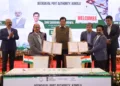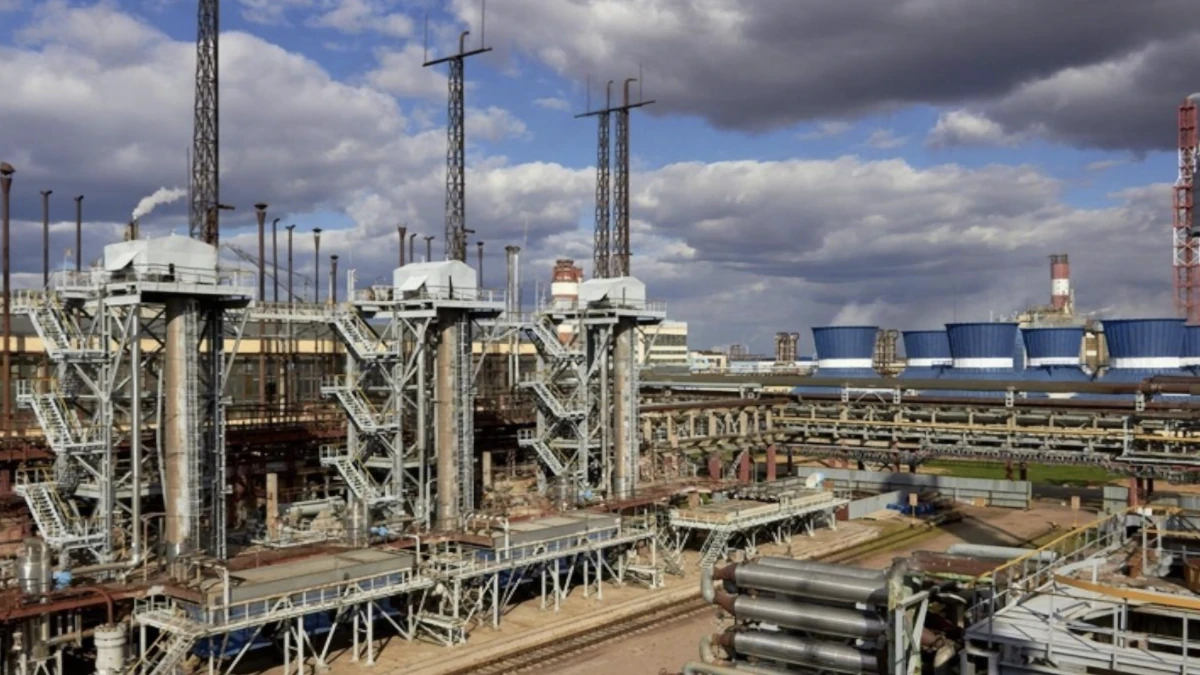
On September 26 2026, Gujarat Chief Minister Bhupendra Patel, Union Ports Minister Sarbananda Sonowal and Assam Chief Minister Himanta Biswa Sarma laid the foundation stone of India’s first port-based e-methanol plant at Deendayal Port, Kandla.
When completed it will make 150 tonnes of e-methanol a day and sell it to ships on the Asia–Europe trade route. Deendayal Port handled 160.11 million tonnes of cargo in 2025-26, the most of any major port in India. Making fuel where that traffic already stops turns a cargo gateway into a refuelling station for the clean-fuel era.
For a country long dependent on imported fuel, has started to shift its role. India plans to make a clean marine fuel for the world not to buy one.
What exactly is e-methanol?
Methanol (CH₃OH) is the simplest alcohol, a clear liquid that industry has used for decades to make formaldehyde, plastics and solvents. Its chemistry does not change with its origin but the climate footprint does.
Most of the world methanol is “grey”, made from natural gas or coal, so fossil carbon ends up in the air. Bio-methanol comes from biomass or biogas. E-methanol, the Kandla will produce is built from two ingredients i.e. green hydrogen, split from water using renewable electricity and captured carbon dioxide.
The Kandla plant will use biogenic CO₂, meaning carbon that plants recently drew from the atmosphere, captured at sources such as biogas units or distilleries. When a ship burns the fuel, that carbon returns to the air and the loop closes without digging up new fossil carbon.
For shipowners, methanol has one big practical advantage. It stays liquid at normal temperature and pressure, so it can be stored and pumped much like conventional marine fuel. Liquefied natural gas needs cryogenic tanks and ammonia is toxic. That ease of handling explains why methanol has become the first green fuel with real orders behind it.
Why the world’s ships are hunting for it
Shipping carries most of world trade and burns heavy fuel oil to do it. The International Maritime Organization’s Fourth GHG Study found that ships emitted 1,056 million tonnes of CO₂ in 2018, about 2.89 per cent of global human-made CO₂.
In 2023, the IMO’s member states agreed to reach net-zero emissions from shipping by or around, i.e. close to, 2050. Two checkpoints fall this decade. By 2030, total emissions must fall by at least 20 per cent from 2008 levels and zero or near-zero fuels must supply at least 5 per cent of the energy used by international shipping.
Europe is already enforcing its own version. Since 1 January 2025, the EU’s Fuel, EU Maritime regulation has required ships trading with Europe to cut the greenhouse-gas intensity of their fuel by 2 per cent, rising to 80 per cent by 2050. Every vessel on the Asia-Europe run is exposed to these rules.
The industry has started to move, in September 2023, a vessel named Laura Maersk, a 2,100-container vessel billed as the world’s first methanol-enabled container ship and 24 more methanol ships were on order for delivery between 2024 and 2027. Those engines now need a dependable supply of green methanol along their routes. Kandla wants to be one of those supply points.
The Kandla plant
The project is a joint venture between Deendayal Port Authority (DPA) and Assam Petro-Chemicals Ltd (APCL) of Namrup. It will be built in modules so that capacity can grow without rebuilding the plant.
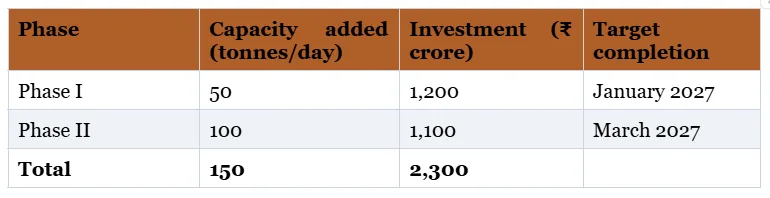
DPA and APCL share the capital in a 76:24 ratio. DPA part goes beyond cash with Rs 567.32 crore in equity, 75 acres of port land, desalinated water and green hydrogen. According to the government, the plant will create more than 3,500 direct and indirect jobs and pull transport, storage and supply businesses into Kandla.
The partnership was first formalised on January 29 2026, when the two sides signed a memorandum of understanding at the Chief Minister’s Secretariat in Dibrugarh. Eight months later, the foundation stone was laid.
What it takes to make 150 tonnes a day
The official announcements give the output where chemistry fills that gap. The figures below are theoretical minimums worked out from the reaction itself, real plants need somewhat more.
- Annual output: about 54,750 tonnes of e-methanol at full capacity.
- Green hydrogen: about 28 tonnes a day or roughly 10,300 tonnes a year.
- Carbon dioxide: about 206 tonnes a day or roughly 75,000 tonnes a year.
- Water: at least 250 tonnes a day for electrolysis, which is why DPA’s desalinated water is part of the deal.
Hydrogen is where the work lies. Kandla’s first 1 MW electrolyser, commissioned in July 2025, makes about 140 tonnes a year. A 5 MW unit awarded to the Oswal–Greenzo joint venture in January 2026 is rated at about 800 tonnes a year, with room to grow to 10 MW. On those ratios, full production would need roughly 65 to 75 MW of electrolysers, several times what is now built or contracted at the port.
The CO₂ supplier has not been named either. Securing about 75,000 tonnes a year of certified biogenic carbon will matter as much as the hydrogen, because buyers in Europe will ask where every molecule came from.
The government says Kandla will produce e-methanol at about US$750 a tonne, against a global rate of about US$1,300. If that holds, Indian green fuel would cost about 42 per cent less than the global rate cited.
One caveat helps readers compare like with like. A kilogram of methanol holds about 19.9 megajoules of energy, a little under half of what fuel oil holds. A ship therefore burns roughly two tonnes of methanol to do the work of one tonne of oil. On an energy basis, $750 a tonne works out to about $1,500 per tonne of oil-equivalent.
Even the figure compares well with independent estimates. In 2023, the shipping consultancy Drewry priced green e-methanol at about $1,200 a tonne or roughly $2,400 per tonne of oil-equivalent.
Cheap solar and wind power in Kutch, free port land and in-house water are the likely reasons Kandla expects to undercut that. The final cost will be known only once the plant runs at scale.
Why Kandla and why a company from Assam
Kandla has been preparing for this role for some time. The Ministry of New and Renewable Energy has recognised it, along with V.O. Chidambaranar and Paradip, as a green hydrogen hub under the National Green Hydrogen Mission.
That mission approved on January 4 2023 with an outlay of Rs 19,744 crore, targets at least 5 million tonnes of green hydrogen a year by 2030.
The port has also tested the last link in the chain. On April 2 2026, Kandla carried out India’s first shore-to-ship methanol bunkering, with Stolt Tankers, J M Baxi, Aegis Vopak and Indian Oil taking part and DNV verifying the operation.
The port reached Level 6 on the International Association of Ports and Harbors readiness scale and has set itself a target of supplying about 500,000 tonnes a year of certified e-methanol by 2028–29. The new plant would cover about a ninth of that.
The Rotterdam–Singapore Green and Digital Shipping Corridor, set up in 2022, covers a 15,000-km route that crosses the Arabian Sea on its way to Suez. By March 2025 it had 28 partners and a goal of cutting emissions from large container ships on the route by 20 to 30 per cent by 2030.
Sonowal expects Kandla to become “a green-fuel hub on the Singapore–Rotterdam route”. India and Singapore signed a letter of intent that same month to build a green and digital shipping corridor of their own.
The partner brings experience. APCL was set up in 1971 and began production at Namrup in 1976. Oil India, the Assam government and the Assam Industrial Development Corporation are its main shareholders.
It is India’s largest maker of methanol and formaldehyde, and Prime Minister Modi dedicated its 500-tonne-a-day methanol plant to the nation in April 2023.
Namrup lies in Dibrugarh, the constituency Sonowal represents. He framed the project as Ek Bharat Shreshtha Bharat in action, recalling Krishna of Dwarka and Rukmini of the Northeast. Sarma called it proof that “the Northeast will power India’s clean energy future.”
Part of a larger maritime push
The plant fits a wider Aatmanirbhar Bharat agenda for the sea. In September 2025, the Union Cabinet approved a Rs 69,725 crore maritime package. It includes a Rs 24,736 crore shipbuilding assistance scheme that offers 25 per cent support for green and hybrid vessels and a Rs 25,000 crore Maritime Development Fund.
The government plans 100 new merchant ships over the next five years and wants India among the world’s top five ship-owning nations by 2047. The supply chain around ships is moving too. On 3 July 2026, Maersk unveiled its first India-made container, built by DCM Shriram and ordered 1,000 more.
In May 2026, the Cabinet cleared a Rs 1,570 crore ship-repair facility at Vadinar to be built by DPA and Cochin Shipyard. With ships, containers, repair yards and now fuel, India is building every link of the maritime chain at home.
The IMO approved its Net-Zero Framework in April 2025, combining a global fuel standard with a price on emissions. Adoption stalled in October 2025 and member states agreed to reconvene after twelve months. If the framework passes, demand for certified green fuel will jump. Kandla will then have a head start.