
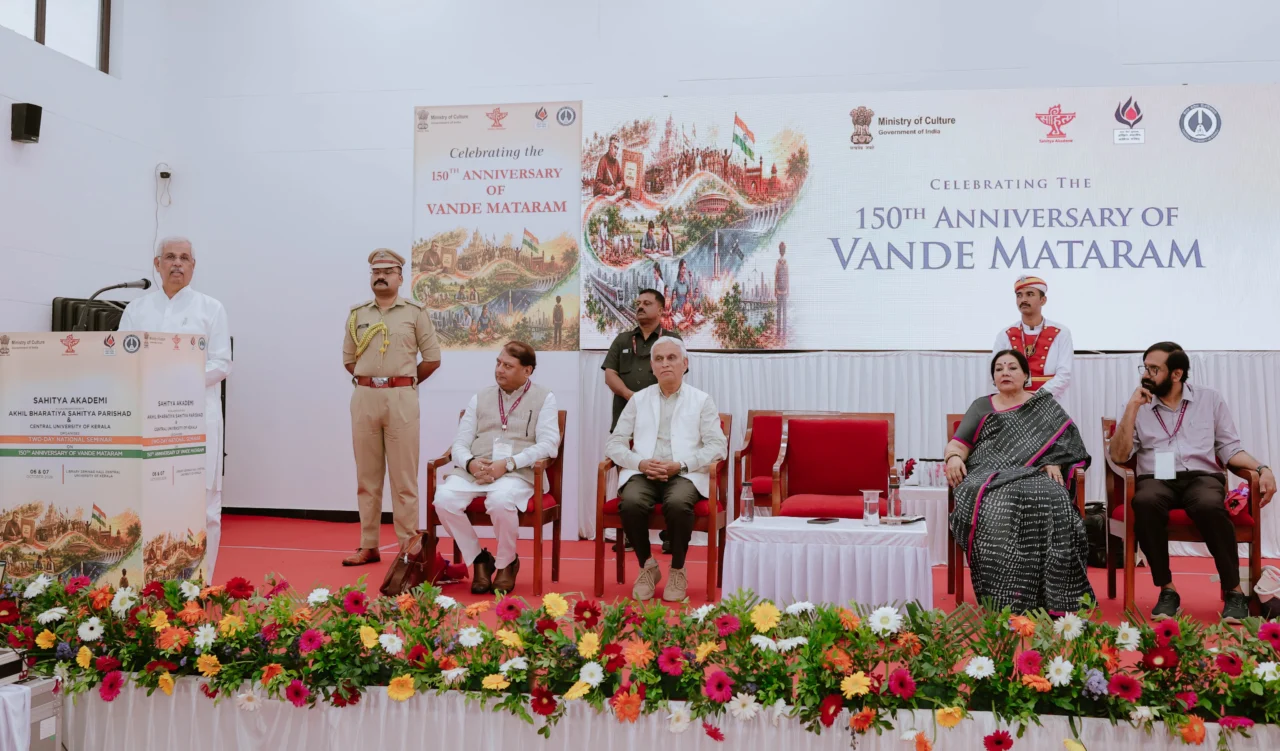
A comprehensive study should be undertaken on the history of Vande Mataram, the circumstances that led to its composition and its influence on the national movement, and the findings should be published as a research document, Governor Rajendra Vishwanath Arlekar said.
The circumstances in which Bankim Chandra Chattopadhyay composed Vande Mataram, what prompted him to write it, and the reasons why Rabindranath Tagore regarded it as the song of the nation should be brought before the younger generation through research, the Governor said. The subject should not be confined to speeches but should be documented as an authoritative study.
The Governor was speaking at the valedictory function, on October 7, at a two-day national seminar organised at the Central University of Kerala as part of the 150th anniversary celebrations of Vande Mataram.
The seminar was organised in collaboration with the Sahitya Akademi, Akhil Bharatiya Sahitya Parishad and the Central University of Kerala.
The forces and ideas behind the protests against Vande Mataram should also be identified, he said.
The incident that occurred the previous day was not an isolated one. Society should remain vigilant about the forces behind such tendencies, from Delhi to the local level.
It was not enough merely to identify them; social intervention was also needed to counter such tendencies, he said.
Vande Mataram was not merely a song but a powerful symbol of the national consciousness that brought the country together.
Even the mere utterance of “Vande Mataram”, without singing the entire song, had the power to unite people across the country.
The national consciousness generated by it shook the foundations of colonial rule. The British realised that it would be difficult for them to remain in India if the country united as one, the Governor said.
The discussion should not be confined to whether Vande Mataram consists of six stanzas or whether only two stanzas are sung. What needs to be understood is the spirit, sentiment and national consciousness behind it.
The time has come to once again awaken the national consciousness that had united the country, he said.
Research on Vande Mataram should go beyond speeches. The socio-political circumstances of Bankim Chandra’s time, the background of the composition, the process through which Vande Mataram became a slogan of the freedom movement and its influence on the national movement should be studied scientifically. Such a study, published as a book and handed over to future generations, would become an important national document, the Governor said.
The Governor also expressed concern over the opposition to Vande Mataram. Society should reflect on where such attitudes questioning the need to sing Vande Mataram originate from.
Discussions on the subject should not remain confined to the four walls of a seminar hall or library. The issue should be discussed with neighbours, colleagues and different sections of society, he said.
There should be vigilance against attempts to weaken the institutions and traditions of the country. The issue was not limited to Vande Mataram alone; society needed to remain vigilant about matters concerning the country’s unity and national heritage.
The country should move forward with the spirit of “Ek Bharat, Shreshtha Bharat”, without allowing divisive ideas to gain ground. If India remains united, nobody can challenge it, the Governor said.
India has the potential to provide leadership to the world, he said. The strength of the country is recognised globally, making national unity all the more important. Everyone should become part of this effort, he added.
When his children ask him about this period in the future, he should be able to tell them with pride that he was not sitting at home watching events unfold, but was himself part of the movement. That, he said, was the message of Vande Mataram. Everyone should become part of this renewed national awakening, the Governor said.