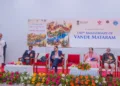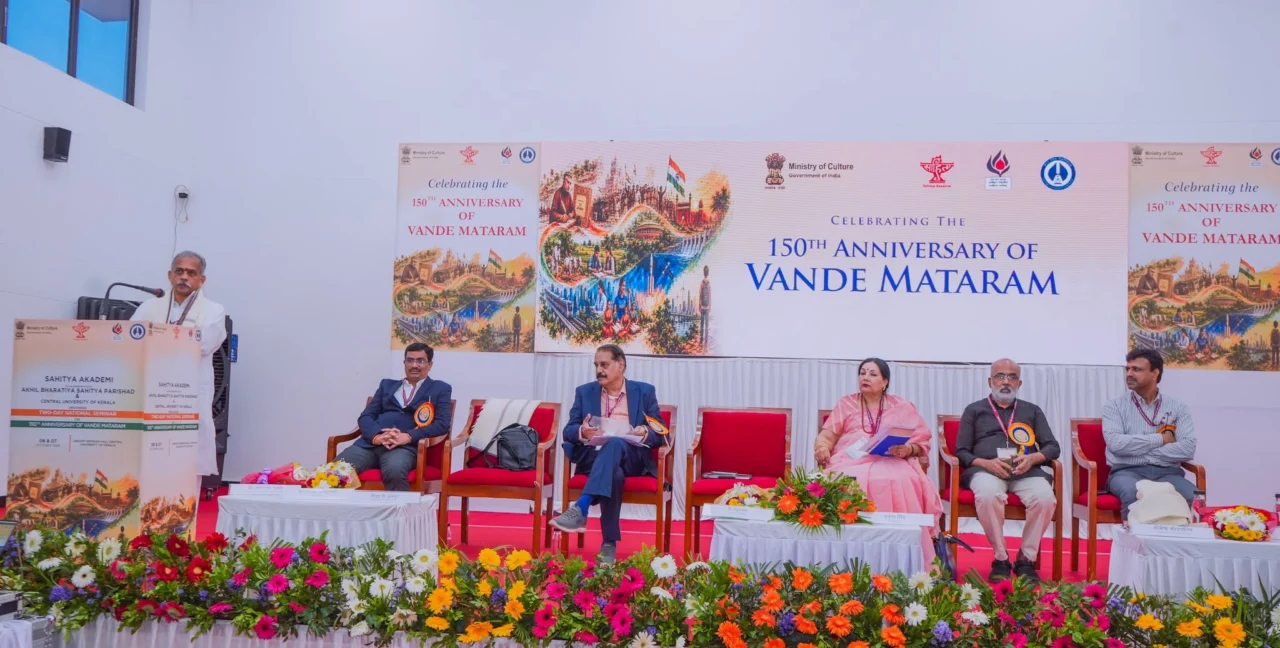
Kasaragod: Vande Mataram was not merely a patriotic song but a spiritually charged invocation and a powerful force that helped inspire India’s freedom struggle, said J Nandakumar, National Convenor of Prajna Pravah, while delivering the keynote address at a national seminar commemorating 150 years of Vande Mataram at the Central University of Kerala (CUK), Kasaragod.
The national seminar, being held on October 6 and 7, is jointly organised by the Ministry of Culture, Sahitya Akademi, Akhil Bhartiya Sahitya Parishad and CUK’s School of Languages and Comparative Literature. The seminar brings together writers, scholars, historians and academics to deliberate on the literary, historical, philosophical and cultural legacy of Vande Mataram.
Nandakumar described Bankim Chandra Chattopadhyay as a Rishi and not merely a poet, arguing that Vande Mataram emerged from a deeper vision of India’s civilisational consciousness. He recalled that when Bankim Chandra wrote the composition in 1875, he had a vision of what the song would eventually become.
According to Nandakumar, when some of Bankim Chandra’s contemporaries questioned the language and meaning of Vande Mataram, the writer is said to have indicated that it would take around 25 to 30 years for its full significance to be understood. He connected this observation with the events of 1905, when Vande Mataram became a powerful rallying cry during the Swadeshi and anti-Partition movements.
“Vande Mataram” subsequently moved from the literary sphere into the national movement and became, in Nandakumar’s words, a national war cry and a spiritual song representing the soul of Bharat.
‘Vande Mataram’ carried enormous weight
Nandakumar said the two words “Vande Mataram” carried an extraordinary historical weight.
He recalled how students left colleges and universities and ordinary men and women joined the freedom movement after hearing the slogan, arguing that no political compulsion or individual political leader was required to give the words their power.
He also highlighted the role of Tamil poet Mahakavi Subramania Bharati in taking Vande Mataram beyond Bengal and into the Tamil literary and cultural sphere. The seminar material also records the cross-regional transformation of the song, noting Bharati’s adaptation of Bankim’s imagery for a wider Indian audience.
Nandakumar argued that the song’s journey demonstrated how a literary composition could become a unifying force across India’s linguistic and regional boundaries.
‘A mantra with powerful, even mighty energy’
Quoting Sri Aurobindo, Nandakumar described Vande Mataram as “a mantra with powerful, even mighty energy”, and said it was not merely a patriotic hymn but a “spiritually charged invocation”.
He explained that the composition could be understood structurally as a progression from the physical description of the motherland to its inner consciousness and spiritual dimension.
Referring to expressions such as “Sujalam Sufalam” and “Shasya Shyamalam”, he said the song initially describes Bharat through its physical attributes before moving towards its inner and spiritual dimensions, culminating in the invocation of the mother as Durga.
Nandakumar also connected this structure with the Vedic conception of the motherland, referring to the Atharvaveda’s “Mata Bhumi Putro Aham Prithivya” — the earth as mother and the individual as her child.
Gandhi’s 1939 warning over truncation
A significant part of Nandakumar’s address focused on the decision to restrict the singing of Vande Mataram to selected portions.
He referred to Mahatma Gandhi’s article published in Harijan on July 1, 1939, in which Gandhi discussed the controversy surrounding Vande Mataram and the political compromise that had resulted in only portions of the song being retained for public singing.
Nandakumar quoted Gandhi’s description of the original Vande Mataram as “pure gold” that had become “base metal”, arguing that the political circumstances of the period had resulted in the truncation of the song.
He said that removing portions of the composition on communal considerations raised a fundamental question about the purpose and integrity of the mantra.
The seminar material similarly records Nandakumar’s reference to Gandhi’s 1939 article and his description of the political compromises surrounding the song.
Recalling the 1923 Kakinada Congress episode
Nandakumar also recalled the 1923 Kakinada Congress session, where Maulana Mohammad Ali objected to the complete rendition of Vande Mataram.
He referred to classical vocalist Pandit Vishnu Digambar Paluskar, who nevertheless stood his ground and sang the song in its entirety.
The episode, he argued, demonstrated the extent to which Vande Mataram had become a symbol of the freedom movement and a matter of national sentiment.
The seminar’s documented proceedings also record the 1923 Kakinada Congress episode and Paluskar’s defiance of the objection to the complete rendition.
Omkarnath Thakur and the 1947 broadcast
Nandakumar further recalled the episode involving legendary vocalist Pandit Omkarnath Thakur on the eve of Independence in August 1947.
According to his account, Information and Broadcasting Minister Sardar Vallabhbhai Patel and All India Radio authorities approached Omkarnath Thakur, a disciple of
Vishnu Digambar Paluskar, to sing Vande Mataram.
When he was informed that only two stanzas had been approved, Omkarnath Thakur refused to sing a truncated version and insisted that he would either sing the composition in full or not sing it.
Nandakumar said Patel subsequently agreed, allowing the full rendition to be broadcast on August 15, 1947.
The seminar documentation records the same episode, stating that Patel conceded to Thakur’s demand and that his untruncated rendition was broadcast across the nation on Independence Day.
‘The struggle of memory against forgetting’
Nandakumar connected the history of Vande Mataram with the broader question of civilisational memory.
Referring to Czech writer Milan Kundera’s The Book of Laughter and Forgetting, he described the struggle against historical amnesia as a struggle of memory against forgetting.
He invoked the Sanskrit concept of Smriti Bhramsha, or loss of memory, and linked it to the loss of awareness about India’s historical and cultural inheritance.
He argued that recovering such memory was essential for understanding the nation’s past and for shaping its future.
From Bankim to Bharati and Tagore
The address also traced the evolution of Vande Mataram from Bankim Chandra’s original composition to its wider national acceptance.
Nandakumar recalled how the song moved through different literary and cultural figures and regions, including Subramania Bharati and Rabindranath Tagore, eventually becoming a song that represented the larger cultural imagination of Bharat.
Earlier in the inaugural proceedings, Tamil writer and scholar Malan V. Narayanan had also highlighted the transformation of Vande Mataram from a Bengali composition into a pan-Indian cultural expression, particularly through Bharati’s Tamil transcreation.
‘Bring the centre of gravity of academic activity back to Bharat’
Towards the end of his address, Nandakumar turned his attention to universities and academic institutions.
He said academic communities have a “divine duty” to bring the centre of gravity of academic activity back to Bharat and urged researchers to use Vande Mataram as a subject for further research and academic inquiry.
He argued that the song offers opportunities for research into literature, history, philosophy, culture, nationalism, translation and the evolution of India’s freedom movement.
He also urged scholars to examine how the concept of the motherland has created unity and inspiration in different civilisations and cultures.
The keynote address formed part of wider academic deliberations at the seminar, which included literary, philosophical, feminist, regional and historical approaches to Vande Mataram, including its role in resistance movements in Tamil Nadu and Hyderabad State.
Concluding his address, Nandakumar said the continuing return of Vande Mataram to India’s public and academic consciousness represented a recovery of historical memory.
“Vande Mataram,” he said, repeatedly invoking the words that he described as having carried the spirit, unity and inspiration of India’s freedom movement.