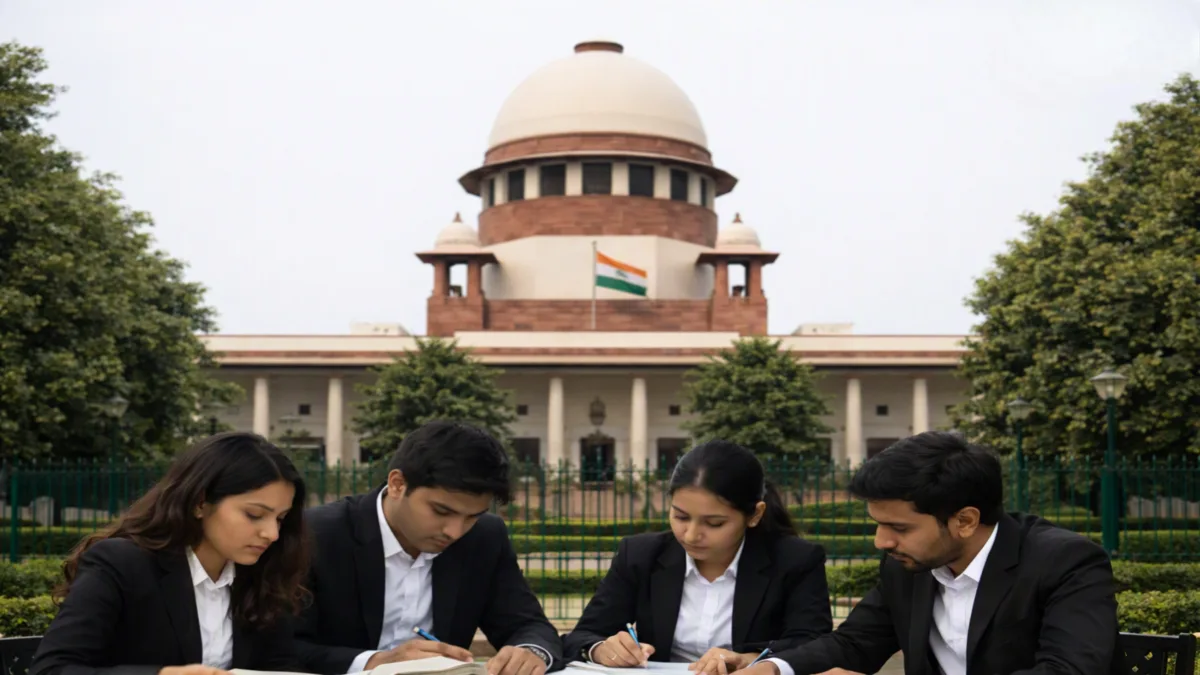
Mandatory Attendance for Law Students? SC Reserves Verdict (This image is generated by AI)
NEW DELHI: The Supreme Court on October 6 reserved its verdict on a batch of appeals challenging the Delhi High Court’s ruling that law students cannot be prevented from appearing in examinations or progressing academically solely because of shortage of attendance.
A Bench comprising Justices Vikram Nath, Sandeep Mehta and Augustine George Masih heard the challenges filed by the Bar Council of India (BCI), NMIMS Law College and others against the High Court judgment delivered in November 2025.
The controversy has its origins in proceedings concerning the death of law student Sushant Rohilla. The Delhi High Court, while dealing with the matter, examined the larger question of mandatory attendance requirements in legal education. It eventually held that students of recognised law institutions should not be detained from examinations or prevented from progressing academically merely because they had failed to meet the prescribed attendance requirement.
The High Court had also called upon the BCI to reconsider its attendance norms for three-year and five-year LL.B. courses. Among other measures, it suggested recognising participation in activities such as moot courts, seminars, debates, model parliament and court visits while calculating attendance.
The ruling, however, was challenged before the Supreme Court.
The BCI and the educational institutions have argued that doing away with attendance as an enforceable requirement could affect academic rigour, institutional autonomy and professional standards in legal education. They also contended that the High Court ruling had resulted in litigation by students seeking exemptions from attendance requirements.
The issue assumes particular significance because legal education is not merely a route to obtaining an academic degree. It is also the principal institutional training through which future advocates enter a regulated profession involving responsibilities towards courts, litigants and the administration of justice.
The Supreme Court had already expressed reservations about the High Court’s approach during an earlier hearing. In May, it stayed paragraph 249 of the High Court judgment prospectively. The Court had then observed that law universities and colleges were facing difficulties following the ruling and questioned whether the High Court had effectively entered the legislative or regulatory domain.
At the same time, the dispute also involves concerns about excessively rigid attendance policies. The Delhi High Court had emphasised that attendance requirements should not become so stringent that they cause serious mental distress to students. Its judgment arose against the background of Rohilla’s death and therefore examined attendance alongside institutional grievance-redressal and student welfare mechanisms.
The BCI presently regulates attendance in Centres of Legal Education under its Rules of Legal Education. It has also strengthened mechanisms for verifying attendance compliance, including through a 2024 circular dealing with attendance and other requirements applicable to law students.
The Supreme Court has, in the interim, protected certain students who were studying during the period when the Delhi High Court judgment operated, clarifying that they should not lose an academic session because of the subsequent prospective stay.
With arguments now concluded, the eventual judgment will have implications beyond the immediate batch of students before the Court. It is expected to clarify the extent to which attendance can be enforced as an academic requirement and, equally importantly, the degree of autonomy that professional legal institutions and the BCI possess in prescribing standards for legal education.
