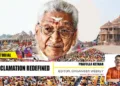

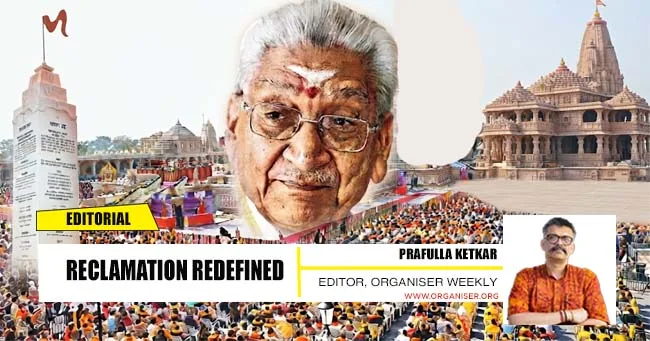
“Through the VHP he awakened the lion character of Hindu society by kindling awareness. His played a pivotal role in taking the Ram Janmabhoomi movement to a very important logical stage. With his good relations with all the saints, sadhus of Bharat, he earned their confidence and honour. He was a fundamental thinker of Hindutva and the same used to be expressed through his statements and speeches and dialogues”
– Sarsanghchalak Dr Mohan Bhagwat in his tribute to Ashok Ji Singhal on his demise, Organiser Weekly, November 29, 2015
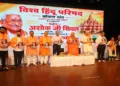
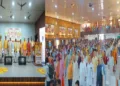
Some people do not just live; they create a legacy. When Ashok Ji Singhal passed away in 2015, many seers and sages, who are generally ascetic, called it the ‘end of an era’. Common people who had seen or experienced Ashok Ji’s persona had tears in their eyes, feeling orphaned. The Ram Janmabhoomi Movement, shaped by the Rashtriya Swayamsevak Sangh (RSS) Pracharak and International Working President of Vishwa Hindu Parishad (VHP), had reached a critical stage. Even after eleven years of his physical absence among us, people from different quarters at Bharat Mandapam in Delhi felt the same about Ashok Ji.
Bharat is the longest-surviving civilisation on the planet, with a known history of at least eight thousand years. Throughout this period, amid upheavals, external aggression, internal disturbances, and brutal colonisation, someone in each era rose to build, nurture, secure, and reclaim sacred places and the civilisational legacy associated with them. From Acharya Chanakya to Adi Shankracharya, Ramanujacharya, entire Bhakti movement, the Sikh Guru Parampara, valorous efforts by Satavahanas, Rashtrakutas, Maharana Pratap, Chhatrapti Shivaji Maharaj, Maharaja Ranjit Singh, and governance models such as Vijayanagara, Maheshwar of Ahilyadevi Holkar and endless list of great sons and daughters of Bharat Mata were not just efforts to save or reform social and political Bharat but to ensure reclamation and restoration of sacred places. Whenever social structures deteriorated, fragmented, or were destroyed, someone rose to the occasion and devised appropriate measures to save the ethos of this sacred land. Even our Independence movement had the same spirit of Swadharma, Swadeshi and Swaraj. Ashok Ji did the same through the Ram Janmabhoomi Movement to reclaim the abode of Ram Lalla in Ayodhya.
Of course, the movement was neither new nor individual centric. Since the first assault on the civilisational ideal of Bharat – Sri Ram – in 1528, there were continuous battles to reclaim and restore the mandir at Ayodhya. During the British period, the battle shifted to the legal course. In 1949, the manifestation of Ram Lalla under the central dome of the disputed structure and the fearless resistance of many against the ‘secular onslaught’ opened a new chapter. The restoration of the Somnath Mandir, with the initiative of Sardar Patel, KM Munshi, and the blessings of Gandhiji and Babu Rajendra Prasad, gave new hope to Ram Janmabhoomi. Unfortunately, after the Somnath restoration, the Nehruvian idea of modernity, building a new nation based on an alien prism of socialist-secular ideals, completely blinded us towards the civilisational ethos. Here, the Ram Janmabhoomi Movement and the role of Ashok Ji made the difference.
The initiative to build the Swami Vivekananda Rock Memorial at Kanyakumari, led by another RSS Pracharak, Eknath Ji Ranade, created a template for involving people to contribute to national monuments. It also built bridges across political ideologies and social and regional barriers. In the 1980s, under the guidance of the third RSS Sarsanghachalak, Balasaheb Deoras, and with the meticulous planning and imagination of Bhaurao Deoras and Moropant Pingale, the Vishwa Hindu Parishad took up the issue of reconstructing the Ram Mandir in Ayodhya. Political resistance, vote-bank politics, social apathy, and legal hurdles made the challenge difficult to overcome. Here, Ashok Ji’s commitment, conviction and leadership made the difference.
Earlier, all the reclamation efforts were against the foreign invasions. Most were individual efforts, supported by the local population. Of course, all those efforts invoked national sentiment and a sense of pride. Still, the case of Ram Janmabhoomi was different, as it was to be reclaimed in an independent Bharat with a new democratic polity. Despite having all legal and historical evidence in favour of Ram Mandir, all kinds of intellectual arguments were made – from the claim that such a destruction never happened historically to why we need a mandir. Courts expected a political decision, while politicians passed it to the courts. Ashok Ji and the Vishwa Hindu Parishad, guided by Dharmacharyas and supported by RSS Swayamsevaks, devised a strategy for national awakening.
Bringing all seers and sages on one platform was the foundational work. The Second Sarsanghachalak Shri Guruji had already shown the path with the formation of VHP in 1964. Ashok Ji took it to the next level by organising Dharma Sansad to deliberate on challenges to this ancient Rashtra. Since 1984, cutting across sects, he bowed to Acharyas from each tradition and galvanised them with the same spirit. Dharma, irrespective of sectarian tradition, is meant to restore balance and protect national ethos that constituted the soul of that spirit. Not just Ram Janmabhoomi, untouchability and social harmony, conversion, demography, national security, education, and social service became concerns for each Mandir and Mutt (Matha). This was a herculean task as each sect was confined to its rituals and sacred practices. From Udupi to Prayag Dharma Sansad, the religious concerns transformed into national ones.
The Ekatmata Yatra, Ram-Janaki Paduka Pujan, Rath Yatra, and Kar-Seva were the stages that connected all sections of society to the movement. Sentiments confined to Ayodhya and a few awakened people suddenly captured the imagination of the masses. Across castes, communities, and regions, everyone was associated with the Ram Mandir movement. Politicians were forced to take a position, and the legal processes were expedited, paving the way for reclamation. Ashok Ji was the central figure in this entire journey.
The Communist-Islamist machination on the intellectual front was the biggest hurdle to Ram Mandir reconstruction. Even though most of the common Muslims were convinced about the historical evidence and did not associate themselves with Babur and his brutalities, the Babari Masjid Action Committee, with support from ‘secular’ politicians and Marxist historians, continued to instigate the fundamentalists and whitewash the history till the final verdict was delivered by the Supreme Court. For Ashok Ji, the movement was not just for a mandir – a place of worship. Prabhu Sri Ram has been the civilisational symbol of Dharma – the soul of Bharat. The battle was to reclaim that. It was a national struggle for cultural and civilisational independence and not a religious one. Ashok Ji connected intellectuals, historians, archaeologists, journalists, and translators to the movement and asked them to share in rebuilding national consciousness. This provided the movement with intellectual zeal.
That is why, Ashok Ji Singhal’s centenary year is not a celebration of the individual but a commemoration of a legacy that has redefined the idea of reclamation. Continuing an unbroken civilisational legacy to build, nurture, secure, and reclaim sacred places, Ashok Ji and the Vishwa Hindu Parishad (VHP), through the Ram Janmabhoomi Movement, added new dimensions by invoking collective participation, building social bridges, and uniting all seers and sages on one platform. Carrying forward that spirit- not in terms of mandirs as places of worship but as a socio-cultural epicentre of Bharat- is our duty and can be a true tribute to the person who redefined reclamation.