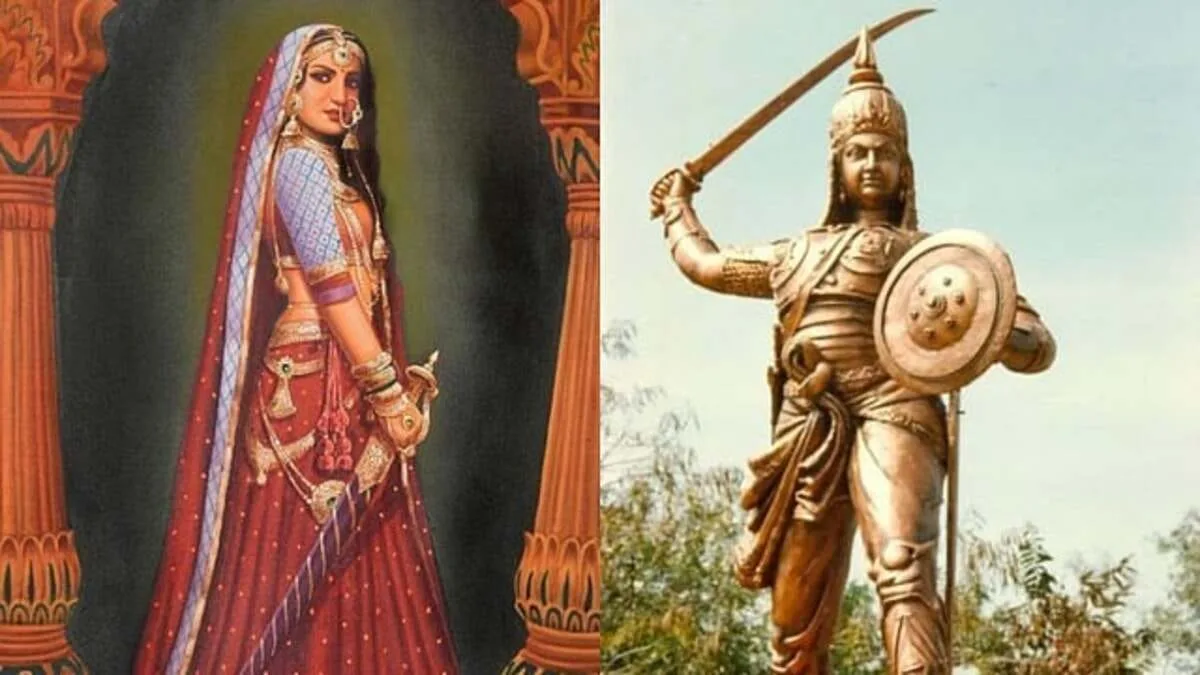
Rani Durgavati’s birth anniversary honours the courageous Gondwana Queen who embodied courage, duty and self-respect
When a life becomes dedicated to the motherland, self-respect and duty, death becomes an immortal chapter in history. Rani Durgavati’s martyrdom on 24 June 1564 at the battlefield of Narrai represents the pinnacle of that immortal tradition. Here was a woman ruler who confronted the formidable military might of the Mughal Empire with extraordinary courage in order to defend her kingdom, her honour and her independent existence. Her life demonstrates that the true meaning of Karmayoga lies not in enjoying power, but in offering oneself in the service of duty.
Birth is the first truth of life, and death its final truth. Between the two, a person gives meaning to life through his or her actions. Countless rulers have appeared and passed into history. Some names have disappeared into the dust of time, while certain personalities have grown even more towering after death. Rani Durgavati belonged to the latter category. The protection and freedom of her people always remained her foremost priority. This is why her sacrifice became an enduring symbol of courage, self-respect and the power of women in Indian history.
She married Dalpat Shah, the ruler of Garha-Katanga. The marriage brought together two powerful royal lineages and, in time, provided Durgavati with the opportunity to emerge as the central force of the vast Gondwana kingdom of central India. Following the death of her husband, the Queen transformed her grief into strength and assumed the responsibility of governing on behalf of her young son. This was the point at which her journey of Karmayoga truly began.
During her approximately 16-year reign, Garha-Katanga became stronger politically, economically and culturally. The kingdom extended across a considerable part of central India. The accounts of Abul Fazl refer to the prosperity of Garha-Katanga, its villages and its revenue system. This prosperity rested upon military strength, well-organised administration and the judicious use of natural resources.
The greatest strength of Rani Durgavati lay in her approach to administration. She encouraged agriculture, animal husbandry, forest produce, handicrafts, textile production and local trade. Forest products such as chironji, mahua, lac, honey, medicinal plants and timber provided a foundation for the rural and forest-based economy. The development of water resources was equally important for agricultural productivity and the stability of rural life.
The water-management system of Garha-Katanga remains a subject worthy of study. The interconnection of ponds, stepwells and other water sources, together with local systems of water harvesting, demonstrates that the administration of that period regarded water as the foundation of both life and the economy. At a time when modern cities are struggling with water scarcity, the water-conservation traditions of Rani Durgavati’s era offer valuable lessons from our own past.
During the sixteenth century, Mughal power was expanding rapidly. Numerous regional powers found themselves under pressure from Akbar’s imperial policies. The prosperity and strategic importance of Garha-Katanga attracted the attention of the Mughal court. Asaf Khan was sent towards Garha-Katanga.
Rather than choosing the path of surrender, Rani Durgavati chose resistance. The conflict progressed from Singaurgarh to Chandal Bhata, the Gaur River and Narrai. The circumstances of the war continued to change.
The Mughal army possessed artillery, whereas the Queen’s strength lay in her knowledge of the terrain, local warfare skills, elephant corps and the indomitable spirit of her soldiers. She made geography an integral part of her military strategy. By using dense forests, narrow routes and natural barriers, she sustained prolonged resistance against a vastly superior military force.
The fighting on 23 June 1564 laid the ground for the decisive battle. On 24 June, a fierce confrontation took place at Narrai. Under the Queen’s leadership, her soldiers mounted a formidable resistance against the Mughal forces. During the battle, she suffered serious injuries. The circumstances continued to turn increasingly against her.
Rani Durgavati had the option of saving her life. She had lived with dignity and self-respect, and she chose to embrace death with the same dignity. She took her own life with her dagger. Her final act conveyed a clear message: a death embraced with honour is more valuable than a life lived in subjugation.
Indeed, this episode challenges conventional definitions of victory and defeat. Military success on a battlefield is not necessarily the final measure of history. History also regards as victorious those who struggle until their final breath to defend their principles and values. Rani Durgavati’s body may have fallen at Narrai, yet her ideal continues to stand tall.
It is therefore important today to ensure that Rani Durgavati receives the breadth of attention she deserves in the study of Indian history. To confine her life to a single battle or to the struggle of a particular community would be to diminish the scale of her personality. She was an able administrator, a far-sighted ruler, a warrior, a mother and a true Karmayogini.
At a time when women’s empowerment is discussed in terms of modern institutions, policies and rights, it is equally important to bring forward the women of Indian history who demonstrated genuine leadership centuries ago. Rani Durgavati’s life shows that empowerment does not emerge from declarations alone. It is built through education, self-confidence, decision-making ability, courage and action.
The memory of Rani Durgavati remains alive in the soil of central India. The battlefield of Narrai and her memorial stand as witnesses to a history in which a Queen placed her self-respect above the overwhelming power of an empire. Her sacrifice compels us to ask what our own duty towards the nation and society should be. A Karmayogi is one who accepts responsibility without waiting for circumstances to become favourable.
That is precisely what Rani Durgavati did. After becoming a widow, she assumed the responsibilities of governance, safeguarded the future of her young son, strengthened and developed her kingdom, gave importance to water and forest resources, led her army and ultimately laid down her life on the battlefield.
Her story is, in essence, a testament to India’s living tradition in which the motherland, self-respect and duty are placed above personal life. Rani Durgavati seems to remind us even today that history remembers, above all, those who remain steadfast in their ideals until their final moment. The morning of 24 June 1564 thus stands as a proclamation of the indomitable confidence of Indian womanhood. At Narrai, Rani Durgavati surrendered her mortal body, yet attained immortality through her deeds. That, indeed, is the greatest victory of a Karmayogini.
